📌 Key Takeaways
August 2025: A patient died during regenerative medicine treatment in Tokyo, prompting Japan’s first-ever emergency order based on patient death
Targets: The treating clinic and Kojin Bio’s Saitama Cell Processing Center
January 2026: On-site inspections confirmed multiple legal violations
Core issue: Failures in cleanroom control, deviation management, and quality review
Key takeaway: Regenerative medicine is no longer judged by innovation alone, but by manufacturing governance and operational accountability
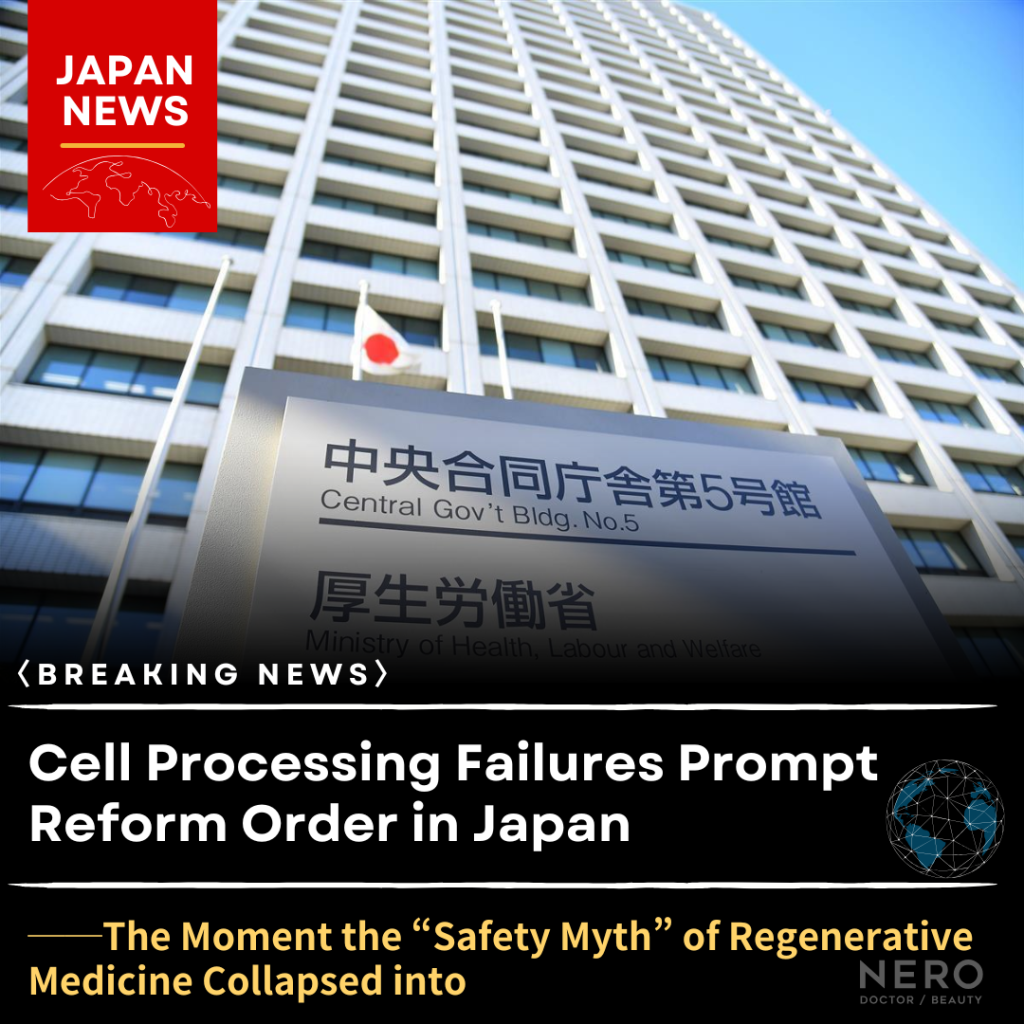
On January 23, 2026, Japan’s Ministry of Health, Labour and Welfare (MHLW) issued an improvement order under Article 48(2) of the Act on the Safety of Regenerative Medicine to
Kojin Bio Co., Ltd.’s Saitama Cell Processing Center.
This order represents the final regulatory outcome of a case first reported by NERO in August 2025, when a patient died during regenerative medicine treatment — an incident that triggered Japan’s first emergency regulatory action based on patient death.
🔗 NERO Breaking Report (August 2025):
https://nero-drbeauty.com/news/24040/


INDEX
1. August 2025|Japan’s First Emergency Order Following a Patient Death
In August 2025, a woman in her 50s suffered sudden deterioration and cardiac arrest during intravenous administration of autologous adipose-derived mesenchymal stem cells at a medical clinic in central Tokyo.
1-1. Death Occurring During Approved Regenerative Treatment
The treatment was conducted under a formally submitted regenerative medicine provision plan titled:
“Treatment for chronic pain using autologous adipose-derived mesenchymal stem cells.”
The patient’s condition rapidly worsened during administration, and death was later confirmed.
1-2. Emergency Regulatory Action by MHLW
In response, MHLW issued an emergency order, which included:
-
Immediate suspension of regenerative medicine services at the treating clinic
-
Suspension of cell manufacturing activities at Kojin Bio’s Saitama Cell Processing Center
This marked Japan’s first emergency order under the Regenerative Medicine Safety Act triggered by a patient fatality.
2. On-Site Inspections Reveal a Breakdown of the Quality System
Following the emergency order, MHLW conducted on-site inspections at both the medical institution and the cell processing facility.
2-1. Not an Isolated Error, but a Structural Compliance Failure
Inspectors found that the quality management system itself had failed, independent of the fatal incident.
Key violations included:
-
Raw material suppliers and specifications not properly documented
-
No verification of incoming material testing or certificates of analysis
-
Mandatory annual quality reviews never conducted
-
Microbial contamination exceeding limits in controlled areas without deviation handling
-
Long-term absence of internal audits
-
No formal quality documentation related to the reported fatal case
2-2. Critical Failure in Cleanroom and Deviation Management
Most concerning was the discovery that
cell manufacturing continued despite repeated microbial counts exceeding regulatory thresholds, without corrective or preventive action.
MHLW identified this as a serious and ongoing threat to the safety of regenerative medicine products.
3. January 2026|What the Improvement Order Truly Signifies
On January 23, 2026, MHLW formally issued an improvement order, concluding its investigation.
3-1. Scope of the Required Corrective Actions
The order went beyond superficial fixes and demanded systemic reconstruction, including:
-
Retrospective deviation analysis and risk assessment
-
Verification of downstream clinical impact for all affected products
-
Thorough decontamination of the facility
-
Third-party evaluation by external cell-processing experts
-
Comprehensive retraining of personnel
-
Overhaul of documentation, deviation management, and audit systems
-
Submission and monitoring of a corrective action and preventive action (CAPA) plan
3-2. The Question Regulators Are Now Asking
The order raises a fundamental question:
“Did safety exist as a functioning system — or only on paper?”
Regenerative medicine has entered an era where
manufacturing discipline, traceability, and deviation response — not innovation alone — define trust.
Practical Implications for Physicians and Clinics
This section provides professional context.
-
Outsourcing cell processing does not transfer responsibility
-
“Previously approved” or “no past issues” is not a safety guarantee
-
Undefined deviation authority is now a regulatory red flag
-
Clinics must be able to explain where and how cells are manufactured to patients
Regenerative medicine now requires accountability beyond the treatment room.
Q&A for the General Public
Q: Is regenerative medicine dangerous?
A: The technology itself is not inherently dangerous.
The risk arises when manufacturing and quality control are poorly managed.
Q: Was the death definitively caused by the treatment?
A: Causality has not been conclusively established.
However, serious deficiencies in the cell manufacturing process were confirmed.
Q: How can patients protect themselves?
A:
-
Ask where cells are processed
-
Confirm regulatory oversight and compliance
-
Demand transparent risk explanations
-
Avoid decisions based solely on “cutting-edge” or “rejuvenation” claims
Editor’s Perspective
This Was Not an Accident — It Was a Structural Blind Spot
What this case exposes is how safety in regenerative medicine remains largely invisible to patients.
Following the fatal incident,
the operating organization and clinic changed names and later filed for closure,
making it even harder for the public to trace past safety issues.
If safety risks can disappear through rebranding and institutional opacity,
the system itself must be questioned.
Regenerative medicine represents hope —
but it is also a field where trust collapses instantly once credibility is lost.
This improvement order marks a critical inflection point for Japan’s regenerative medicine governance.
Summary
-
August 2025: Patient death leads to Japan’s first emergency order
-
January 2026: Improvement order issued after regulatory inspections
-
Core failure: Cell processing quality and hygiene management
-
Regenerative medicine is shifting from
“innovation-led care” to “governance-driven medicine”
NERO’s Mission
NERO reports on global developments in aesthetic medicine
through the lens of structure, ethics, and long-term consequence.
Rather than amplifying surface-level trends,
we examine how medical practices are regulated, commercialised, and normalised —
and what is reshaped when innovation moves faster than existing frameworks.
As aesthetic medicine expands beyond traditional clinical boundaries,
NERO focuses on the grey zones where definitions blur, responsibilities shift,
and medical decision-making becomes increasingly complex.
In an era of accelerating innovation,
NERO remains committed to transparency, critical scrutiny,
and responsible reporting —
so readers can understand not only what is new,
but what deserves closer examination before it becomes standard practice.