📌 Key Takeaways
Consumer complaints related to aesthetic medical services in Japan continue to rise
A growing number of cases involve online ads and search-driven visits followed by same-day contracts
Complaints related to men’s aesthetic treatments, including medical hair removal and circumcision surgery, are becoming more visible
Typical patterns include fear-based sales tactics, such as “severe case” diagnoses or “today-only discounts”
Authorities urge consumers to avoid same-day contracts and same-day procedures


INDEX
What Is Happening in Men’s Aesthetic Medicine?
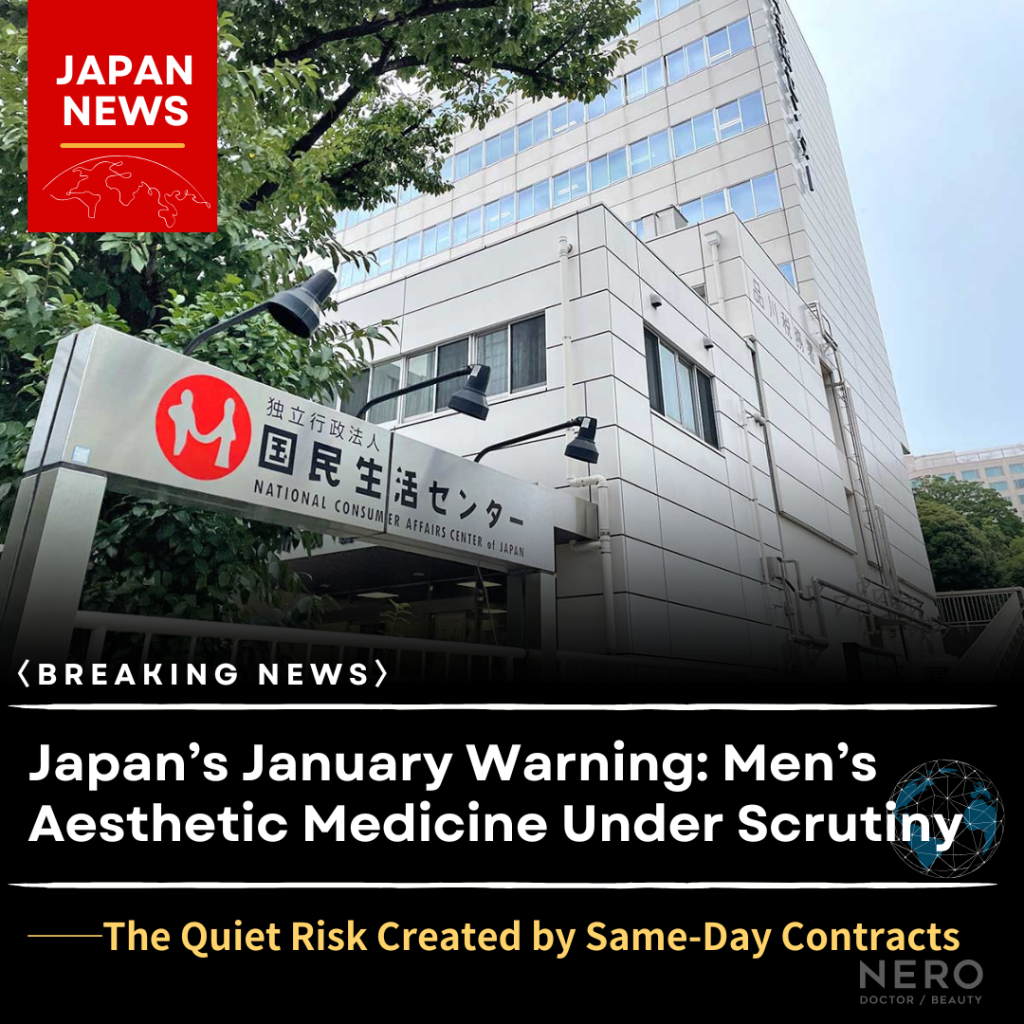
In January 2026, the National Consumer Affairs Center of Japan released a new public warning,
reporting a continued increase in consumer consultations related to aesthetic medical services.
What stands out is that many reported problems are not related to the medical procedures themselves,
but rather to the process leading up to the contract.
Online advertisements and search results often serve as the entry point,
with consumers being guided toward high-cost contracts and even same-day procedures,
leaving little time for calm comparison or reflection.
Source: National Consumer Affairs Center of Japan
“An Increase in Men’s Aesthetic Medicine Troubles” (Public Awareness Material, January 2026)

A Structure That Attracts with “Low Prices” and Decides with Fear
According to consultation cases published by the Center,
many consumers first encounter advertisements promoting low prices, such as
“Full-body hair removal: 5 sessions for ¥150,000” or “From ¥50,000.”
However, once they visit a clinic, they are told:
-
“Five sessions are not enough”
-
“Your case is severe”
-
“Fifteen sessions are the standard option”
As a result, consumers are presented with far more expensive treatment plans than initially expected.
The use of installment payments further reduces the psychological weight of the total cost,
making it easier to commit without fully grasping the financial impact.
The core issue is not pricing itself,
but the fact that consumers are not given sufficient time to compare, question, and decide.
The Risk of “Same-Day Decisions” in Men’s Aesthetic Care
Consultations related to men’s aesthetic medicine have increased in recent years.
In addition to medical hair removal,
complaints now include procedures such as circumcision surgery and penile augmentation —
areas characterized by high sensitivity and difficulty in seeking peer advice.
Consumers report being pressured with statements such as:
-
“You’ll get a discount if you sign today”
-
“The director is available today only”
Under these conditions, some proceed to immediate contracts and same-day procedures
without adequate consideration.
Most aesthetic medical treatments are not medically urgent.
Yet an atmosphere is often created in which delaying a decision feels like a loss —
this is where the structural risk lies.
What Consumers Should Know to Regain Control
The National Consumer Affairs Center emphasizes the following points:
-
Risks and side effects must be explained directly by a physician
-
Treatment effects, costs, and cancellation conditions vary by individual case
-
Consumers should avoid making decisions on the spot and take time to reconsider
Depending on the contract conditions,
some aesthetic medical agreements may be eligible for an 8-day cooling-off period
under Japan’s Specified Commercial Transactions Act.
When concerns or disputes arise,
consumers are encouraged to contact Japan’s consumer hotline “188” for guidance.
Editor’s Perspective— The Problem Is Not Price, but the Design of Decision-Making
This warning does not suggest that aesthetic medicine itself is dangerous.
Rather, it highlights how the sequence of
advertising → consultation → contract → procedure
has become a decision-making environment that discourages careful thought.
In men’s aesthetic medicine especially,
feelings of embarrassment, urgency, and uncertainty about “normal pricing”
can easily cloud judgment.
What will matter going forward is not
how cheaply a service can be presented,
but how much time and clarity are provided for calm, informed decisions.
Summary
-
Aesthetic medicine-related disputes increasingly stem from contract processes, not procedures
-
Same-day high-cost contracts are particularly visible in men’s aesthetic care
-
Pressure-driven decision structures represent a key risk
-
Physician-led explanations and time to reconsider are essential safeguards
-
In case of trouble, Japan’s consumer hotline 188 is available
NERO’s Mission
NERO reports on global developments in aesthetic medicine
through the lens of structure, ethics, and long-term consequence.
Rather than amplifying surface-level trends,
we examine how medical practices are regulated, commercialised, and normalised —
and what is reshaped when innovation moves faster than existing frameworks.
As aesthetic medicine expands beyond traditional clinical boundaries,
NERO focuses on the grey zones where definitions blur, responsibilities shift,
and medical decision-making becomes increasingly complex.
In an era of accelerating innovation,
NERO remains committed to transparency, critical scrutiny,
and responsible reporting —
so readers can understand not only what is new,
but what deserves closer examination before it becomes standard practice.