📌 Key Takeaways
IMCAS 2026 stands as the world’s largest congress spanning aesthetic medicine, dermatology, plastic surgery, and aging science
Program emphasis has shifted from “new technologies” to safety, anatomy, complications, and governance
Regenerative medicine, exosomes, AI, and GLP-1 are now examined in a post-hype, evidence-driven phase
Cadaver dissection workshops and ultrasound training highlight a global return to fundamentals
Aesthetic medicine is transitioning from “rejuvenation” to a discipline focused on managing aging itself
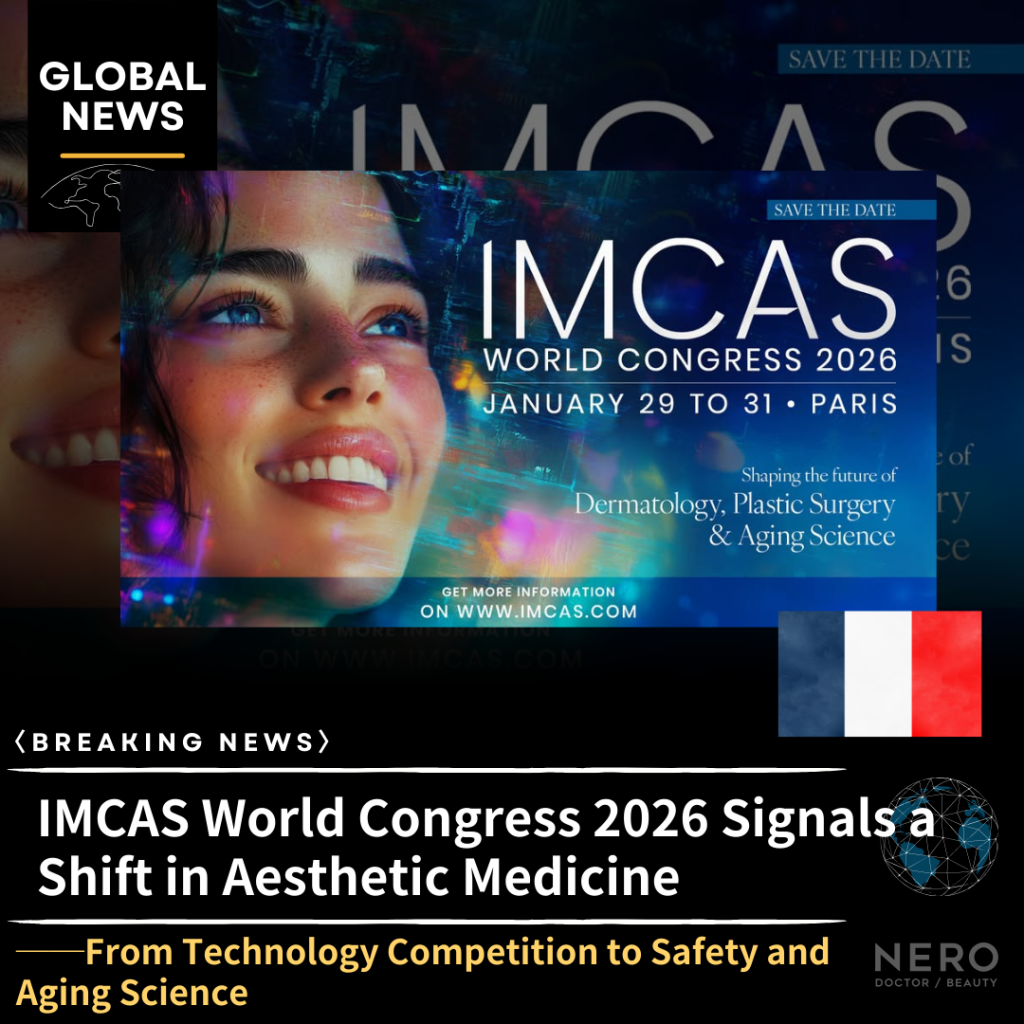
From January 29 to 31, 2026, the IMCAS World Congress will convene in Paris, France.
Recognized as the world’s largest international congress in aesthetic medicine, dermatology, and plastic surgery, IMCAS is no longer merely a platform for unveiling new devices or techniques. It has become a global barometer indicating where aesthetic medicine is heading—and what it is leaving behind.
Even without on-site coverage, a close examination of the official program structure, historical data, and academic themes reveals a clear and deliberate shift in direction at IMCAS 2026.


INDEX
1. What Is IMCAS?
A Global Decision-Making Arena for Aesthetic Medicine
Founded in 1994 by plastic surgeon Dr. Benjamin Ascher, IMCAS (International Master Course on Aging Science) has grown into the most influential global forum for aesthetic medicine.
At IMCAS 2025:
-
20,121 participants
-
1,061 speakers
-
374 exhibiting companies
-
67% non-sponsored scientific sessions
This structure—where independent scientific sessions dominate—clearly distinguishes IMCAS from commercially driven exhibitions.
2. A Noticeable Shift in the 2026 Program
2-1. Safety, Anatomy, and Complications Over New Technology
One of the most striking features of IMCAS 2026 is the density of sessions focused on:
-
Cadaver dissection workshops
-
Facial danger zones and vascular anatomy
-
Injection complications and vascular occlusion
-
Ultrasound-guided safety practices
This emphasis reflects a global rise in aesthetic complications—and a collective recognition that preventing harm now outweighs chasing novelty.
2-2. Regenerative Medicine and Exosomes Enter the Validation Phase
Topics such as exosomes, stem cells, PRP, and growth factors are no longer framed as futuristic breakthroughs.
Instead, sessions critically examine:
-
The strength and limits of current evidence
-
Unresolved mechanisms and risks
-
Long-term safety and reproducibility
Regenerative medicine has clearly entered a verification phase, rather than a hype cycle.
3. Aging Science and AI Become the Core Narrative
IMCAS 2026 places the following themes at the center—not the periphery—of aesthetic medicine:
-
Aging science
-
AI and robotics
-
GLP-1 therapies and their effects on skin and facial structure
-
Nutrition, epigenetics, and biohacking
This marks a decisive shift:
from “making patients look younger”
to understanding, modulating, and managing the biology of aging itself.
Editor’s Perspective
IMCAS 2026 Chooses Durability Over Spectacle
Viewed as a whole, IMCAS 2026 suggests that global aesthetic medicine has moved beyond the phase of seeking ever-new tools.
What now defines value is:
-
Can it be used safely?
-
Can it be scientifically explained?
-
Can it earn long-term trust?
As private medical markets expand globally—including in Japan—these same questions are becoming unavoidable.
Summary
-
IMCAS 2026 defines the current global position of aesthetic medicine
-
The shift from technology competition to safety, structure, and aging science is unmistakable
-
Regenerative medicine and AI are undergoing sober scientific reassessment
-
Aesthetic medicine is entering an era where medical accountability determines longevity
NERO’s Mission
NERO reports on global developments in aesthetic medicine
through the lens of structure, ethics, and long-term consequence.
Rather than amplifying surface-level trends,
we examine how medical practices are regulated, commercialised, and normalised —
and what is reshaped when innovation moves faster than existing frameworks.
As aesthetic medicine expands beyond traditional clinical boundaries,
NERO focuses on the grey zones where definitions blur, responsibilities shift,
and medical decision-making becomes increasingly complex.
In an era of accelerating innovation,
NERO remains committed to transparency, critical scrutiny,
and responsible reporting —
so readers can understand not only what is new,
but what deserves closer examination before it becomes standard practice.