📌 Key Takeaways
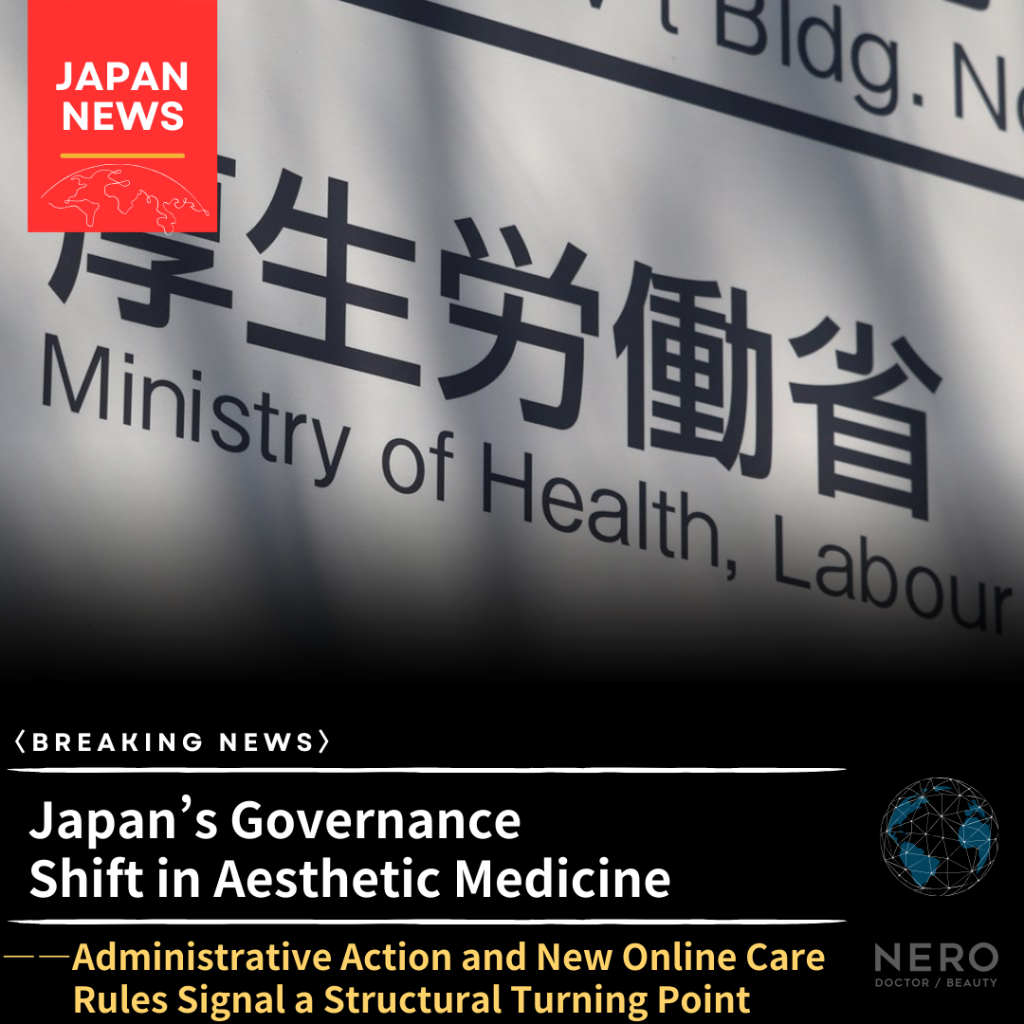
Japan’s Ministry of Health issued an administrative improvement order against a regenerative medicine clinic, focusing on operational compliance rather than medical risk
A new system called “Online Medical Consultation Facilities” will be introduced in April 2026 under the revised Medical Care Act
Medical associations warn the system could enable “physician-absent web clinics” if poorly managed
Aesthetic medicine, which relies heavily on online patient pathways, may face increased governance and design risks
Japan’s free-market aesthetic sector appears to be entering a new era of structural oversight


INDEX
- A Governance Shift Begins — Two Domestic Developments Reshape Japan’s Aesthetic Medical Landscape
- Administrative Action in Regenerative Medicine — The Risk Lies in Operational Design
- Online Consultation Facilities — A New Entry Point with New Risks
- Why Aesthetic Medicine May Be Especially Affected
- Editor’s Perspective — The Era of Structural Governance Has Begun
- Summary
A Governance Shift Begins — Two Domestic Developments Reshape Japan’s Aesthetic Medical Landscape
Japan’s aesthetic medical industry is facing a structural turning point, as two recent domestic developments signal a shift toward stronger governance in the free-practice sector.
First, on February 20, 2026, Japan’s Ministry of Health, Labour and Welfare issued an administrative improvement order under the Act on the Safety of Regenerative Medicine against a Tokyo-based clinic.
The issue was not the danger of regenerative therapies themselves, but discrepancies between the approved treatment plan and actual clinical operations.
Second, a new system called Online Medical Consultation Facilities — scheduled to take effect in April 2026 as part of the revised Medical Care Act — has sparked debate across the medical community.
A policy statement from the Kanagawa Prefecture Physicians’ Association warned that the system could create structures resembling “web clinics without on-site physicians.”
Together, these developments suggest a broader transition:
Japan’s aesthetic medical field is moving from rapid growth toward structured governance.
Administrative Action in Regenerative Medicine — The Risk Lies in Operational Design
According to the Ministry’s announcement, the clinic involved had implemented treatments using physicians and medical materials not listed in the officially approved regenerative medicine plan.
Authorities emphasized that the administrative action did not question the scientific validity of regenerative medicine itself.
Instead, the focus was on operational management — including:
-
Procedures conducted by unregistered physicians
-
Use of unlisted medical materials
-
Failure to submit required safety reports
In Japan’s regulatory framework, the approved treatment plan functions as a legal blueprint for clinical practice.
Deviations from that blueprint can trigger administrative measures regardless of clinical outcomes.
For industry observers, this case signals that governance and operational compliance are becoming as important as medical innovation.
Online Consultation Facilities — A New Entry Point with New Risks
The second development centers on the introduction of Online Medical Consultation Facilities, a concept established within the broader revision of Japan’s Medical Care Act.
These facilities are legally classified as “medical care facilities,” yet they do not themselves provide treatment.
Instead, they function as physical locations where patients can connect with remote physicians via online consultation.
Medical associations have expressed concern over several structural characteristics:
-
Facilities may be operated by non-medical corporations
-
Regulatory requirements are relatively simplified
-
Under certain models (“D to P with N”), nurses may assist procedures under remote physician supervision
Critics argue that these features could allow business-driven expansion of medical-like environments without traditional physician presence — raising questions about accountability, safety, and governance.
Why Aesthetic Medicine May Be Especially Affected
Aesthetic medicine stands at the intersection of these changes because of its strong reliance on online pathways.
Many aesthetic clinics already use:
-
Online consultations and pre-visit assessments
-
Social media-driven patient acquisition
-
Web-based appointment and counseling systems
If operational structures are not carefully designed, new regulatory frameworks may create risks related to:
-
unclear responsibility chains
-
documentation and reporting gaps
-
reputational or compliance issues
In this context, the debate is less about technology and more about how digital patient journeys are governed.
Editor’s Perspective — The Era of Structural Governance Has Begun
Neither of these developments suggests that regenerative medicine or online care itself is inherently unsafe.
What they reveal instead is a deeper transformation.
Japan’s aesthetic medical market, long characterized by flexibility and rapid innovation, is gradually entering an era where:
design, governance, and operational structure define credibility.
The question facing clinics and industry stakeholders is no longer simply “What treatment can we offer?”
but increasingly,
“How is the system around that treatment designed and managed?”
Summary
- Japan issued an administrative order against a regenerative medicine clinic due to operational compliance issues
- New online consultation facility rules may reshape digital patient pathways
- Medical groups warn of potential “physician-absent web clinic” structures
- Aesthetic medicine may face heightened governance expectations
- Operational design is emerging as a core factor in industry sustainability
NERO’s Mission
NERO reports on global developments in aesthetic medicine
through the lens of structure, ethics, and long-term consequence.
Rather than amplifying surface-level trends,
we examine how medical practices are regulated, commercialised, and normalised —
and what is reshaped when innovation moves faster than existing frameworks.
As aesthetic medicine expands beyond traditional clinical boundaries,
NERO focuses on the grey zones where definitions blur, responsibilities shift,
and medical decision-making becomes increasingly complex.
In an era of accelerating innovation,
NERO remains committed to transparency, critical scrutiny,
and responsible reporting —
so readers can understand not only what is new,
but what deserves closer examination before it becomes standard practice.