📌 Key Takeaways
Japan will introduce “Online Medical Consultation Facilities” in April 2026 under revisions to the Medical Care Act
A policy statement from a medical association warns the system could enable structures resembling physician-absent web clinics
Facilities may be operated by non-medical corporations with relatively simplified requirements
Aesthetic medicine, which relies heavily on digital patient pathways, may face new governance and compliance challenges
The debate highlights a broader shift toward operational design and accountability in online healthcare


INDEX
A New Type of Medical Space — What Are Online Consultation Facilities?
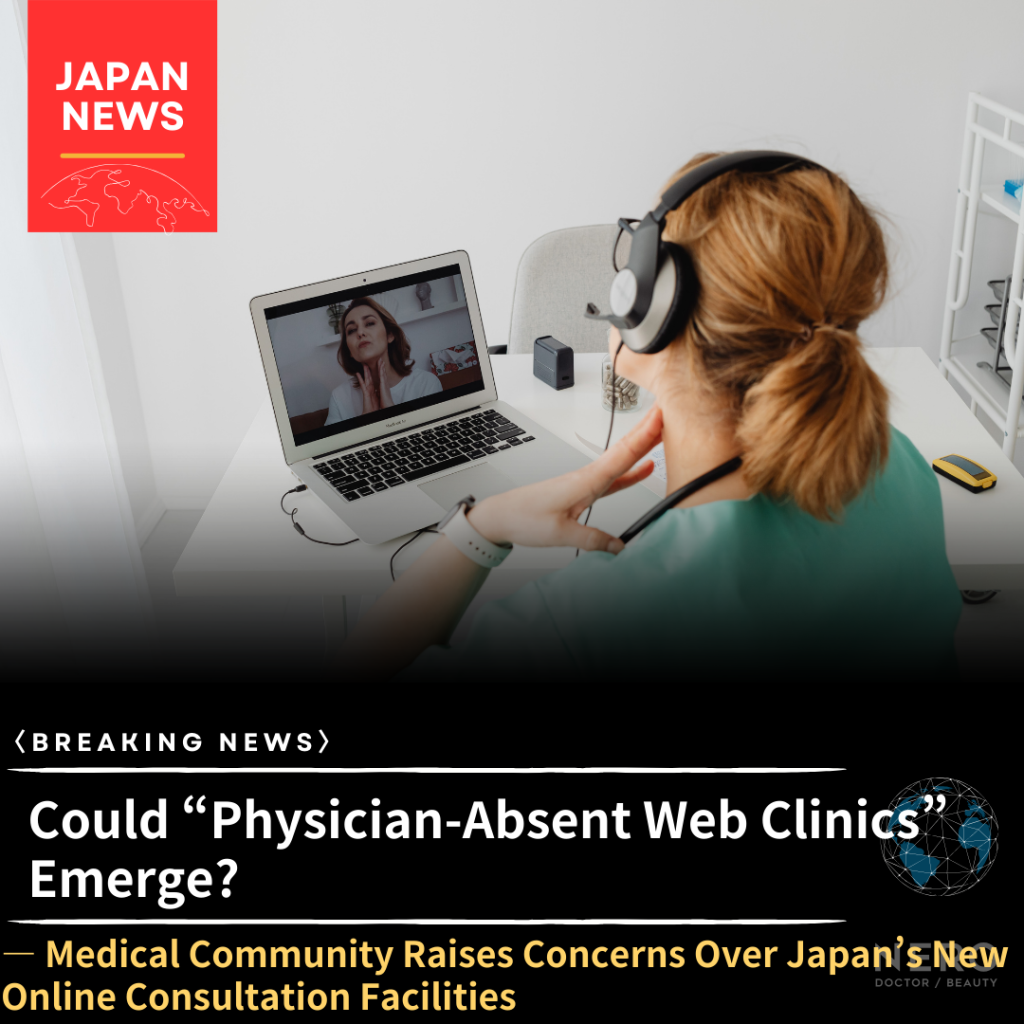
Japan is preparing to launch a new framework known as Online Medical Consultation Facilities, scheduled to take effect in April 2026 as part of the revised Medical Care Act.
Unlike traditional clinics, these facilities do not provide medical treatment themselves.
Instead, they serve as physical spaces where patients can connect with remote physicians through online consultations.
Despite not delivering care directly, the facilities are legally categorized as medical care facilities, creating a hybrid model that blends healthcare access with infrastructure services.
The system was originally positioned as a way to expand access to care, especially through remote consultation environments.
Why the Medical Community Is Raising Concerns
On February 18, 2026, a policy statement released by the Kanagawa Prefecture Physicians’ Association warned that the new system could lead to structures resembling “web clinics without on-site physicians.”
Several structural characteristics have sparked debate:
-
Facilities may be established by for-profit corporations, not only medical professionals
-
Regulatory requirements are comparatively simplified
-
Under certain models (“D to P with N”), nurses may assist procedures under remote physician supervision
Critics argue that these conditions could blur the boundary between healthcare providers and infrastructure operators, raising questions about responsibility, safety, and oversight.
It is important to note that these concerns reflect the perspective of a medical organization — not an official warning from Japan’s Ministry of Health, Labour and Welfare.
Why This Matters for Aesthetic Medicine
Aesthetic medicine may be particularly affected because of its strong reliance on digital patient journeys.
Many aesthetic clinics already integrate:
-
Online counseling and pre-visit assessments
-
Social media-driven patient acquisition
-
Remote consultations before in-person treatment
If the operational structure surrounding online care becomes unclear, risks may emerge in areas such as:
-
responsibility and decision-making chains
-
documentation and reporting practices
-
reputational and regulatory exposure
In this context, the debate extends beyond technology itself — focusing instead on how online healthcare environments are designed and governed.
Editor’s Perspective — A Structural Question, Not a Technological One
This development does not suggest that online medicine is inherently unsafe.
Rather, it highlights a deeper question now facing Japan’s healthcare system:
How far can digital access expand while maintaining medical accountability?
For aesthetic medicine — a field built on speed, accessibility, and digital engagement — the challenge will be balancing innovation with clear governance structures.
The conversation around Online Medical Consultation Facilities may therefore represent the beginning of a broader shift toward structural oversight in Japan’s free-practice medical sector.
Summary
Japan will introduce Online Medical Consultation Facilities in April 2026
A medical association warns the model could resemble physician-absent web clinics
The system reflects broader reforms under Japan’s revised Medical Care Act
Aesthetic medicine may face increased governance expectations due to strong online pathways
Operational design and accountability are becoming central industry themes
NERO’s Mission
NERO reports on global developments in aesthetic medicine
through the lens of structure, ethics, and long-term consequence.
Rather than amplifying surface-level trends,
we examine how medical practices are regulated, commercialised, and normalised —
and what is reshaped when innovation moves faster than existing frameworks.
As aesthetic medicine expands beyond traditional clinical boundaries,
NERO focuses on the grey zones where definitions blur, responsibilities shift,
and medical decision-making becomes increasingly complex.
In an era of accelerating innovation,
NERO remains committed to transparency, critical scrutiny,
and responsible reporting —
so readers can understand not only what is new,
but what deserves closer examination before it becomes standard practice.