📌 Key Takeaways
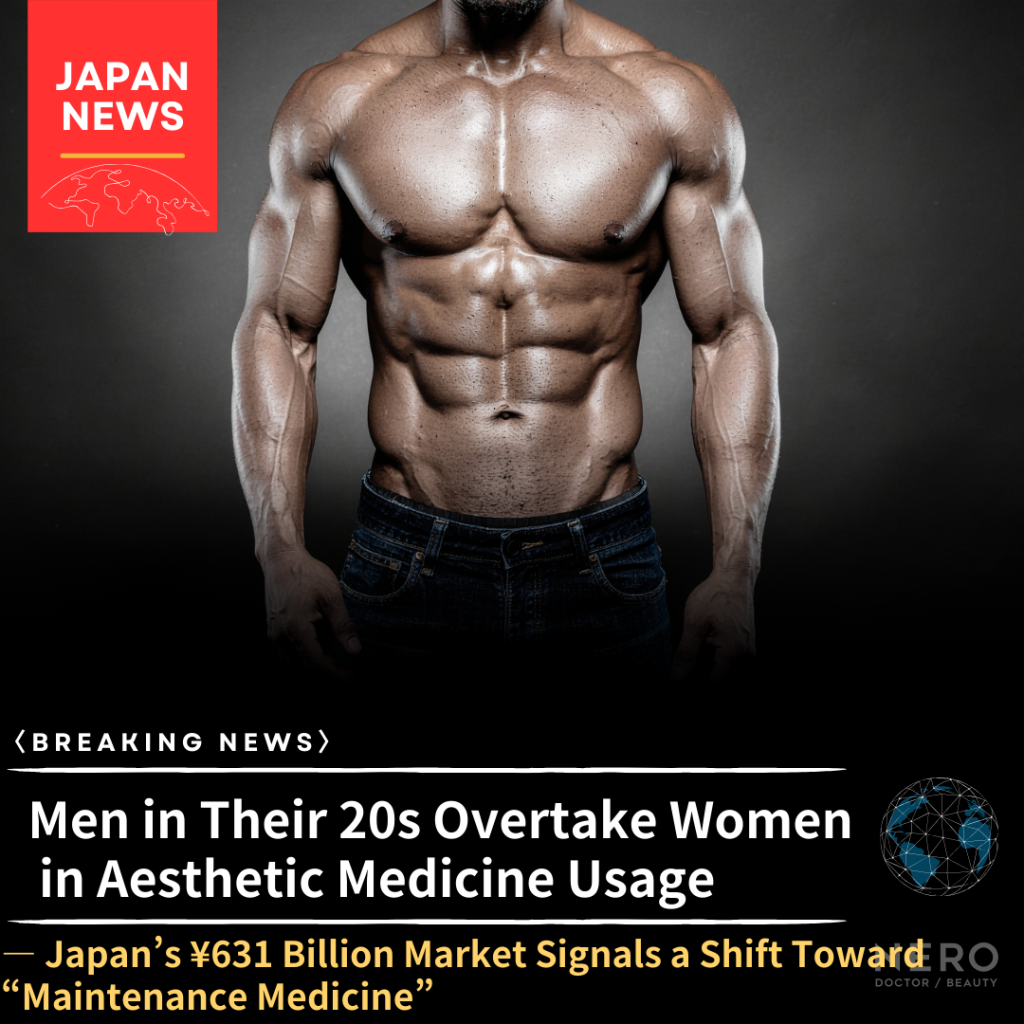
Men in their 20s in Japan recorded a 22.8% aesthetic medicine usage rate, surpassing women of the same age group
Average annual spending by male users exceeds ¥100,000
Growth is driven by dermatology-based treatments and skin maintenance rather than surgery
Key motivations include cost efficiency, time-saving, and predictable outcomes
Aesthetic medicine is shifting from transformational procedures toward subscription-like maintenance habits


INDEX
A Quiet Reversal in Market Structure
Japan’s aesthetic medicine consumption model is undergoing a subtle but significant transformation.
According to Recruit’s Beauty Census (Second Half of 2025), the one-year usage rate of aesthetic medical services among men in their 20s reached 22.8%, exceeding that of women in the same demographic.
Annual spending has surpassed ¥100,000, while usage among individuals aged 50 and above is also expanding.
Once perceived primarily as a female-driven market, aesthetic medicine in Japan is increasingly evolving into a cross-gender, cross-generational self-management infrastructure.
The real shift is not about dramatic transformation —
it is about the rise of maintenance-oriented medical consumption.
Aesthetic medicine is moving from an investment in change to a routine of preservation.
Not Masculinization, but Rationalization
Survey data suggests that the increase in usage is less about growing vanity and more about rational decision-making.
Common motivations highlighted include:
-
Visible and predictable results
-
Short treatment times
-
Lower and more standardized pricing
Rather than signaling a rise in beauty interest alone, the trend reflects a broader shift toward viewing aesthetic medicine as a cost-effective self-care tool.
This reframes aesthetic services as practical lifestyle management rather than emotional consumption.
From Surgery to Dermatology — Signs of Structural Change
Data from SBC Medical Group indicates that surgical procedures, which once accounted for nearly 80% of demand, are declining in relative share.
Currently, dermatology-related treatments represent roughly 70% of procedures.
This does not imply that surgery is disappearing.
Instead, recent demand favors low-invasive, repeatable treatments such as:
-
Medical hair removal
-
Skin booster injections
-
Botox
The common denominator is continuity rather than transformation.
Aesthetic medicine is becoming less of a once-in-a-lifetime event and more of a routine maintenance practice — closer to a dental check-up than a dramatic makeover.
A New Pathway: Corporate Welfare Programs and Users Over 50
One of the fastest-growing segments is consumers aged 50 and above.
An emerging driver is corporate welfare programs, with some providers introducing aesthetic services as employee benefits across approximately 150 companies.
This signals a structural change not only in demand but also in access channels.
Free-practice medicine is no longer limited to luxury individual spending.
Instead, it is gradually entering everyday life through corporate systems — a shift that may reshape marketing strategies across the industry.
Inside a ¥631 Billion Market
According to Yano Research Institute, Japan’s aesthetic medical market reached ¥631 billion in 2024, representing a 6% year-on-year increase.
Alongside growth, challenges remain:
-
disputes related to procedures and contracts
-
regional disparities among physicians
-
shortages of specialized practitioners
As aesthetic medicine moves closer to becoming a lifestyle infrastructure, expectations around explanation, informed consent, patient selection, and aftercare are rising.
This is not merely a boom — it is a structural transformation.
Editor’s Perspective — From Emotional Spending to Managed Consumption
The current shift is clear:
-
Transformation → Maintenance
-
Female-centered → Cross-gender
-
Occasional luxury → Recurring expenditure
Aesthetic medicine is transitioning from emotionally driven consumption to structured self-management.
As the market expands, deeper questions emerge:
Where is the boundary between healthcare and lifestyle?
Who defines safety standards in a free-practice environment?
How should ethical frameworks evolve alongside growth?
Aesthetic medicine is no longer just a niche option.
It is becoming part of broader social infrastructure — and the next challenge lies in how this transformation is designed.
Summary
Men in their 20s surpassed women in one-year aesthetic medicine usage rates at 22.8%
Average annual spending among male users exceeds ¥100,000
Dermatology-based, repeatable treatments are gaining dominance
Corporate welfare programs are creating new access pathways
As the market expands, governance and accountability are becoming increasingly important
NERO’s Mission
NERO reports on global developments in aesthetic medicine
through the lens of structure, ethics, and long-term consequence.
Rather than amplifying surface-level trends,
we examine how medical practices are regulated, commercialised, and normalised —
and what is reshaped when innovation moves faster than existing frameworks.
As aesthetic medicine expands beyond traditional clinical boundaries,
NERO focuses on the grey zones where definitions blur, responsibilities shift,
and medical decision-making becomes increasingly complex.
In an era of accelerating innovation,
NERO remains committed to transparency, critical scrutiny,
and responsible reporting —
so readers can understand not only what is new,
but what deserves closer examination before it becomes standard practice.