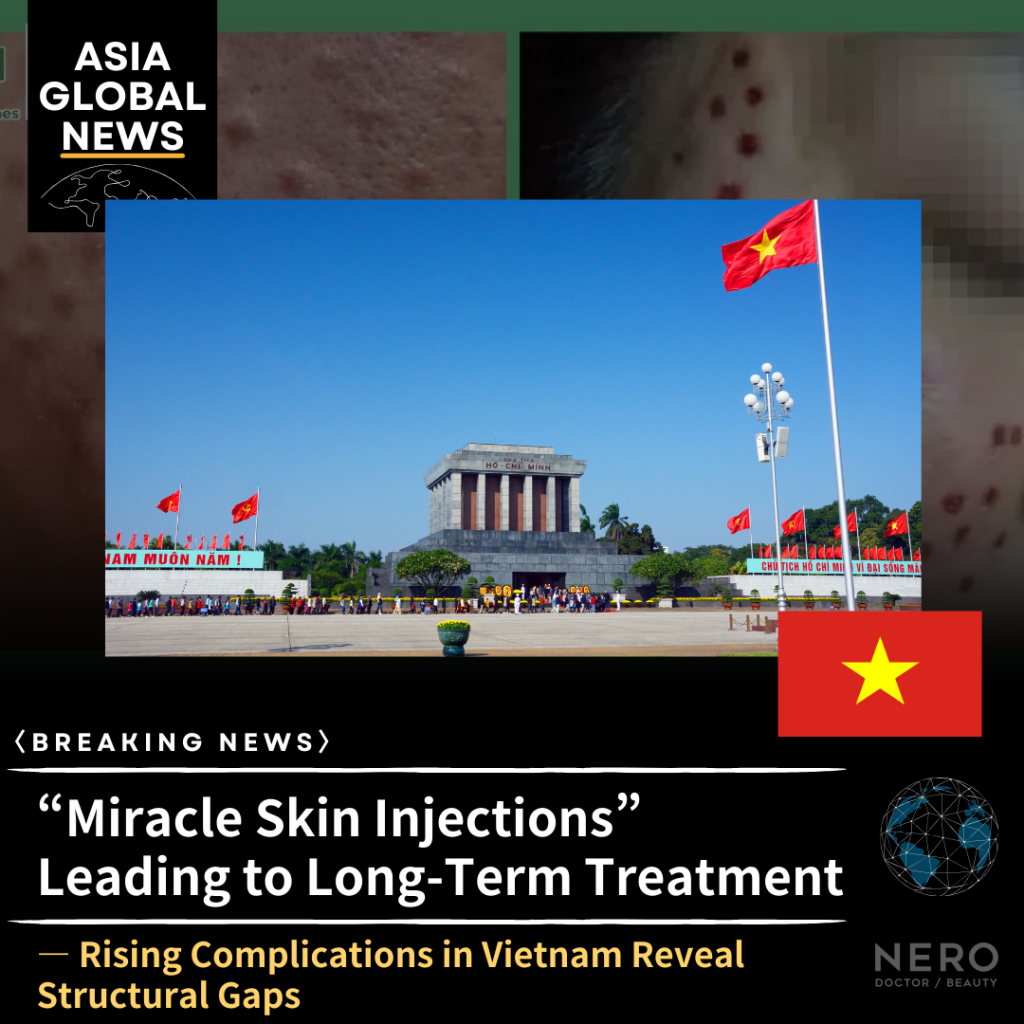
📌 Key Takeaways
213 complications linked to skin booster injections were reported at IMCAS World Congress 2026
About 73% occurred in non-medical beauty facilities
Vietnam’s National Dermatology Hospital issued an official warning
Severe cases have appeared even among patients in their 20s and 30s
The core issue is not the technology, but gaps in management and market structure


INDEX
A Rapidly Growing Market — And Its Hidden Risks
Asia’s aesthetic medicine market is expanding at remarkable speed.
Skin booster injections — often promoted as quick “miracle skin” solutions — have become symbolic of this growth.
Short treatment time.
Minimal downtime.
Accessible pricing.
These factors have accelerated demand.
But when market expansion moves faster than safety governance, structural risks begin to surface.
In Vietnam, an increasing number of patients seeking smoother skin have required months of medical treatment after injection-related complications.
NERO’s cross-analysis of IMCAS presentations, local media coverage, and official hospital statements suggests this is not an isolated incident, but a broader systemic trend.
The real question is not whether the technology itself is good or bad —
but who performs injections, where they occur, and under what management systems.
The Weight of “213 Cases” Presented at IMCAS
At IMCAS 2026, Vietnamese physicians reported 1,016 aesthetic-related complications identified between 2022 and 2025.
Among them, 213 cases involved microinjection-based skin boosters.
At first glance, the percentage may appear limited.
However, the treatment location data changes the perspective instantly:
-
73% occurred in non-medical beauty facilities
-
Only 4% were linked to licensed medical clinics
The discussion is therefore not simply about whether mesotherapy is dangerous.
The deeper issue lies in where medical injections are performed and how they are managed.
Reported complications included:
-
persistent nodules
-
granulomas
-
inflammatory reactions
-
scar formation
These were not temporary redness or mild swelling.
Many patients required long-term antibiotics, high-dose steroids, or specialized laser treatment.
A Warning from Ho Chi Minh City Dermatology Hospital
In January 2026, Ho Chi Minh City Dermatology Hospital issued an official public warning — a rare move that reflects growing concern within Vietnam’s medical community.
The hospital reported increasing cases of:
granulomas
infection
scarring
pigmentation disorders
following injections performed at non-medical facilities such as spas.
One case involved a 36-year-old woman who received injections from a non-physician practitioner using an unidentified product.
Weeks later, painful nodules developed.
Diagnosis: inflammatory granuloma.
Treatment lasted several months and resulted in residual scarring.
What stands out here is crucial:
The issue cannot be simplified as “a problematic product.”
Instead, it reveals a dual structural risk:
-
injections performed by unlicensed practitioners
-
unclear product distribution and quality control
Medical injections require:
-
anatomical knowledge
-
sterile technique
-
appropriate indication assessment
-
immediate complication response
Without these foundations, even identical products may carry dramatically different risks.
Severe Cases Among Young Patients in Northern Vietnam
Similar reports have emerged in northern regions, including Hanoi.
A 25-year-old male patient who received injections at a non-medical facility developed granulomatous reactions and prolonged inflammation requiring more than six months of treatment.
Although the skin condition stabilized, pigmentation remained, and long-term monitoring was recommended.
Reports also indicate a growing number of patients in their 20s and 30s seeking treatment — a sign that rapid market expansion is reaching younger demographics.
The debate is not about whether mesotherapy should be supported or rejected.
The real questions are:
Who performs injections?
What products are used?
Through which supply channels?
Under what governance systems?
Japan restricts injections to licensed physicians.
However, structural risks may still exist:
-
intensified price competition
-
parallel import products
-
opaque distribution channels
-
social media-driven “instant miracle” narratives
-
limited international sharing of complication data
As procedures are increasingly marketed as “light treatments,”
the reality that they remain medical acts may gradually fade from public perception.
Market growth itself is not the problem —
but whether the speed of expansion matches the speed of safety design.
Summary — Is This Only Vietnam’s Issue?
Over three years, 213 complications were reported, with the majority occurring outside licensed medical environments.
Major hospitals across Vietnam have issued warnings, and severe cases have appeared even among younger patients.
This is not simply a technological issue —
it is a structural question:
Is rapid market growth leaving governance frameworks behind?
What is happening in Asia today may not remain confined to one country.
How Japan’s aesthetic medicine sector interprets this signal could shape its future.
NERO’s Mission
NERO reports on global developments in aesthetic medicine
through the lens of structure, ethics, and long-term consequence.
Rather than amplifying surface-level trends,
we examine how medical practices are regulated, commercialised, and normalised —
and what is reshaped when innovation moves faster than existing frameworks.
As aesthetic medicine expands beyond traditional clinical boundaries,
NERO focuses on the grey zones where definitions blur, responsibilities shift,
and medical decision-making becomes increasingly complex.
In an era of accelerating innovation,
NERO remains committed to transparency, critical scrutiny,
and responsible reporting —
so readers can understand not only what is new,
but what deserves closer examination before it becomes standard practice.