📌 Key Takeaways
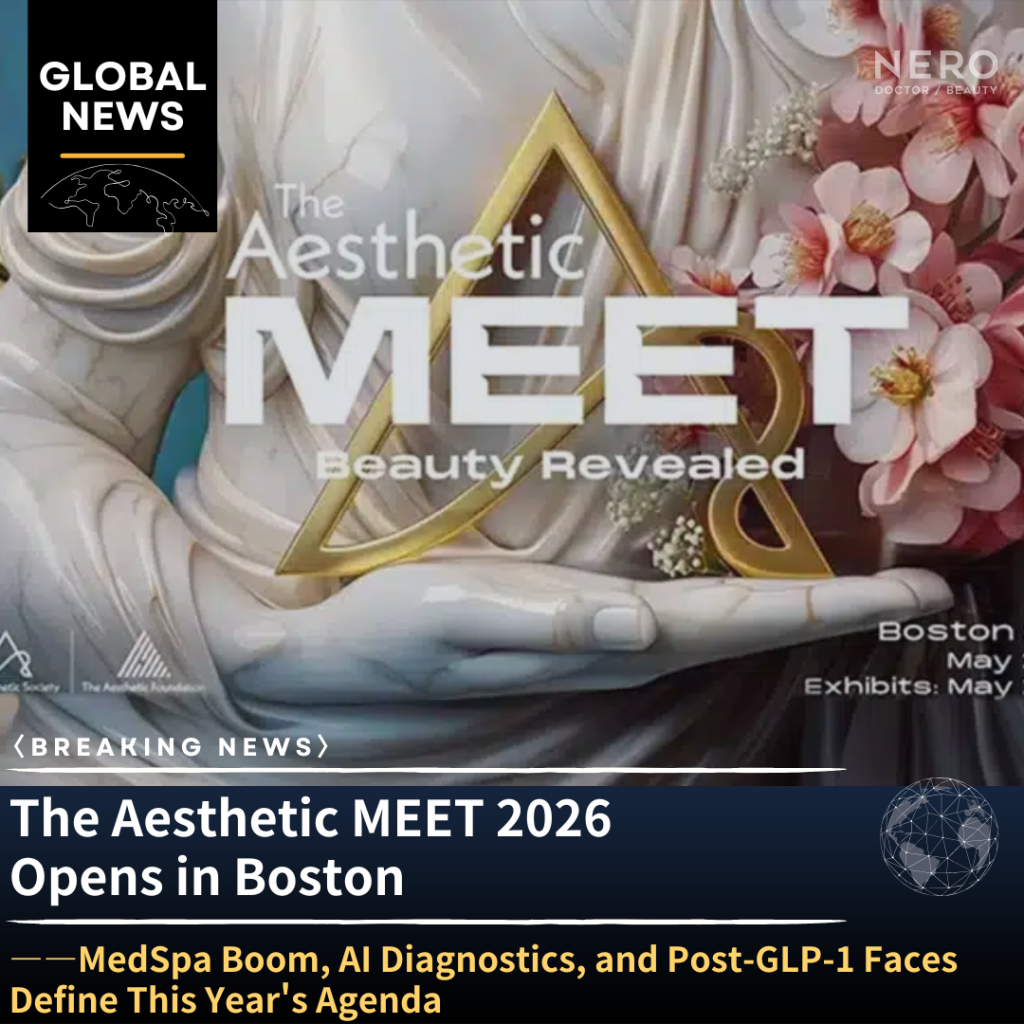
- The Aesthetic MEET 2026, the world’s largest aesthetic plastic surgery congress, opened May 14–17 in Boston
- This year’s three defining themes: the rapid expansion of MedSpa business, the practical deployment of AI diagnostics, and the management of post-GLP-1 facial changes
- What is discussed in Boston this week will shape the global—and Japanese—aesthetic medicine landscape over the next 6 to 12 months
To understand where global aesthetic medicine is heading, there is no better place this week than Boston.
On May 14, 2026, The Aesthetic MEET 2026 opened at the Boston Convention & Exhibition Center in Massachusetts. Hosted by The Aesthetic Society, the congress brings together plastic surgeons, dermatologists, aesthetic practitioners, MedSpa operators, and aesthetic nurses from around the world—making it one of the largest annual gatherings in the specialty.


INDEX
What Is The Aesthetic MEET?
Founded in 1967, The Aesthetic Society is one of the largest professional bodies in aesthetic medicine globally, with approximately 2,600 board-certified plastic surgeons, cosmetic surgeons, and dermatologists worldwide. Its annual congress, The Aesthetic MEET, is widely regarded as a defining venue for the field’s clinical, technological, and business direction.
The 2026 theme is “Beauty Revealed.” Attendees can earn up to 32 CME credits across surgical and non-surgical sessions, live demonstrations, and practice-building workshops.
Three Themes Defining Aesthetic Medicine in 2026
1. The MedSpa Boom and the Rise of Business Strategy
The single largest share of sessions at this year’s congress is dedicated to MedSpa business expansion.
MedSpas—facilities that combine medical procedures such as botulinum toxin, fillers, and laser treatments with aesthetic services—have grown to over 10,000 locations in the United States, roughly a fivefold increase since 2010.
This year’s program features extensive discussion on hiring strategy, patient retention, revenue model optimization, and regulatory compliance.
Historically, aesthetic surgery congresses centered on surgical technique. But as non-surgical procedures have expanded dramatically, business questions—how to operate a clinic, how to acquire and retain patients—have moved to the center of academic discussion. This shift reflects a broader transition in aesthetic medicine: from surgical to non-surgical, from technique to operations.
2. AI Diagnostics and Skin Analysis Move into Clinical Practice
AI-based skin diagnostics became a popular topic in 2023–2024, but in 2026 the conversation has shifted from concept to clinical implementation.
This year’s sessions covered the application of AI to facial mapping (determining the precise volume and placement of botulinum toxin and fillers), aging prediction, and post-treatment outcome forecasting. AI is no longer framed as an emerging concept—it is positioned as a competitive necessity for forward-looking practices.
3. Managing the Post-GLP-1 Face — A New Subspecialty Emerges
GLP-1 receptor agonists—originally developed for type 2 diabetes and now widely used for weight loss under brand names such as Ozempic and Wegovy—are reshaping aesthetic medicine in unexpected ways.
Rapid weight loss from these medications often results in facial fat loss, producing the now widely recognized phenomenon of “Ozempic Face.” Managing this aesthetic consequence has become one of the congress’s most prominent themes.
📊 GLP-1 and Aesthetic Medicine (Allergan Aesthetics, March 2026)
Sessions focused on practical treatment protocols, including how to sequence biostimulators (collagen-inducing agents such as PLLA and CaHA) with traditional fillers in post-GLP-1 patients.
Why This Matters Beyond the Conference Floor
It may seem that academic congress discussions are removed from everyday clinical reality. The opposite is true.
What is discussed at The Aesthetic MEET typically appears on clinic menus worldwide within 12 to 24 months. Post-GLP-1 facial management and AI-driven skin diagnostics are already entering practices in Japan and across Asia.
The three themes of The Aesthetic MEET 2026 reveal the trajectory of global aesthetic medicine: from surgery to injection, from injection to device, from device to AI—and a new role for the field in addressing aesthetic side effects of pharmaceutical weight loss.For practitioners and informed patients alike, understanding the post-GLP-1 facial framework is no longer optional. It is becoming a foundational consideration in how aesthetic medicine will be practiced over the next decade.
Summary
- The Aesthetic MEET 2026 opened May 14–17 in Boston—one of the largest annual congresses in aesthetic plastic surgery
- Three defining themes: MedSpa business expansion, the clinical deployment of AI diagnostics, and post-GLP-1 facial management
- The discussions will shape clinical practice and patient expectations globally over the next 1–2 years
- Post-GLP-1 facial aging is an immediate concern in Japan and Asian markets, not a distant trend
Frequently Asked Questions
Sources
The Aesthetic Society, “The Aesthetic MEET 2026 Official Program,” May 14–17, 2026
Allergan Aesthetics, “Medical Weight Loss Data 2026,” March 2026
NERO’s Mission
NERO reports on global developments in aesthetic medicine
through the lens of structure, ethics, and long-term consequence.
Rather than amplifying surface-level trends,
we examine how medical practices are regulated, commercialised, and normalised —
and what is reshaped when innovation moves faster than existing frameworks.
As aesthetic medicine expands beyond traditional clinical boundaries,
NERO focuses on the grey zones where definitions blur, responsibilities shift,
and medical decision-making becomes increasingly complex.
In an era of accelerating innovation,
NERO remains committed to transparency, critical scrutiny,
and responsible reporting —
so readers can understand not only what is new,
but what deserves closer examination before it becomes standard practice.