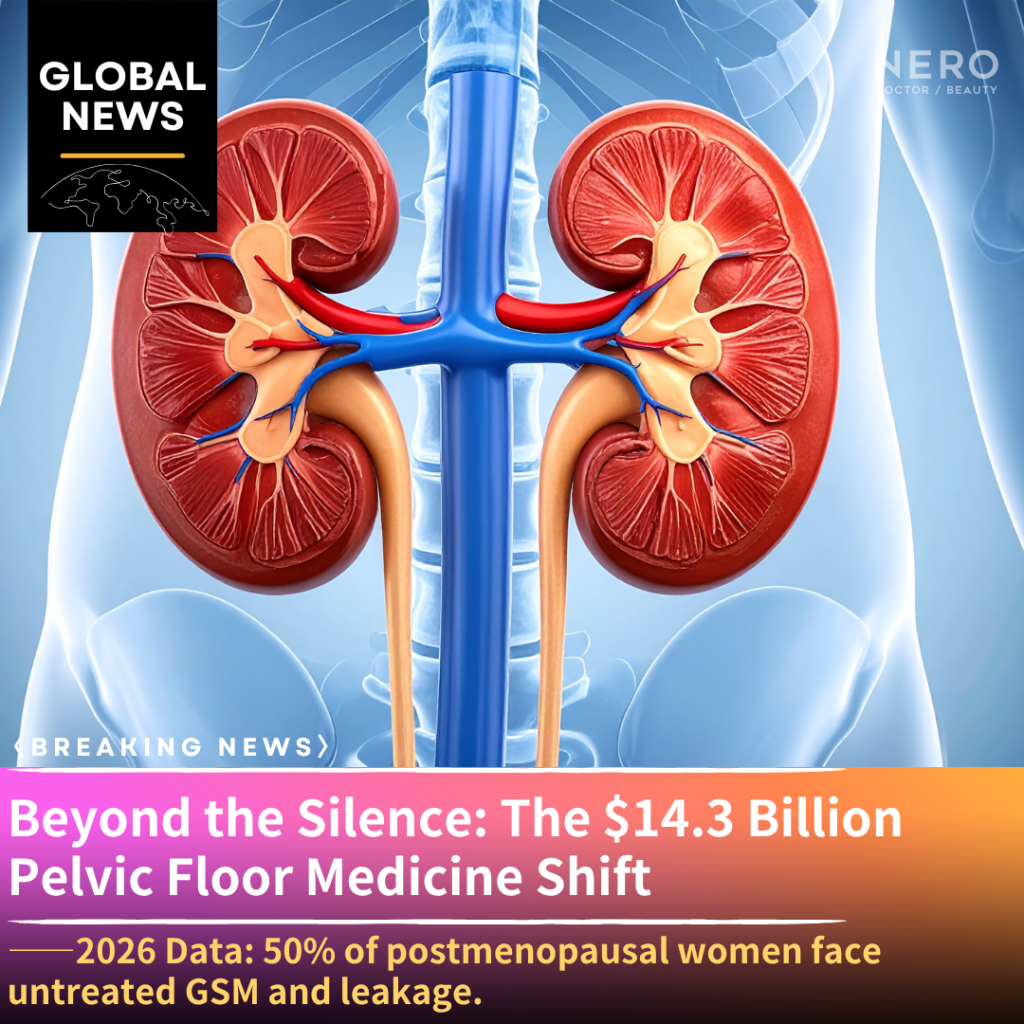
📌 Key Takeaways
- The 28th Annual Meeting of the Japan Society for Female Pelvic Medicine
is scheduled for July 25–26, 2026, in Gifu City.
The 2024 meeting drew 490 attendees, reflecting growing clinical momentum. - Urinary incontinence, pelvic organ prolapse, and genitourinary syndrome of menopause (GSM)
affect an estimated 50% of postmenopausal women —
yet most receive no treatment, citing embarrassment or resignation. - The global feminine wellness market is projected to grow
from $3.6 billion (2023) to $14.3 billion by 2030
(Grand View Research, 2024), as aesthetic medicine and pelvic health converge. - Treatment options now span from non-surgical (pelvic floor rehab,
local estrogen, hyaluronic acid, laser/RF devices)
to surgical (laparoscopic and robot-assisted procedures).
“I leak a little when I laugh.”
“Since menopause, vaginal dryness has made sex painful.”
“I feel like something is descending — but I’ve never told anyone.”
Millions of women carry these concerns in silence.
The prevailing assumption — “It’s just aging, nothing can be done” — is medically outdated.
These symptoms have names, clinical definitions, and established treatment pathways.


INDEX
What Is the Pelvic Floor — And Why Does It Matter?
The pelvic floor is a complex of muscles, ligaments, and fascia
that forms the base of the pelvis.
It supports the bladder, urethra, uterus, vagina, rectum, and anus —
and governs urinary control, bowel function, sexual response,
and core stability.
Function declines with pregnancy, vaginal delivery, aging, menopause,
and chronic heavy lifting.
“Pelvic Floor Dysfunction” is the umbrella term for the range of problems
that arise from overactivity, underactivity, or structural changes in this muscle group.
In Japan, this field has developed under the name Urogynecology
(泌尿器婦人科学 / 女性骨盤底医学) — a subspecialty bridging urology and gynecology.
Genitourinary Syndrome of Menopause (GSM): A Condition Affecting 1 in 2 Women
burning, urinary incontinence, recurrent vaginal infections
in vaginal, vulvar, urethral, and bladder tissue
it typically worsens without treatment
“I’m embarrassed” and “It’s just aging” remain the dominant barriers.
Treatment Options: Surgery Is No Longer the Only Answer
① Pelvic Floor Rehabilitation — The Safest First-Line Option
Supervised pelvic floor muscle training (PFMT) is internationally recommended
as the first-line, drug-free intervention.
Strong evidence supports its effectiveness for mild-to-moderate urinary incontinence
and early-stage pelvic organ prolapse.
Access depends on availability of pelvic floor physical therapists —
a specialty that remains underrepresented in Japan.
② Local Estrogen & Vaginal Hyaluronic Acid — First-Line for GSM
Local (topical) estrogen — delivered via vaginal cream, tablet, or ring —
is the highest-evidence treatment for vaginal atrophy, dryness, and dyspareunia.
Systemic absorption is minimal, making it suitable for most women.
Vaginal hyaluronic acid serves as an effective alternative
for those who cannot use estrogen.
③ Energy-Based Devices (Laser / RF) — Non-Invasive Tissue Remodeling
Fractional CO₂ laser and radiofrequency (RF) devices stimulate vaginal mucosa
and promote collagen production.
However, ACOG (American College of Obstetricians and Gynecologists) has stated
that “sufficient evidence to support safety and efficacy is lacking” —
patients should verify device approval status and physician credentials
before proceeding.
④ Surgical Intervention — For Severe or Refractory Cases
Severe pelvic organ prolapse (uterine prolapse, cystocele, etc.)
may require laparoscopic sacrocolpopexy (LSC)
or robot-assisted laparoscopic sacrocolpopexy (RSC).
The latest surgical techniques were discussed at the 19th Annual Meeting
of the Japan Society for Pelvic Organ Prolapse Surgery (Awaji City, March 2026).
The $14.3 Billion Feminine Wellness Market — And Japan’s Information Gap
According to Grand View Research (2024),
the global feminine wellness market — encompassing vaginal care and intimate health —
is projected to grow from $3.6 billion in 2023 to $14.3 billion by 2030.
This expansion reflects three converging shifts:
① A cultural shift from “just endure it” to “this is treatable”
② Rapid expansion of non-surgical treatment options
③ Rising societal attention to postpartum and perimenopausal care
In Japan, however, clinic-level information in this category remains scarce.
“I don’t know where to go” is the most common barrier reported by patients —
an information asymmetry that clinical societies are beginning to address.
The Japan Society for Female Pelvic Medicine maintains a specialist directory
at jfpfm.smoosy.atlas.jp.

The reason NERO covers pelvic floor medicine and aesthetic gynecology is straightforward.
Too many women are giving up simply because they don’t know options exist.
Postpartum incontinence, menopausal discomfort, painful sex —
these are not conditions women should silently endure.
They are medical problems that can be properly assessed and treated.
Knowledge creates the right to choose.
“Nothing can be done”
may simply mean
“No one told me it could be.”
The pelvic floor is treatable.
- Pelvic floor dysfunction — including urinary incontinence, pelvic organ prolapse,
and GSM — affects an estimated 50% of postmenopausal women,
yet most receive no treatment. - The 28th Annual Meeting of the Japan Society for Female Pelvic Medicine
is scheduled for July 25–26, 2026, in Gifu City.
The society’s specialist directory is available at jfpfm.smoosy.atlas.jp. - Treatment follows a stepwise approach:
Pelvic floor rehab → Local estrogen / hyaluronic acid → Energy-based devices → Surgery.
“Surgery is the only option” is no longer accurate. - The global feminine wellness market is projected to reach $14.3 billion by 2030.
In Japan, closing the information gap on where to seek care
remains the most urgent priority.
Frequently Asked Questions
a specialist bridging urology and gynecology.
Pelvic floor physical therapy (supervised PFMT) is also recommended as an initial intervention.
In Japan, the Japan Society for Female Pelvic Medicine maintains a specialist directory
at jfpfm.smoosy.atlas.jp.
and are treatable with local estrogen, vaginal hyaluronic acid, or laser therapy.
Consulting a gynecologist or urogynecologist is the recommended first step.
offer the most reliable access.
Some gynecology and urology clinics also provide this service —
confirm that a pelvic floor-specialized physical therapist is on staff.
The Japan Society for Female Pelvic Medicine’s specialist directory is a useful starting point.
Sources
Japan Society for Female Pelvic Medicine, “28th Annual Scientific Meeting,” July 25–26, 2026, Gifu City /
Japan Society for Female Pelvic Medicine, Specialist Directory, jfpfm.smoosy.atlas.jp /
Grand View Research, “Vaginal Rejuvenation Market Size & Share Report, 2030,” 2024 /
NAMS, “Genitourinary Syndrome of Menopause,” Patient Guide, 2023 /
ACOG, “Vaginal Rejuvenation and Cosmetic Vaginal Procedures,” Official Position Statement /
Japan Society for Pelvic Organ Prolapse Surgery, “19th Annual Scientific Meeting,” March 2026, Awaji City /
AUA / SUFU / AUGS, “Genitourinary Syndrome of Menopause Guideline 2025”