📌 Key Takeaways
- GLP-1 drugs like Mounjaro and Wegovy are triggering “Ozempic Face” —
rapid facial volume loss and accelerated aging —
alongside serious excess skin concerns on the body. - The American Society of Plastic Surgeons (ASPS) warned in 2025 that patients starting GLP-1 therapy
should understand the potential need for corrective surgery before beginning treatment. - A global post-GLP-1 facial protocol is emerging,
combining biostimulators (Sculptra, Radiesse), EZgel, HIFU,
and deep-plane facelifts for severe cases. - Body procedures — tummy tuck, brachioplasty, thigh lift — are surging in demand.
“Losing weight” and “losing weight beautifully” require entirely different medical planning. - 6–12 months after weight stabilization is the recommended window for surgery.
Operating during active weight loss significantly increases complication risk.
“I lost 8 kg in three months on Mounjaro.
The scale moved — but somehow, my face looks older.”
This is one of the most common complaints now surfacing
in aesthetic clinic consultations and on social media.
It is not imagined, and it is not simply what happens when anyone loses weight.
GLP-1 drugs produce a specific, well-documented pattern of change
in both the face and body — and the aesthetic medicine world is responding fast.


INDEX
What Is “Ozempic Face”? The Mechanism Behind GLP-1 Facial Aging
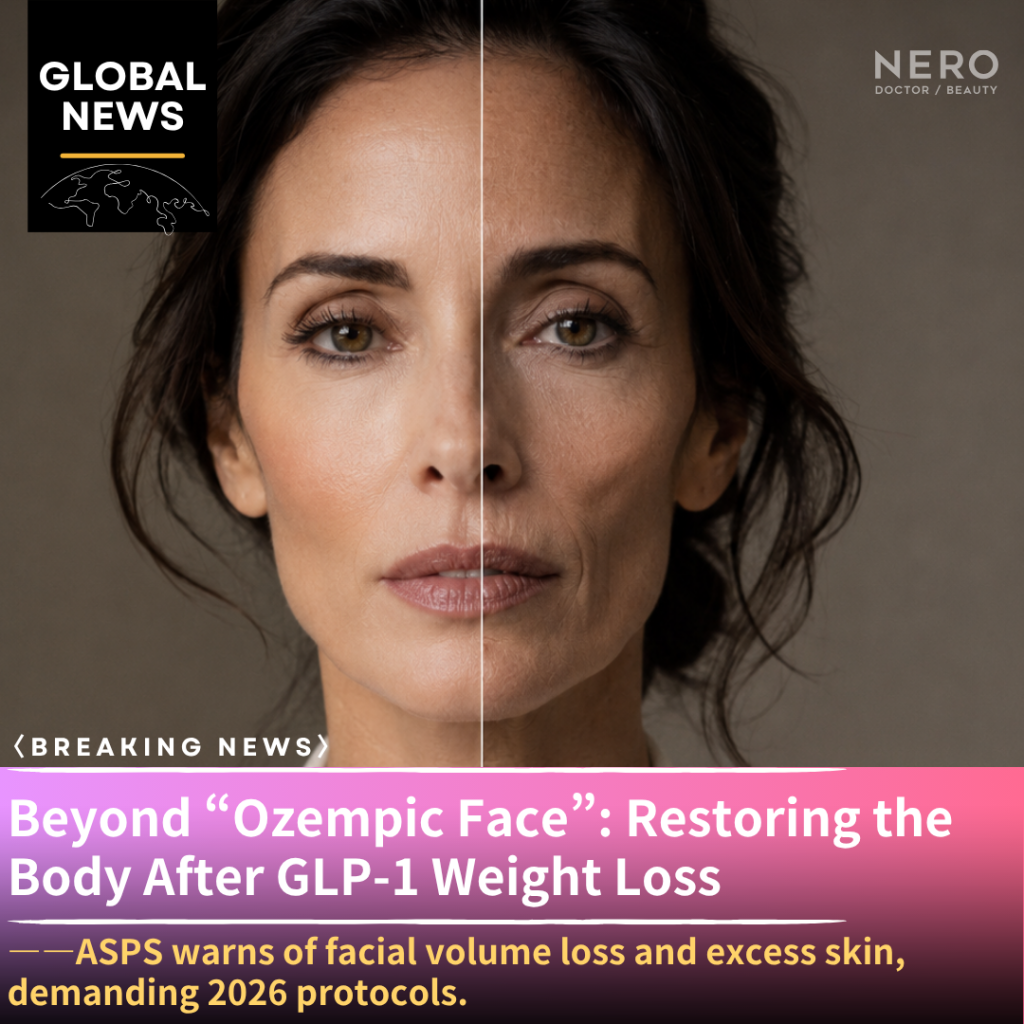
Rapid weight loss from GLP-1 drugs does not just reduce body fat.
It also depletes the facial fat compartments —
the discrete pockets of fat beneath the cheeks, temples, and under-eye area
that give the face its youthful volume.
A young-looking face depends on fat sitting atop the bone structure as volume.
When that volume disappears rapidly, the result is:
・Hollowed cheeks and sunken temples
・Deepened under-eye hollows and worsened dark circles
・Accelerated jowling and facial sagging
・An overall appearance of aging 5–10 years in a matter of months
This constellation of changes is what clinicians now call “Ozempic Face.”
The body becomes lighter — but the face looks older.
That paradox is the defining challenge of post-GLP-1 aesthetics.
Treating the Face: The Emerging Post-GLP-1 Protocol
✅ Mild to Moderate: Non-Surgical Approaches
Biostimulators (Sculptra, Radiesse): Restore lost volume and stimulate collagen production.
Effective for cheeks, temples, and jawline volume recovery.
EZgel (PRF Gel): Autologous platelet-rich fibrin gel for delicate areas
like the under-eye and temples — natural, gradual volume restoration.
HIFU and RF Microneedling: Skin tightening and collagen induction to address laxity.
Combination protocols using these modalities are becoming
the first-line approach for post-GLP-1 facial restoration worldwide.
⚠️ Severe: Surgical Approach (Deep-Plane Facelift)
For significant facial sagging, a facelift — particularly deep-plane technique —
becomes the definitive option.
Consultation with a plastic surgeon experienced in post-GLP-1 facial changes is essential.
Timing: 6–12 months after weight stabilization is the recommended window.
Surgery during active weight loss should be avoided.
Treating the Body: The Surge in Excess Skin Surgery
Recommended 6–12 months after weight stabilization.
driving increased demand for augmentation and breast lift.
Surgery during or immediately after active weight loss is contraindicated.
Why the ASPS Is Sounding the Alarm
In its December 2025 trend forecast, the American Society of Plastic Surgeons (ASPS) stated plainly:
“GLP-1 drugs have fundamentally transformed the demand landscape for plastic surgery.”
But the more urgent message from plastic surgeons is about “unprepared weight loss.”
Losing weight and managing what the face and body look like afterward
require entirely separate medical planning.
A growing number of patients are now consulting plastic surgeons
before starting GLP-1 therapy — precisely for this reason.
⚠️ Regulatory Note: GLP-1 Off-Label Use in Japan
Japan’s Ministry of Health, Labour and Welfare (MHLW) issued a proper-use notice
on June 16, 2026, addressing the off-label cosmetic and weight-loss use of GLP-1 drugs.
Mounjaro’s approved indications in Japan are limited to type 2 diabetes and severe obesity.
Prescribing for cosmetic weight loss constitutes off-label use
and may fall outside Japan’s adverse drug reaction relief system.
Patients using GLP-1 drugs for aesthetic purposes should understand this distinction fully.

A global ecosystem is forming around the sequence:
GLP-1 weight loss → facial aging → corrective aesthetics.
The connection between losing weight and looking good while doing so
demands a completely different medical design —
and that recognition is spreading fast.
“Losing weight”
and “losing weight beautifully”
are entirely different disciplines.
Before you start GLP-1,
design what comes after.”
Summary
- “Ozempic Face” — facial volume loss and accelerated aging after GLP-1 therapy —
alongside excess body skin, has become one of aesthetic surgery’s defining challenges in 2026. - Facial treatment follows a staged protocol:
biostimulators + EZgel + HIFU (mild to moderate) → deep-plane facelift (severe). - Body procedures — abdominoplasty, brachioplasty, thigh lift — are surging in demand.
The recommended timing for all is 6–12 months after weight stabilization. - Japan’s MHLW issued a proper-use notice on GLP-1 off-label cosmetic use on June 16, 2026.
Losing weight and looking good afterward require separate, intentional medical planning.
Frequently Asked Questions
typically at least 6 months — before consulting a specialist.
For mild to moderate laxity, non-surgical options include
biostimulators (Sculptra, Radiesse), EZgel, and HIFU.
Severe cases may require a deep-plane facelift.
Begin with a thorough assessment from a qualified aesthetic physician.
but excess skin that has been stretched at the dermal level cannot be removed through exercise alone.
Mild cases may respond to radiofrequency or HIFU tightening treatments.
Significant excess skin — where large folds of skin and fat remain —
typically requires surgical excision such as abdominoplasty.
Consultation with a board-certified plastic surgeon is recommended.
Understanding in advance how much weight you plan to lose,
what physical changes to expect, and what procedures may become relevant
leads to significantly better outcomes and satisfaction.
In some cases, certain surgical procedures are better performed before weight loss begins.
A comprehensive plan developed with your physician is the most effective approach.
Sources
ASPS, “Looking into the future: Plastic surgery trends for 2026,” December 29, 2025 /
Orange County Plastic Surgery, “Top 2026 Plastic Surgery Trends,” January 2026 /
La Belle Vie Cosmetics, “2026 Plastic Surgery Trends,” January 30, 2026 /
Japan Ministry of Health, Labour and Welfare, “Proper Use Notice on GLP-1 Receptor Agonists and GIP/GLP-1 Receptor Agonists,” June 16, 2026, Notification No. 0616-16 /
IAPAM, “Top Aesthetic Medicine Trends to Watch in 2026,” March 2026