📌 Key Takeaways
- B4A, Japan’s leading clinic management platform for cash-pay aesthetic practices,
is deployed in over 700 clinics as of January 2026
and ranked #1 in multiple BOXIL categories in H1 2026. - At B4A Summer Summit 2026 Tokyo on July 7,
CEO Shotaro Uematsu officially launched B4A-I —
an integrated AI suite targeting 30 new features within the year. -
B4A-I Voice, the first release, auto-transcribes consultations
into SOAP-format medical records.
Free trials begin August 1; full rollout planned for September 2026. - Additional AI modules cover patient messaging, campaign marketing,
and daily business reporting —
all integrated within B4A’s core data infrastructure.
Walk into almost any aesthetic clinic in Japan
and you’ll encounter the same friction:
fill out a paper intake form, wait for the counselor,
wait again at checkout while staff manually enter records.
Most of that delay originates not at the front desk —
but in the backend systems powering the clinic.
On July 7, 2026, over 400 clinic operators, physicians, and industry stakeholders
gathered at JP Tower Hall & Conference in Tokyo
for B4A Summer Summit 2026.
The event’s central announcement:
B4A, the dominant clinic management platform for Japan’s cash-pay aesthetic sector,
is going all-in on AI.


INDEX
What Is B4A — and Why Does It Matter to Patients?
B4A is not a patient-facing app.
It is the invisible infrastructure running inside the aesthetic clinics you visit —
handling appointments, electronic medical records (EMR),
CRM messaging, payment processing, and business analytics
on a single integrated platform.
What B4A Manages Inside an Aesthetic Clinic
Appointment & Reception Automation
Real-time booking, auto staff assignment,
and digital intake forms to reduce wait times
Electronic Medical Records & Treatment Logs
Tablet-based charting, before/after photo management,
and automated session-count tracking
CRM & Patient Marketing
LINE messaging, segmented campaigns,
and retention programs linked to EMR data
Payment & Business Management
Course contracts, refund calculations, revenue analytics —
with on-site payment terminals launching August–September 2026
Source: B4A official website
As of January 2026, B4A is deployed in over 700 aesthetic clinics across Japan.
In H1 2026, it ranked #1 in seven categories on BOXIL —
Japan’s leading B2B SaaS review platform —
including both “Medical Appointment Systems” and “Electronic Medical Records.”
B4A-I: Three AI Modules That Could Change the Clinic Experience
The summit’s headline announcement was B4A-I (pronounced “B4A-Eye”) —
an integrated AI layer built directly into B4A’s core platform.
CEO Shotaro Uematsu framed the strategic logic clearly:
“Because we own the core data — appointments, records, payments, marketing —
we can build AI that actually connects all of it.”
💡 Why “Core-System AI” Has a Structural Advantage
Bolting an external AI tool onto a clinic’s existing software
creates data silos between records, scheduling, and marketing.
A platform that already unifies all clinic data —
like B4A — can deliver AI that acts on the full picture,
not just one slice of it.
When a voice-recorded consultation auto-populates the EMR,
and that EMR data then informs the next marketing campaign,
the value compounds in ways a standalone AI tool cannot replicate.
① B4A-I Voice — Eliminating the Charting Bottleneck
The first feature demonstrated at the summit was B4A-I Voice:
an AI-powered voice transcription and auto-summarization tool
built for clinical consultations.
The workflow is straightforward:
the physician or counselor activates the microphone within B4A at the start of a session.
The conversation is transcribed in real time,
then automatically structured into SOAP format
(Subjective / Objective / Assessment / Plan —
the international standard for medical documentation).
One click pushes the summary into the patient’s EMR.
🎙 B4A-I Voice: How It Works
Activate the microphone inside B4A before the consultation begins
Conduct the session with zero manual documentation —
full attention on the patient
AI generates a SOAP-format summary immediately after the session ends
One click transfers the summary directly into the patient’s electronic record
The patient-facing benefit is indirect but real:
physicians freed from real-time charting can move to the next patient faster,
reducing wait times across the board.
There is also a qualitative dimension:
when a doctor looks at the patient instead of a screen,
the consultation itself becomes more substantive.
📊 The Charting Burden: Industry Context
Documentation overhead is a documented problem across global healthcare systems
NTT Communications & Nara Prefecture Joint Study (2023)
Healthcare workers spending the most time on charting
devoted up to 30% of their working day to EMR entry
Japan Ministry of Health, Labour and Welfare (2023 Survey)
EMR adoption among Japanese clinics stands at 55.0%.
The government targets 100% adoption by 2030.
Sources: MHLW 2023 Survey; NTT Communications / Nara Prefecture Joint Study (2023); Medical DX Reiwa Vision 2030
② B4A-I Message & Marketing — Automating Patient Communication
For Japan’s aesthetic clinics, LINE messaging has become
the primary channel for patient communication —
appointment reminders, post-treatment follow-ups, promotional campaigns.
The manual workload of crafting individual responses at scale
is a significant operational burden.
B4A-I Message generates reply drafts automatically
based on each patient’s conversation history.
Staff can send as-is or edit before sending.
B4A-I Marketing extends this further,
automating three stages of campaign execution:
AI Audience Segmentation
AI proposes multiple patient segments based on treatment history,
visit frequency, and stated goals
AI Message Generation
Campaign copy is auto-generated to match
the selected segment and campaign objective
AI Image Generation
Multiple visual assets are generated automatically —
regeneratable with one click
③ B4A-I Daily Report — Operational Intelligence at a Glance
The third module, B4A-I Report,
auto-summarizes each day’s revenue, bookings, and cancellations
into a single AI-generated brief —
including day-over-day trend analysis and recommended actions for the following day.
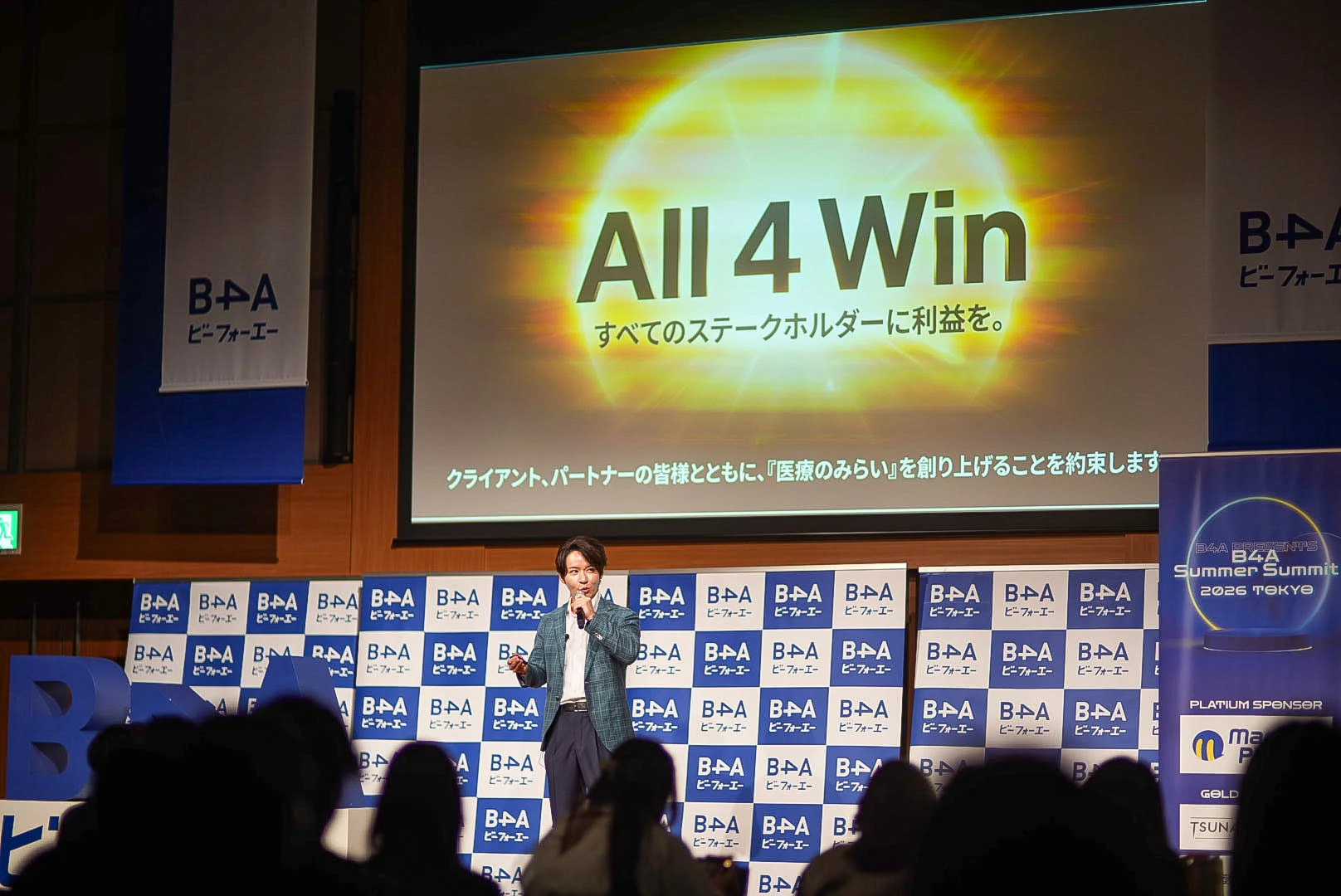
Shotaro Uematsu, CEO — “All 4 Win: Value for Every Stakeholder” (B4A Summer Summit 2026 Tokyo)
NERO’s Assessment: Is B4A-I Actually Useful?
The strategic direction announced at the summit is sound.
Integrating AI into a core clinic management platform —
rather than layering it on top as a disconnected add-on —
is the right architectural approach.
That said, several questions warrant neutral scrutiny.
0+
Clinics on B4A
(as of Jan 2026)
0+
Attendees
Tokyo Summit
0
AI features planned
within 2026
✅ Strengths Worth Noting
- Core-system integration reduces
data fragmentation risk - 700-clinic install base provides
real-world feedback loops for development - BOXIL multi-category #1 ranking
reflects genuine market validation - August free trial lowers
adoption barriers for new clinics
⚠ Points Requiring Independent Verification
- “30 features in 12 months”
remains unverified in execution - Voice AI accuracy with
medical terminology is untested - “Industry-lowest payment fees”
require confirmation post-launch - Competitors are actively
entering the same space
Beyond Tokyo: Osaka and Fukuoka Summits Follow
B4A Summer Summit 2026 continues beyond the Tokyo event.
Osaka (July 22, Umeda Sky Building) and
Fukuoka (August 7, Daimyo Conference) follow,
with regional clinic directors and operators joining the speaker lineup.
B4A Summer Summit 2026 — Full Schedule
July 7, 2026 (Tue) 14:00–20:00
TOKYO / JP Tower Hall & Conference (directly connected to Tokyo Station)
400+ attendees / Free admission / 15 speakers
Organizer: B4A Inc. / Host: Next-Generation Medical Promotion Association
July 22, 2026 (Wed) 14:00–20:00
OSAKA / Umeda Sky Building
Featuring top clinic directors from the Kansai and Chubu regions. Free admission.
August 7, 2026 (Fri) 14:00–20:00
FUKUOKA / Daimyo Conference
Aligned with B4A’s regional expansion into Kyushu and western Japan. Free admission.

What stands out about this announcement is the strategic repositioning:
B4A is no longer positioning itself as a software vendor —
it is moving to become the operating infrastructure of the aesthetic clinic industry.
AI features are the means, not the end.
The design logic — “AI is only possible because we own the core data” —
is architecturally sound.
The direction, toward improving the patient experience as the ultimate destination,
is the right one.
That said, 30 features in 12 months is an ambitious commitment.
We will be watching whether quality keeps pace with quantity.
The quality of an aesthetic medicine experience
is not determined by the treatment alone.
Booking friction, wait times, consultation depth,
and post-treatment follow-up all shape how patients evaluate a clinic.
B4A-I is attempting to improve the parts of that experience
that patients never see — but always feel.
Summary
- B4A, deployed in 700+ Japanese aesthetic clinics,
officially launched its AI suite B4A-I at Summer Summit 2026 Tokyo on July 7. - B4A-I Voice auto-transcribes consultations into SOAP-format EMR entries.
Free trials begin August 1; full client rollout planned for September 2026. - AI marketing modules automate audience segmentation,
message generation, and image creation —
drawing on integrated clinic data for relevance that standalone tools cannot match. - On-site payment terminals are planned for August–September 2026.
B4A’s headquarters will relocate to Ebisu, Tokyo in September.
Frequently Asked Questions
Sources:
1. B4A Summer Summit 2026 TOKYO — CEO Shotaro Uematsu keynote address (July 7, 2026)
2. B4A official website. b4a.co.jp
3. B4A press release. “BOXIL H1 2026 Rankings: #1 in 7 Categories.” June 26, 2026.
4. B4A Summer Summit 2026 event materials — Tokyo, Osaka, Fukuoka editions.
5. Japan Ministry of Health, Labour and Welfare. Medical Information Systems Security Guidelines; 2023 EMR Adoption Survey.
6. NTT Communications / Nara Prefecture. Joint study on clinical documentation burden (2023).
※ This article is an editorial report by NERO Editor-in-Chief Kenichi Adachi, who attended the event and reviewed primary source materials. All figures, features, and schedules reflect information as announced on July 7, 2026, and are subject to change.