📌 Key Takeaways
- A Unilever study published in the British Journal of Dermatology (October 2025)
is the first to show measurable skin microbiome differences
between same-age individuals who look younger vs. older. - People who appear younger have more abundant Acinetobacter bacteria
and a more stable, resilient microbial network.
Those who look older show a fragile, unstable microbiome. - After 4 weeks of using a retinyl propionate–containing product,
the “older-looking” group’s microbiome shifted toward the younger-looking profile—
with improvements in elasticity, hydration, and barrier function. - This is among the first clinical evidence that skincare can
directly reshape the skin’s microbial community.
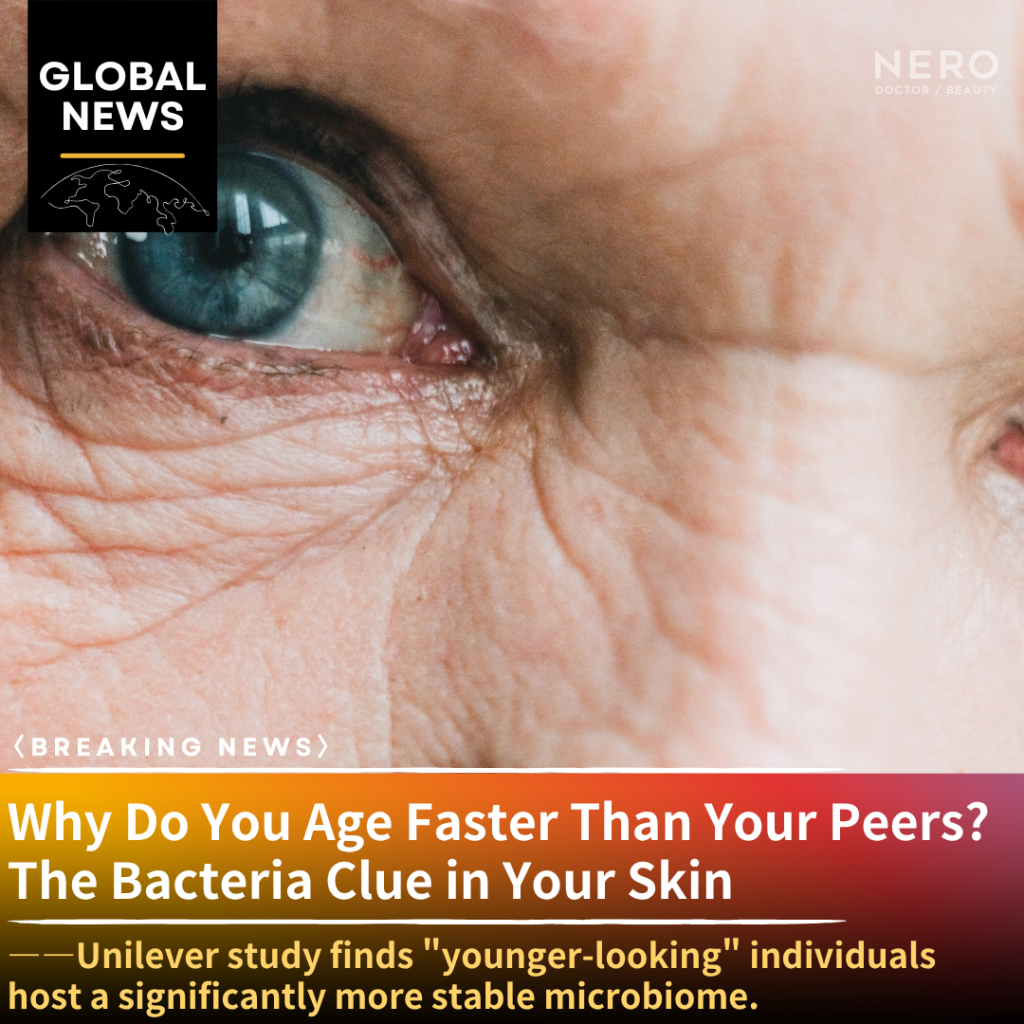
“Why do I look so much older than my friends, even though we’re the same age?”
It’s a question many people ask—and until recently, the answer defaulted to genetics or lifestyle.
A new study suggests a third factor: the community of bacteria living on your skin.
Published in the British Journal of Dermatology—the official journal of the British Association of Dermatologists—
Unilever’s research offers the first scientific comparison of skin microbiomes
between same-age individuals who appear to age at different rates.
The findings have significant implications for how the beauty and dermatology industries
understand and address skin aging.


INDEX
The Study: Same Age, Different Skin
Most skin microbiome research has compared young people to elderly populations.
What made this study different was its design:
it focused on women in the same age group (40s–50s),
divided by whether they appeared to age faster or slower than their chronological age.
Researchers compared 30 participants in the premature-aging group
against 35 in the delayed-aging group.
Microbiome samples were collected from the upper cheek
and analyzed using 16S rDNA sequencing—
a gold-standard method for identifying microbial communities.
What the Bacteria Revealed
Source: Unilever Research · British Journal of Dermatology · DOI: 10.1093/bjd/ljaf098
The skin microbiome refers to the entire community of microorganisms—
bacteria, fungi, and viruses—that live on the skin’s surface.
It plays a central role in immune defense, barrier function, and inflammation control.
When the microbiome becomes imbalanced (a state called dysbiosis),
conditions like acne, eczema, dryness, and accelerated aging can follow.
The concept of “microbiome-friendly skincare”—
products designed to support rather than disrupt this ecosystem—
is gaining rapid traction in both dermatology and the beauty industry.
Can Skincare Actually Shift the Microbiome?
The most clinically significant finding in this study
may not be the microbiome differences themselves—
but what happened when researchers intervened.
When the premature-aging group used a product containing
retinyl propionate (a retinoid-class ingredient) for 4 weeks,
their skin microbiome shifted toward the profile seen in the delayed-aging group.
Simultaneously, improvements were observed in skin brightness, elasticity,
hydration, and barrier function.
This represents some of the first clinical evidence that
a topical skincare product can meaningfully reshape
the skin’s microbial community.
Retinyl propionate is a retinoid-class compound—related to vitamin A—
used in topical skincare for its anti-aging properties.
It is generally considered milder than retinoic acid (prescription tretinoin)
and is available in over-the-counter formulations.
Its ability to influence the skin microbiome, as shown in this study,
adds a new dimension to understanding how retinoids work.
A Paradigm Shift in How We Think About Skin Aging
Emphasis on visible improvement over underlying mechanisms.
Unilever’s research provides the first peer-reviewed scientific basis for this approach.
L’Oréal’s partnership with OpenAI is already moving in this direction.

We’ve long attributed visible age differences between peers
to genetics or lifestyle choices.
This study introduces a third axis: the microbial community living on your skin.
The intervention data is promising—
but this is still early-stage, single-study evidence.
Replication and larger trials will determine how far this finding holds.
The question consumers will soon be asking isn’t “Does this contain probiotics?”
It’s “Does this product actually stabilize my skin’s microbial network?”
That’s a fundamentally different standard—and the industry isn’t ready for it yet.
- A Unilever study in the British Journal of Dermatology found that
people who appear younger (n=35) have more abundant Acinetobacter bacteria
and a more stable skin microbiome than those who appear older (n=30). - The delayed-aging group’s microbiome showed greater resilience
to environmental stressors—a key differentiator from the premature-aging group. - Four weeks of retinyl propionate use shifted the premature-aging group’s microbiome
toward the younger-looking profile,
with concurrent improvements in elasticity, hydration, and barrier function. - This is among the first clinical evidence that topical skincare
can meaningfully alter the skin’s microbial ecosystem—
and potentially influence the rate of visible aging.
Frequently Asked Questions
In this Unilever study, the effective ingredient was retinyl propionate—a retinoid—
not a probiotic formulation.
When evaluating “microbiome-friendly” products,
look for the specific ingredient and the research behind it,
rather than relying on general marketing claims.
but all three microbiomes are understood to influence systemic health and aging rate.
A growing body of research explores the “microbiome-aging” axis holistically—
the idea that managing microbial balance across the body
may collectively slow visible aging.
and advanced dermatology practices globally.
However, clinical standardization of microbiome-based personalized skincare
remains largely in the research and development phase.
Broader availability is expected within the next two to three years
as the field matures.
Sources
· Unilever Research. “Skin microbiome as a signature of premature ageing: enhancement with a retinyl propionate-containing topical product.” British Journal of Dermatology. Volume 193, Issue Supplement_2, October 2025, Pages ii24–ii31. DOI: 10.1093/bjd/ljaf098.
· Cosmetics & Toiletries. “Unilever Study Links Skin Microbiome and Premature Aging.” February 6, 2026 (paper published October 2025).
· Personal Care Insights. “Unilever study links skin microbiome to premature aging and appearance.” September 2025.