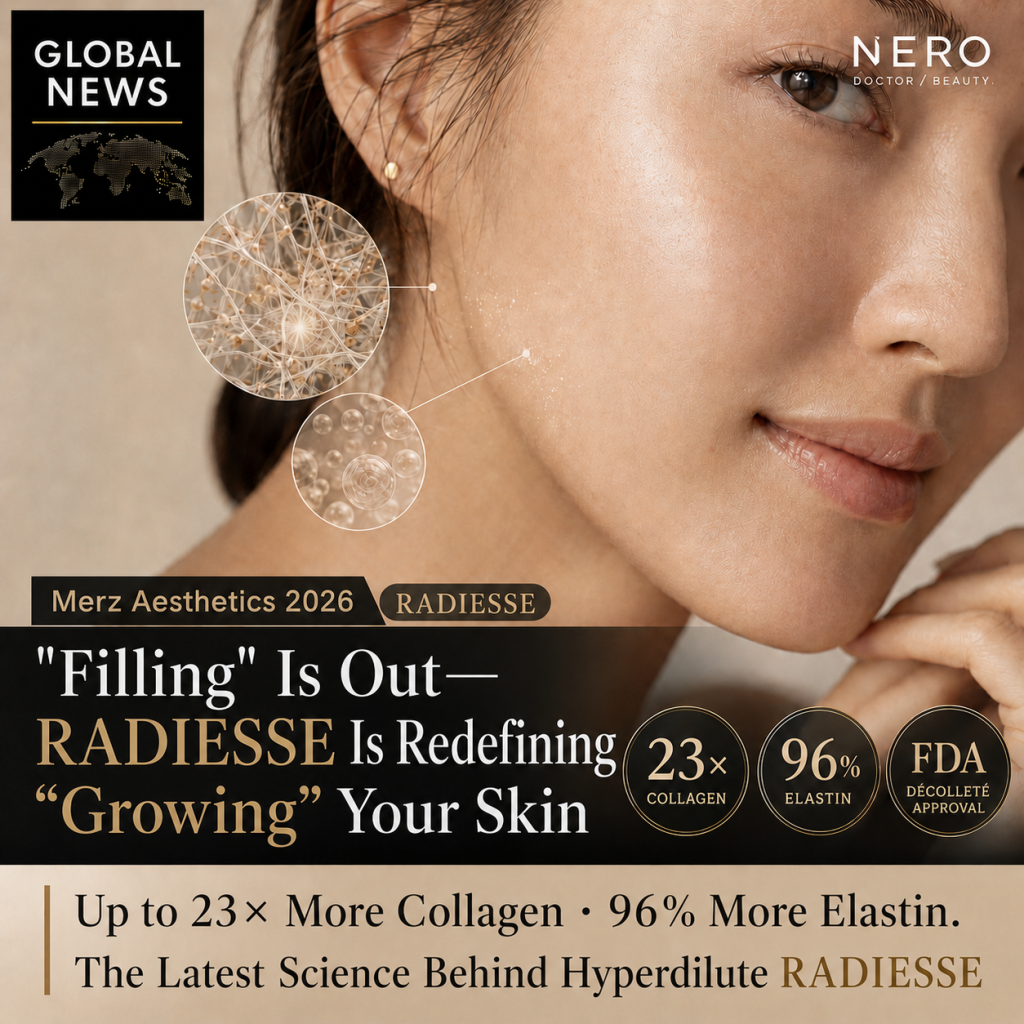
📌 Key Takeaways
- A May 2026 placebo-controlled study published in the Journal of Cosmetic Dermatology confirmed
Hyperdilute RADIESSE increased collagen production up to 23x and elastin by 96% vs. placebo. - On April 8, 2026, the FDA granted RADIESSE its 4th approved indication —
treatment of décolleté wrinkles — making it the only biostimulator approved
for both face and body in the United States. - Three primary clinical targets are driving global adoption:
Ozempic Face recovery, neck and décolleté rejuvenation,
and preventive maintenance in patients aged 20–40. - Over 250 peer-reviewed publications and 20 million syringes shipped across 85+ countries
support RADIESSE’s long-term safety profile.
“My face looked deflated after losing weight on Ozempic.”
“I don’t want to be filled up — I want my skin to actually regenerate.”
These are the questions science is now answering.
In 2026, one of the fastest-accelerating trends in aesthetic medicine is Hyperdilute RADIESSE —
a technique that repositions calcium hydroxylapatite (CaHA) not as a filler,
but as a biological trigger for the skin’s own regenerative machinery.
On May 27, 2026, Merz Aesthetics published a 6-month, placebo-controlled biomarker study
in the Journal of Cosmetic Dermatology.
The results were striking: collagen production increased up to 23x vs. placebo;
elastin rose by 96%.
Just weeks earlier, on April 8, 2026, RADIESSE received FDA approval
for its 4th indication — décolleté wrinkle treatment —
becoming the only regenerative biostimulator cleared for both face and body in the U.S.
This article breaks down what Hyperdilute RADIESSE is,
why it is attracting global clinical attention in 2026,
and what the latest primary data actually shows.


Let’s start with the fundamentals.
RADIESSE’s active ingredient — calcium hydroxylapatite (CaHA) — is a mineral compound
naturally found in human bone and teeth, giving it high biocompatibility.
When diluted to hyperdilute concentrations, the volumizing effect is bypassed entirely.
What remains is pure biostimulation: targeted activation of fibroblasts,
the cells responsible for producing collagen and elastin.

On May 27, 2026, Merz Aesthetics published findings from a 6-month,
placebo-controlled biomarker study in the Journal of Cosmetic Dermatology.
Researchers describe it as one of the most comprehensive human evaluations
of extracellular matrix (ECM) regeneration in aesthetic medicine to date.

Collagen production (vs. placebo, peak value)
Primary structural protein for firmness and support
Compared to a saline placebo, collagen production increased up to 23-fold.
This figure exceeds any previously reported outcome in peer-reviewed aesthetic medicine literature.
Elastin production increase (vs. placebo)
Protein responsible for skin elasticity and recoil
Elastin is notoriously difficult to restore once lost to aging.
A 96% increase represents a meaningful clinical answer to one of dermatology’s
most persistent challenges.
129%
Decorin (+82%) and Versican (+129%) increases
ECM proteins governing hydration and structural integrity
Decorin and versican regulate moisture retention and structural scaffolding in the dermis.
Increases of 82% and 129% respectively suggest comprehensive improvement
in skin texture, plumpness, and thickness.
🌞 Solar Elastosis (Photoaging) Also Showed Measurable Improvement
The study also reported that ultrasound characteristics of solar elastosis —
chronic UV-induced skin damage — improved at both the 3-month and 6-month timepoints
in RADIESSE-treated areas.
This marks the first published evidence of a biostimulator addressing
a root cause of crepey skin, wrinkles, and laxity.
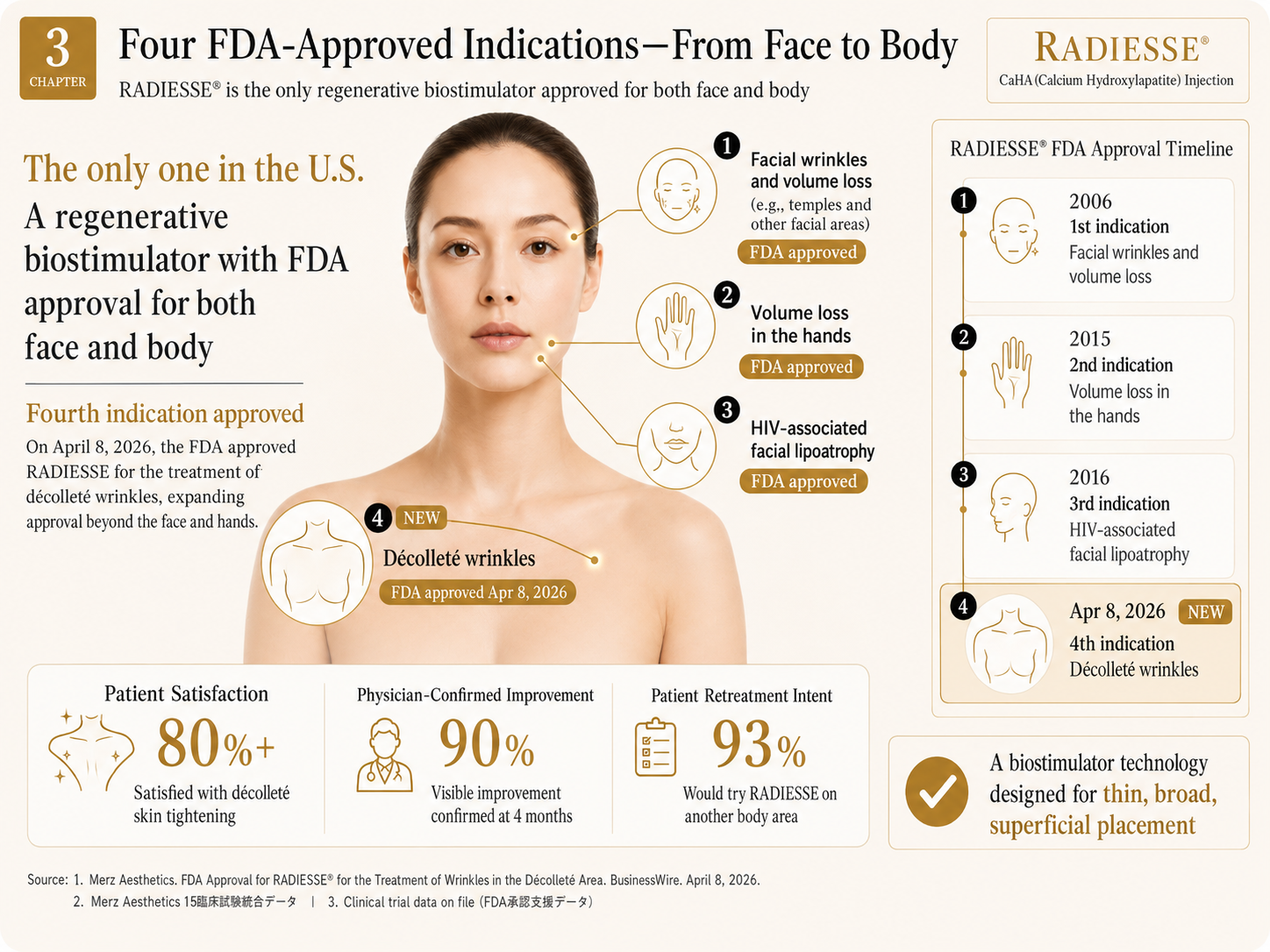
On April 8, 2026, Merz Aesthetics received FDA clearance for RADIESSE
to treat wrinkles in the décolleté area in patients aged 22 and older.
This is RADIESSE’s 4th FDA-approved indication,
and it establishes the product as the only regenerative biostimulator approved
for both face and body in the United States.
The décolleté is among the thinnest, most UV-exposed skin on the body —
and one of the most overlooked in standard skincare routines.
As Merz Chief Scientific Officer Samantha Kerr noted, it is
“one of the areas where age shows most clearly, yet is most often neglected.”
RADIESSE is now the world’s first FDA-approved biostimulator
for horizontal neck lines and crepey décolleté skin —
areas where Botox and hyaluronic acid fillers offer limited utility.
Merz Aesthetics’ global promotional strategy — anchored by pinned content
on their official Instagram — identifies three primary patient profiles.
These profiles map directly onto the clinical question: who benefits most from this approach?

Ozempic Face — GLP-1 Weight Loss and Facial Volume Loss
Merz’s official messaging: “Rapid weight loss from GLP-1s showing on your face?”
GLP-1 medications like semaglutide (Ozempic, Wegovy) and tirzepatide (Mounjaro)
cause rapid fat loss — including facial fat.
Restoring that volume with hyaluronic acid filler often looks unnatural.
Hyperdilute RADIESSE addresses the underlying issue differently:
by rebuilding skin thickness itself — up to 48% — rather than adding foreign volume.
Neck Lines, Décolleté Wrinkles, and Crepey Skin
Official messaging: “Give your décolleté the attention it deserves.”
The neck and chest are among the first areas to show visible aging,
yet are routinely undertreated.
With the April 2026 FDA approval, RADIESSE is now the first cleared biostimulator
for this indication — and clinics globally are rapidly adding it to their menus.
Demand for neck line and crepey skin treatment is rising sharply across all markets.
Preventive Maintenance — Ages 20–40
Official messaging: “Maintenance Mode.”
Gen Z and Millennial patients are increasingly choosing proactive skin investment
over reactive correction.
Rather than waiting until significant aging has occurred,
younger patients are using Hyperdilute RADIESSE to build collagen reserves early —
a concept aligned with the emerging “skin longevity” framework in aesthetic medicine.
🌐 Global Context: Why This Matters Now
The “natural result” preference is reshaping global aesthetics.
Patients worldwide are increasingly resistant to the overfilled look.
Hyperdilute RADIESSE’s “grow, don’t fill” approach aligns with this shift.
GLP-1 adoption is accelerating globally.
As semaglutide and tirzepatide prescriptions rise across North America, Europe, and Asia,
the downstream demand for facial skin restoration is growing in parallel.
Merz is actively expanding clinical adoption.
The Xperience Merz HCP program currently offers double reward points
per RADIESSE syringe — a direct incentive for clinics to add it to their treatment menus.
The evidence base is substantial.
Over 250 peer-reviewed publications, 20+ million syringes shipped,
and availability in 85+ countries provide a robust safety and efficacy foundation.

Having observed clinical practice as a U.S. registered nurse,
I see Hyperdilute RADIESSE as representing a genuine paradigm shift in aesthetic medicine.
“23x collagen, 96% elastin” — these are not marketing claims.
They come from a placebo-controlled, peer-reviewed trial.
The shift from “fill” to “regenerate” mirrors a broader conceptual evolution:
from anti-aging to skin longevity.
For patients who want results that look earned, not injected —
this approach is worth understanding.
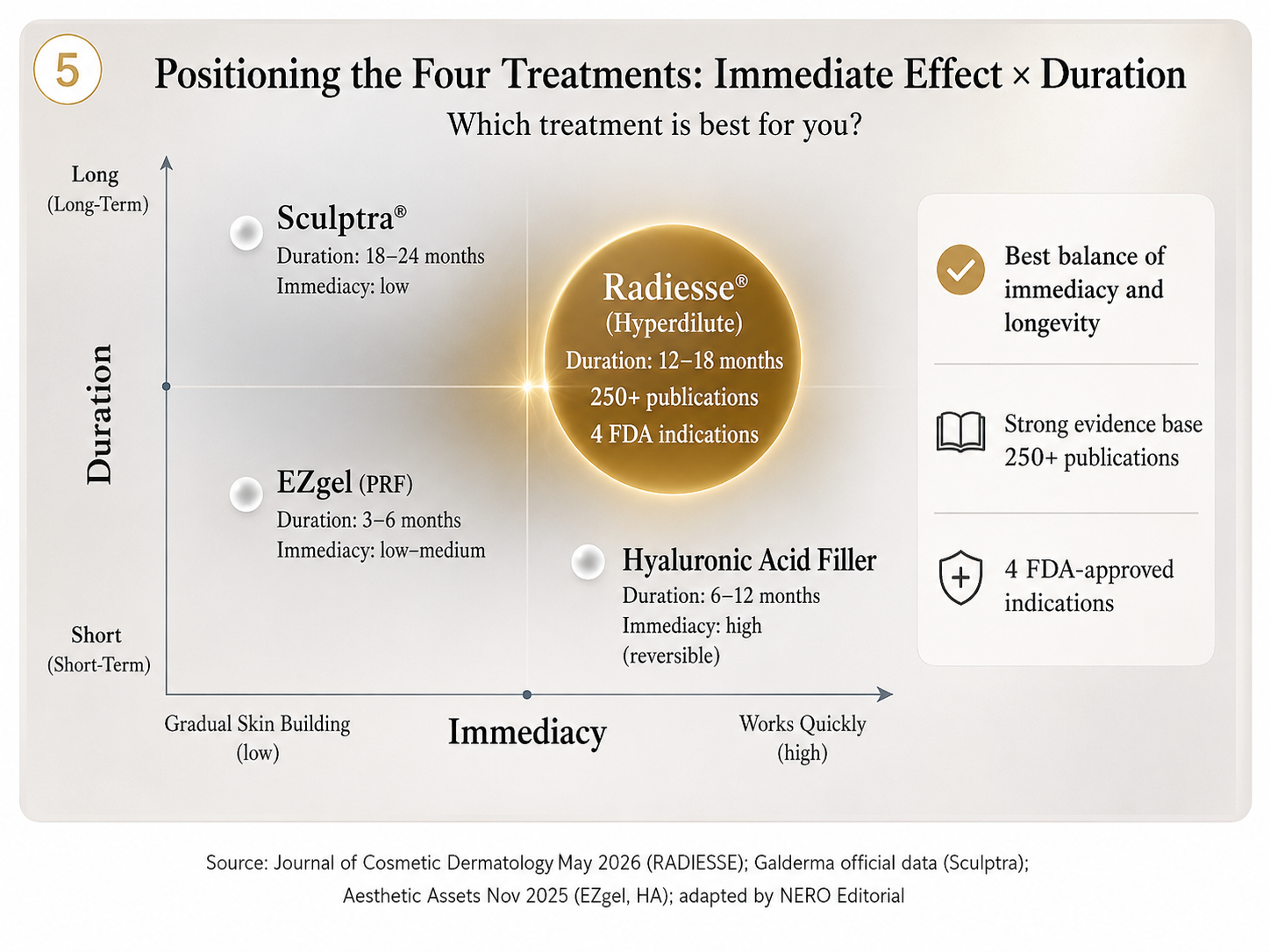
Saying “the era of hyaluronic acid fillers is over” would be an overstatement.
But the fact that a treatment exists which can multiply your own collagen 23-fold
will inevitably change how patients and clinicians evaluate their options.
Summary
- Hyperdilute RADIESSE (CaHA diluted 1:2 to 1:6 with saline) is a biostimulator technique
that targets fibroblast activation — not volume replacement.
The goal is collagen and elastin induction, resulting in improved skin quality and tightening. - A May 2026 placebo-controlled trial (Journal of Cosmetic Dermatology) confirmed:
collagen up to 23×, elastin +96%, decorin +82%, versican +129% vs. placebo.
Solar elastosis improvement was also documented for the first time. - On April 8, 2026, RADIESSE received FDA approval for décolleté wrinkle treatment —
its 4th indication — becoming the only U.S.-approved biostimulator for both face and body.
Patient satisfaction exceeded 80%; physician-assessed improvement reached 90%. - Three primary patient profiles are driving global adoption:
Ozempic Face recovery, neck/décolleté rejuvenation, and preventive maintenance in younger adults.
The “grow, don’t fill” philosophy is reshaping patient expectations across markets.
Frequently Asked Questions
a foreign substance is injected to physically fill space and reshape contours.
Hyperdilute RADIESSE works differently: it stimulates the body’s own fibroblasts
to produce more collagen and elastin, thickening the skin from within.
Results appear gradually over 1–3 months and last 12 months to 3+ years.
It is better suited for patients seeking natural-looking improvement in skin quality,
texture, and laxity — rather than immediate volumization.
Note: HA fillers can be dissolved with hyaluronidase; RADIESSE is bioabsorbable
but cannot be reversed on demand.
Source: Journal of Cosmetic Dermatology, May 27, 2026; Merz Aesthetics FDA Approval, April 8, 2026
neck, décolleté, hands, upper arms, knees, and buttocks.
Global clinical use is expanding particularly for horizontal neck lines,
hand volume loss, and crepey skin on the chest and arms.
Approved indications vary by country and regulatory authority.
Patients should consult a board-certified dermatologist or plastic surgeon
to confirm which applications are approved and available in their region.
including facial fat — resulting in a deflated, aged appearance sometimes called “Ozempic Face.”
Restoring this with HA filler often produces an overfilled, unnatural result
because the underlying skin has thinned.
Hyperdilute RADIESSE addresses the root issue: it increases skin thickness by up to 48%
and stimulates collagen production — rebuilding the skin’s structural foundation
rather than adding external volume.
Merz Aesthetics has highlighted this application in both clinical presentations
and official promotional materials.
Source: Merz Aesthetics official communications; Journal of Cosmetic Dermatology, May 2026
Sources
1. Merz Aesthetics. “New Research Shows RADIESSE® Supports Substantial Regeneration of Collagen and Key Extracellular Matrix Proteins.” BusinessWire. May 27, 2026. Published in: Journal of Cosmetic Dermatology, 2026.
2. Merz Aesthetics. “Merz Aesthetics Receives FDA Approval for RADIESSE® for the Treatment of Wrinkles in the Décolleté Area.” BusinessWire. April 8, 2026.
3. American Med Spa Association. “Merz Aesthetics’ Radiesse Receives FDA Approval for Décolleté Wrinkles.” April 8, 2026.
4. ReachMD. “RADIESSE Study Links Calcium Hydroxylapatite to ECM Regeneration.” May 27, 2026.
5. Cogorno Wasylkowski V. “Starting Point for Protocols on the Use of Hyperdiluted Calcium Hydroxylapatite (Radiesse®) for Optimizing Age-Related Biostimulation.” Clin Cosmet Investig Dermatol. 2023.
6. PMC. “Efficacy and Tolerability of Hyperdiluted Calcium Hydroxylapatite (Radiesse) for Neck Rejuvenation.” Clin Cosmet Investig Dermatol. 2023.
7. Medscape. “FDA Approves Radiesse for Decolletage Despite Advisory Panel’s Concerns.” April 10, 2026.