📌 Key Takeaways
- Ovarian aging involves not only hormone decline
but also physical tissue stiffening driven by fibrosis. - A July 2026 study in Nature Aging identified IL-11
as a central driver of this ovarian fibrosis. - Blocking IL-11 in mice and rats reduced ovarian stiffness
and improved fertility outcomes. - This remains animal- and tissue-level research —
no human treatment exists yet.
For decades, ovarian aging has been framed almost entirely
as a story of declining hormones.
Estrogen drops. Fertility fades. Menopause arrives.
But a study published on July 2, 2026 in Nature Aging
reframes that story at the tissue level —
and the implications reach well beyond reproductive medicine.
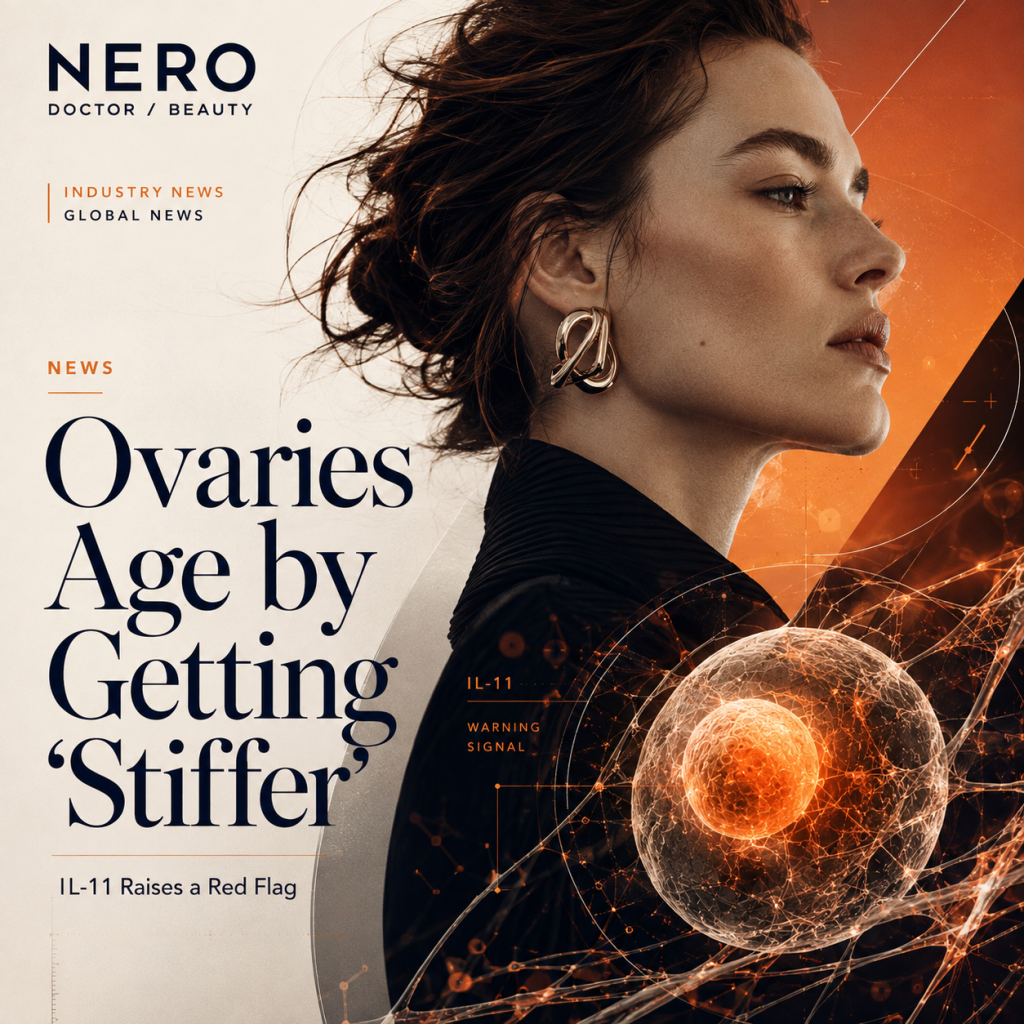
The research identifies IL-11 (Interleukin-11),
a protein involved in inflammation and tissue repair,
as a key driver of ovarian stiffening with age.
The finding connects ovarian aging to a broader biological phenomenon:
the fibrosis that hardens skin, blood vessels, and organs over time.


INDEX
The Ovary Is a Tissue — and Tissues Age
It’s easy to think of the ovaries purely as hormone-producing organs.
But like skin, blood vessels, and cardiac muscle,
the ovary is composed of living tissue —
and living tissue undergoes structural change with age.
The research team found that in aging ovaries,
IL-11 levels rise significantly.
This triggers fibroblasts — the cells responsible
for building the tissue’s structural scaffold —
to overproduce extracellular matrix (ECM) components.
The result: the ovary becomes physically stiffer.
IL-11 (Interleukin-11) is a cytokine — a signaling protein —
involved in inflammation and tissue repair.
When overexpressed, it can trigger fibrosis:
the excessive accumulation of collagen and ECM proteins
that causes tissue to harden and lose elasticity.
→ Aesthetic medicine connection: Fibrosis is the same biological process
behind skin sagging, post-treatment stiffness,
and loss of tissue suppleness — familiar territory in aesthetic medicine.
Critically, this stiffening was not observed in mice alone.
The research team confirmed elevated IL-11 levels
in aging ovarian tissue from mice, rats, and humans.
This cross-species consistency is what makes the finding significant.
What Happened When IL-11 Was Blocked?
The research team tested two approaches to suppress IL-11 activity.
Aging → IL-11 rises → fibroblasts overactivate → ECM accumulates → ovary stiffens → function declines.
The intervention targets the upstream trigger — IL-11 itself.
What This Research Does Not Yet Prove
NERO is deliberate about this distinction:
this study represents animal- and tissue-level findings.
It does not constitute an established human treatment.
at the human clinical level.
If you encounter any service or product claiming to “stop ovarian aging”
based on this research, ask: is the evidence from animal studies,
or from peer-reviewed human clinical trials?
That distinction is the difference between a hypothesis and a treatment.
Why the Femtech Industry Is Paying Attention
and tissue fibrosis driven by inflammation,
menopause, infertility, and women’s longevity
begin to share a common mechanistic framework.
This opens new research and clinical conversations.
Discussing inflammation and lifestyle factors with your physician
may become increasingly relevant.
expands the vocabulary available to femtech, gynecology,
and aesthetic medicine alike.
This research points a direction — not yet a destination.
accurately communicating the gap between
current evidence and future potential.

“Aging by stiffening” may sound surprising at first.
But skin stiffens. Blood vessels stiffen.
The ovary, it turns out, is no exception.
That’s why “inflammation” and “tissue quality”
will become increasingly central to how we talk about women’s health.
Hold the optimism — and the precision. That’s the NERO position.
✨ Summary
- Ovarian aging involves both hormonal decline
and physical tissue fibrosis — with IL-11 identified
as a central driver, confirmed across mice, rats, and human tissue. - Blocking IL-11 in animal models reduced ovarian stiffness
and improved fertility — but this remains preclinical research,
not an established human therapy. - This framework — inflammation and tissue quality as drivers of aging —
may reshape how femtech, reproductive medicine,
and women’s longevity are understood and discussed.
for human use.
Current findings are from animal and tissue-level studies.
Clinical application in humans requires further validation
through human trials.
is associated with reduced ovarian function in animal models.
When stiffness was reduced, fertility outcomes improved in those models.
Whether the same holds true in humans remains under investigation.
This research adds a new lens — tissue fibrosis and inflammation —
to a conversation previously dominated by hormone levels alone.
It’s a meaningful addition to how women’s longevity is understood,
though clinical implications are still being established.
Source: Modulating IL-11-dependent matrix stiffness to delay ovarian aging. Nature Aging (Research Article). Published July 2, 2026. nature.com