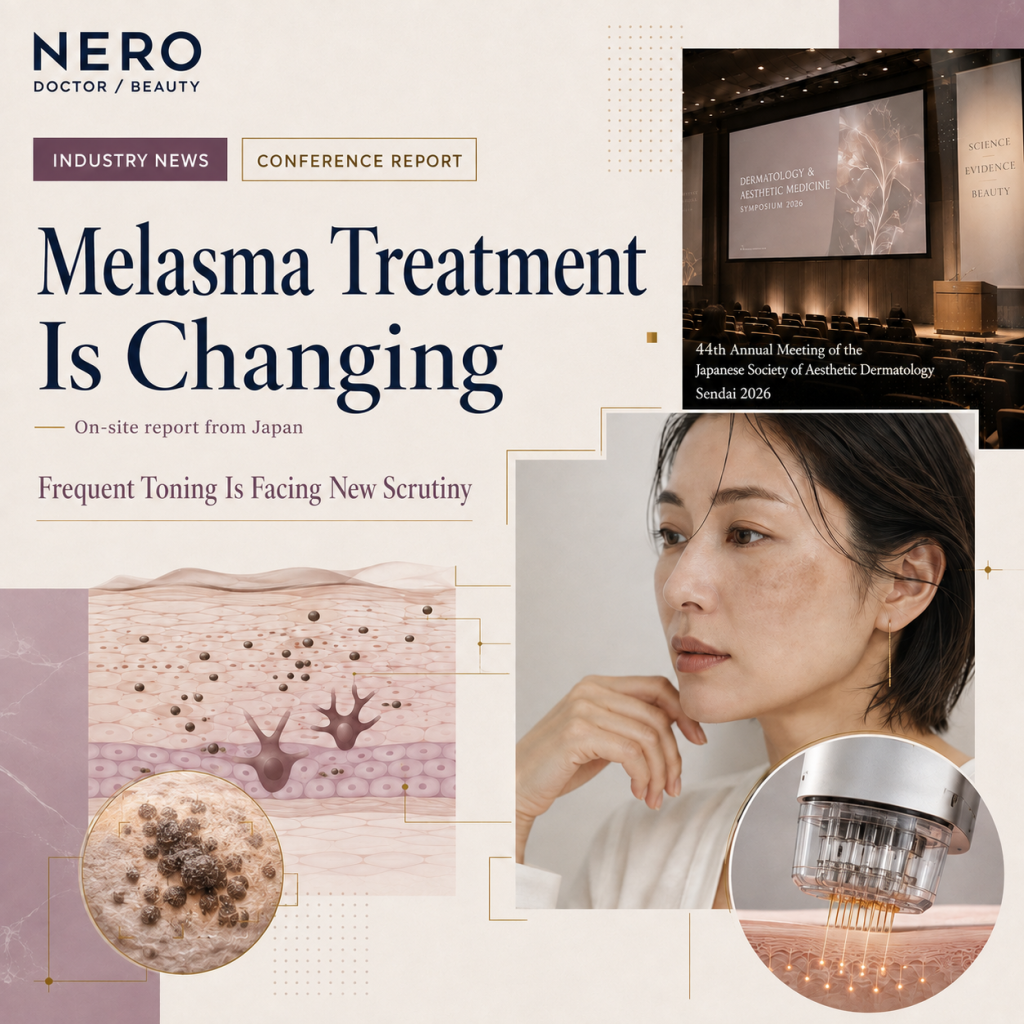
August 1–2, 2026 · Sendai, Japan
📌 Key Takeaways
- Japan’s 44th Aesthetic Dermatology Congress (Sendai, August 2026)
reinforced growing consensus against high-frequency laser toning for melasma. - Melasma is now understood as a multi-factor condition involving
not just melanin, but basement membrane damage, vascular components,
and senescent fibroblasts. - Microneedling RF (radiofrequency) is emerging as a primary-tier option,
capable of addressing multiple pathological layers simultaneously. - Four consultation checkpoints can help patients evaluate
whether a clinic’s treatment plan aligns with current evidence.
On August 1–2, 2026, the 44th Annual Congress of the Japanese Society of Aesthetic Dermatology (JSAD) convened at the Westin Hotel Sendai,
under the theme “Beautiful and Happy for Everyone.”
Across sessions on pigmentation and melasma, one message resonated clearly:
comprehensive treatment over laser-centric approaches.
As NERO’s editor-in-chief attending on the ground,
the overriding impression was that the industry is shifting —
slowly, but unmistakably.
Over the past several years, warnings against repeated low-fluence laser toning
at short intervals have accumulated in both domestic and international literature.
This congress confirmed that the trajectory continues.


INDEX
The Repeated Warning Against High-Frequency Laser Toning —
What the Evidence Now Shows
A consistent message has echoed through Japan’s aesthetic dermatology congresses for several years running.
This year was no exception.
can cause mottled hypopigmentation (patchy depigmentation)
and rebound darkening of melasma.
Without a foundation of sun protection, oral agents, and topicals,
laser-only approaches have clear limitations.
in peer-reviewed literature, including a report published in the Journal of Clinical and Aesthetic Dermatology
(Tian B. JCAD. 2017;10(7):40–42).
Patchy depigmentation caused by excessive damage to melanocytes —
the cells responsible for producing melanin —
from repeated laser exposure.
Once it occurs, recovery is difficult and often prolonged.
A study by Jang et al. (Ann Dermatol. 2015; PMC4466296) found that
in hypopigmented areas following laser toning,
melanin pigment was nearly absent while melanocytes themselves remained present.
The mechanism of recovery was described as “not yet fully understood” by the authors.
What NERO observed on the ground is that this is no longer the position of a cautious minority.
It represents an accumulating international dermatological consensus.
For readers, the key is to receive this not as a new trend,
but as an industry-wide update in clinical understanding.
The True Pathology of Melasma —
It Was Never Just About Melanin
A recurring theme at this year’s congress was the evolving understanding of melasma’s pathology.
Once described simply as “excess melanin production,”
recent research reveals a far more complex picture.
Simply targeting melanin with laser energy addresses only one dimension
of this multi-layered condition.
This is precisely why multi-modal treatment design —
aimed at achieving and sustaining mild, stable improvement —
is being re-emphasized across the field.
Three Directional Shifts Observed on the Ground
Across conversations with multiple clinicians at the congress,
three consistent directional shifts emerged.
followed by intervals of at least once monthly —
with some clinicians adopting a more conservative stance of once every three months.
Japan’s Aesthetic Medicine Clinical Guidelines (revised 2021, Ministry of Health, Labour and Welfare research group;
co-authored with the Japanese Dermatological Association and multiple societies)
classify IPL and laser for melasma as “conditionally weak recommendation.”
The guidelines prioritize rigorous sun protection above all,
with brightening topicals and oral agents as the foundation,
positioning laser and IPL as adjunctive options when conservative measures prove insufficient.
Reference: Aesthetic Medicine Clinical Guidelines (2021 Revised Edition, Minds)
A procedure combining microneedling —
creating micro-channels in the skin with ultra-fine needles —
with RF (radiofrequency) energy delivered directly from needle tips.
This design delivers thermal energy to the dermis
while minimizing surface epidermal damage.
Representative devices include Sylfirm X (VIOL, South Korea; FDA-cleared in the U.S.;
not approved in Japan) and Secret RF.
Both are used in Japan under off-label, self-pay (non-covered) arrangements.
The wound-healing response triggered by micro-needle stimulation,
combined with minimal epidermal thermal damage,
is drawing significant clinical attention.
Microneedling RF is noted for its ability to simultaneously address
basement membrane remodeling, vascular components, and senescent fibroblasts —
making it a strong conceptual fit for melasma’s complex pathology.
The rationale of “reducing senescent fibroblasts” was a recurring topic
across multiple presentations and discussions at the congress.
not just how you deliver it —
determines long-term outcomes.
tretinoin/retinoids, azelaic acid, vitamin C derivatives
(non-negotiable; treatment cannot succeed without this)
How these are tailored to each patient’s melasma subtype,
skin condition, and lifestyle is where meaningful differences between clinics become apparent.
Four Consultation Checkpoints for Patients
These are not universal answers —
they are minimum questions to deepen your dialogue with your treating physician
when evaluating whether to continue or begin a treatment plan.
run counter to the direction established by current academic evidence.
Clinics that define a cumulative energy ceiling in advance offer greater clinical accountability.
oral tranexamic acid, and brightening topicals is part of the plan.
If laser alone is proposed, ask for a clear explanation of that rationale.
Clinics that can explain needle depth, density, session frequency,
and adjunctive medications demonstrate more deliberate treatment design.
Look for clinics that can proactively outline when to stop cumulative treatments,
when to reassess, and what the moisturization, sun protection,
and medication adjustment plan looks like.
The answer reveals a clinic’s preparedness.

Listening to multiple clinicians on the ground,
the takeaway was never that laser is the problem —
it’s that how it’s used, and what it’s combined with, is now under scrutiny.
As long as “unlimited monthly” packages exist in the market,
readers need to know what an appropriate treatment frequency actually looks like.
Publishing this may draw pushback from some practitioners who feel it overstates the case.
But when multiple clinicians at a national congress are pointing in the same direction,
this is no longer a matter of personal preference or passing trend —
it is an industry-wide shift in understanding,
and readers deserve to know.
All final decisions must be made in consultation with your treating physician.
Use this article as a tool to deepen that conversation.
Summary
- Japan’s 44th Aesthetic Dermatology Congress (Sendai, August 2026)
confirmed the ongoing consensus against high-frequency laser toning for melasma.
Evidence from domestic and international literature consistently advises
against treatment intervals shorter than two weeks. - Melasma is a multi-factor condition involving not only melanin overproduction,
but also basement membrane disruption, vascular involvement,
and senescent fibroblast signaling.
Laser alone cannot address this full spectrum. - Microneedling RF is emerging as a primary-tier option,
with the ability to simultaneously target basement membrane remodeling,
vascular components, and senescent fibroblasts —
aligning well with melasma’s complex pathology. - Four consultation checkpoints:
① session interval and cumulative limit,
② oral and topical foundation,
③ availability of microneedling RF,
④ stopping criteria and recovery protocol.
All final decisions must be made in person with your physician.
📌 Optimal melasma treatment varies significantly by skin type, medical history, season, and lifestyle.
This article is intended as one reference point —
use it to inform and deepen your conversation with your treating physician.
The right decision depends on your treatment interval, cumulative session count,
and current skin condition.
Use the four checkpoints in this article to ask your physician directly:
“What is our plan for session intervals and cumulative limits?”
and “What would you do if my skin worsened?”
If your skin is currently showing no adverse signs,
the most practical first step is to evaluate your current status together with your physician.
Outcomes vary depending on device type, practitioner skill, and individual skin condition.
Devices such as Sylfirm X and Secret RF each have different parameter settings.
A useful question to ask during consultation:
“How much experience does your clinic have using microneedling RF specifically for melasma?”
listed in Japan’s Aesthetic Medicine Clinical Guidelines (2021 revised edition)
alongside sun protection and brightening topicals as a conservative treatment pillar.
However, the degree of improvement with oral agents alone varies considerably between individuals.
Rigorous sun protection and combination topical therapy remain essential.
While available over the counter in Japan as a Class 1 OTC drug,
long-term use is best managed under physician supervision.
Sources
- 44th Annual Congress of the Japanese Society of Aesthetic Dermatology (JSAD).
President: Dr. Katsuko Kikuchi. August 1–2, 2026, Sendai.
shun-convention.jp/bihifu44/ - Jang YH et al. “Changes in melanin and melanocytes in mottled hypopigmentation
after low-fluence 1,064-nm Q-switched Nd:YAG laser treatment for melasma.”
Ann Dermatol. 2015;27(3):340–342. PMC4466296 - Tian B. “The Asian Problem of Frequent Laser Toning for Melasma.”
J Clin Aesthet Dermatol. 2017;10(7):40–42. PMID: 29104723.
(Retrospective case series; n=23; single center) - Aesthetic Medicine Clinical Guidelines (2021 Revised Edition).
Japanese Dermatological Association / Minds.
On-site report: NERO Editor-in-Chief Kenichi Adachi, Sendai, August 2026.