📌 Key Takeaways
- Epigenetic clocks estimate biological age
by reading DNA methylation patterns —
not DNA sequence itself. - A June 2026 expert commentary in Nature Aging states clearly:
“The functional significance of the signals
these clocks capture remains unknown.” - “Looking younger” and “functioning younger”
are not the same thing —
and the clocks don’t yet distinguish between them. - Used wisely, these tests can motivate
lifestyle change —
but should never be treated as definitive diagnoses.
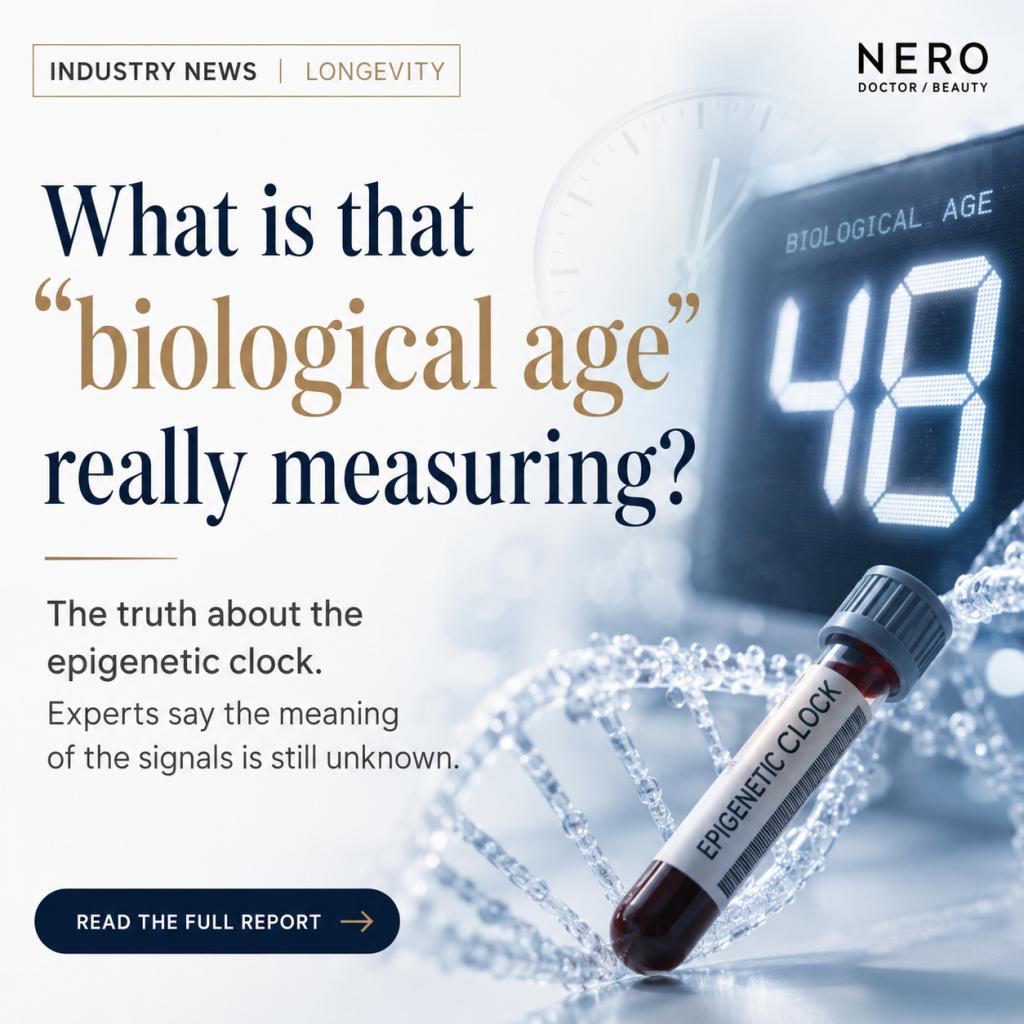
“Your body’s true age is 48.”
You may have seen a result like this —
perhaps at a longevity clinic,
or through a direct-to-consumer wellness test.
Biological age testing is expanding rapidly
in private-pay aesthetic and longevity medicine worldwide.
But what exactly does that number measure?
And how much should you trust it?
In June 2026, Nature Aging published an expert commentary
that offers a rare, measured assessment of the field.
The conclusion is both promising and sobering:
the technology is real,
but its clinical meaning is still being worked out.


INDEX
🧬 What Epigenetic Clocks Actually Measure
An epigenetic clock does not read your DNA sequence.
Instead, it reads how your DNA is used —
specifically, patterns of DNA methylation,
chemical tags that act like on/off switches for genes.
As we age, these patterns shift gradually —
a process called epigenetic drift.
Clocks are trained on large datasets to estimate age
from these drifting patterns.
→ Relevance to aesthetic medicine:
This is the exact technology being commercialized
as “biological age testing” in private-pay clinics globally.
On June 24, 2026, Nature Aging published a Comment —
an expert perspective piece —
framing epigenetic clocks as quantitative readouts
of epigenetic drift across the lifespan.
the commentary’s authors state explicitly:
“The functional significance of the signals
these clocks capture remains unknown.”
In plain terms: the number can be generated —
but what that number means for your body,
your health, or your future
is still an open scientific question.
🪞 “Looking Younger” vs. “Functioning Younger” — Not the Same
The appeal of biological age testing lies in compression:
it reduces the complexity of aging
into a single, legible number.
But that simplicity carries risk.
An epigenetic clock score is a statistical estimate —
not a direct readout of organ function,
physical performance, or appearance.
The three are related, but not interchangeable.
using validated statistical models.
disease risk, or long-term health outcomes.
hydration, stress, and other transient factors.
🧭 Does the Test Still Have Value?
Given these limitations, is biological age testing worth doing at all?
The answer depends entirely on how you use it.
Used as a definitive verdict on your health,
it overreaches what the science currently supports.
Used as a motivational prompt —
a nudge toward better sleep, exercise, and nutrition —
it can be genuinely useful.
Track trends over time —
don’t treat one measurement as a verdict.
If your result is “older than your chronological age,”
don’t panic — treat it as a signal to review your habits.
guaranteeing score improvement.
This is an index whose meaning is not yet settled.
Positioning the test as a “motivation tool for behavior change”
is both honest and clinically defensible.
an expert perspective piece, not a new experimental study.
It synthesizes the current state of the field.
That is precisely why its statement —
“the meaning is not yet established” —
carries significant weight.

The idea of quantifying aging is genuinely exciting.
But “being able to measure something”
and “understanding what that measurement means”
are still two different things.
At NERO, we recommend using these numbers
as a prompt for action — not as a verdict.
Staying calm and informed
is the most underrated beauty habit there is.
✨ Summary
- Epigenetic clocks estimate biological age
from DNA methylation patterns —
but a 2026 Nature Aging commentary states explicitly
that the functional significance of these signals
remains unknown. - Results can fluctuate with testing conditions.
A single measurement should not be treated as a diagnosis.
“Looking younger” and “functioning younger”
are distinct concepts the clocks do not yet separate. - The most defensible use of biological age testing today
is as a motivational tool —
a starting point for improving sleep, exercise, and diet —
not as a definitive measure of health.
💬 Frequently Asked Questions
trained on large datasets.
However, a 2026 expert commentary in Nature Aging notes
that the functional significance of the signals they capture
remains scientifically unresolved.
They are research-grade tools, not clinical diagnostics.
Epigenetic clock results can vary based on testing conditions,
hydration, stress levels, and other transient factors.
A single result above your chronological age
is best treated as a prompt to review lifestyle habits —
not as a cause for alarm.
The value lies in motivation, not diagnosis.
Using the result as a starting point
to improve sleep, exercise, and nutrition
is a legitimate and evidence-consistent application.
Treating it as a definitive health verdict is not.
Sources:
1. “Epigenetic clocks as quantitative readouts of epigenetic drift.” Nature Aging (Comment). Published June 24, 2026. nature.com