📌 Key Takeaways
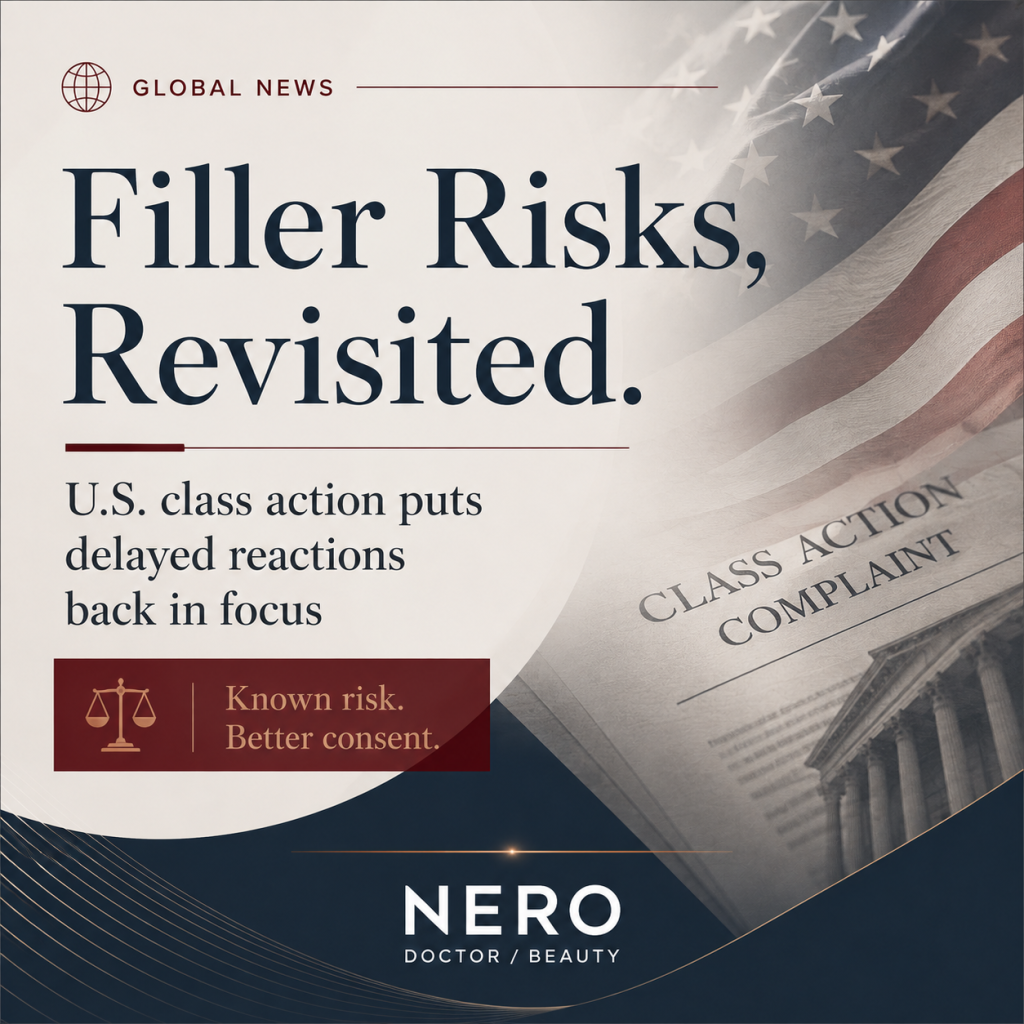
- On June 27, 2026, a putative class action (García v. AbbVie, Inc.) was filed in the U.S. District Court for the Northern District of Illinois,
targeting Juvederm Ultra and Ultra Plus products. - The lawsuit does not dispute that delayed-onset granulomas exist —
it challenges whether patients received adequate warning of this known risk. - The FDA officially stated in 2025 that dermal fillers can cause granulomas and nodules
“weeks to years after injection.” - A review of 28 studies covering 13,136 cases found a mean delayed-reaction rate of 1.13% (occurring 30+ days post-injection).
The critical issue is not the percentage — it is the time gap.
“It’s FDA-approved, so it’s safe.”
“Any swelling will resolve within a few days.”
These are among the most common reassurances patients hear before a filler procedure.
But in June 2026, a lawsuit filed in the United States reframed the entire conversation.
The question was not whether a side effect had occurred.
It was whether patients had ever truly been told it could.


INDEX
- What Happened in the U.S. — The Facts and Legal Claims
- Delayed-Onset Nodules Are Not a New Discovery — The FDA Already Said So
- How Often Does It Happen? What 28 Studies and 13,136 Cases Show
- Why It Happens — A Multifactorial Problem, Not a Single Product Defect
- This Is Not Only a U.S. Story — Japan’s PMDA Package Insert Already Lists Granuloma
- Summary
- Frequently Asked Questions
What Happened in the U.S. — The Facts and Legal Claims
According to the plaintiff’s filing, Christina García received multiple Juvederm injections in 2023.
By June 2026, she alleges she developed severe delayed-onset granulomas
requiring hospitalization and multiple medical interventions.
(These are the plaintiff’s allegations; no court findings have been made.)
It asks whether that known risk was communicated to consumers in a way that could meaningfully inform their decision.
In legal terms, “product defect” and “adequacy of warning” are distinct questions.
Understanding that distinction is essential to reading this case correctly.
Delayed-Onset Nodules Are Not a New Discovery — The FDA Already Said So
This is the core of the story.
Delayed-onset nodules and granulomas were not uncovered by this lawsuit.
They have been documented and acknowledged by regulators for years.
which can occur weeks to years after injection.“
“Weeks to years after injection” — this is the language of a regulatory authority,
not a fringe warning buried in academic literature.
Delayed-onset nodules and granulomas are not a rare anomaly.
They represent a recognized, category-wide risk across HA fillers — acknowledged at the highest regulatory level.
DON (Delayed-Onset Nodule): A firm nodule appearing two or more weeks after injection.
Can be infectious or non-infectious — and treatment differs significantly depending on the cause.
Granuloma: A chronic inflammatory lesion formed when immune cells encapsulate a foreign body.
Can appear months to years post-injection.
Entirely distinct from the immediate post-procedure swelling (edema) patients are typically warned about.
How Often Does It Happen? What 28 Studies and 13,136 Cases Show
across 28 studies covering 13,136 cases
but the authors themselves caution against direct comparisons across formulations —
definitions of “delayed,” injection sites, and denominators vary significantly between studies.
Whether 1.13% reads as “rare” or “significant” depends on individual perspective.
But at NERO, the more important dimension is not the percentage — it is the time axis.
But delayed reactions can begin after that chapter is considered closed.
Some appear at 30 days. Others at several months. Some cases are reported a year or more later.
This time gap is precisely what creates a disconnect between patient perception and actual risk.
Why It Happens — A Multifactorial Problem, Not a Single Product Defect
Current clinical consensus does not frame delayed nodules and granulomas
as a failure of one particular product.
They are understood as a phenomenon driven by multiple intersecting factors.
are all thought to influence inflammatory response.
is implicated in many delayed reactions.
Dental procedures, periodontal disease, viral infections, and vaccinations
have all been reported as potential triggers.
can all serve as triggers.
The same product does not cause reactions in all patients —
individual immune status plays a significant role.
A 2024 international consensus review noted that the peak onset of delayed nodules
is typically 3–4 months post-injection —
but explicitly stated that onset can occur even later.
This is why no one can say “delayed nodules are only a problem with one specific filler.”
A dental visit after filler treatment. A bout of influenza. A period of immune suppression.
Any of these everyday events could, months or years later, become a contributing factor.
This is not a rare exception — it is a structural challenge shared across the HA filler category.
This Is Not Only a U.S. Story — Japan’s PMDA Package Insert Already Lists Granuloma
For readers outside the United States, the regulatory picture is equally clear.
the following are explicitly listed:
· Small nodules
· Beaded micro-elevations
· Granuloma
In other words, even within Japan’s regulatory framework,
“granuloma” appears as a documented adverse event in the approved product labeling.
“It’s approved, so it’s safe” and “it’s in the package insert, so we’re covered”
are two very different statements from
“the patient understood the risk in a way that informed their decision.”
That distinction — between disclosure and comprehension — is what this lawsuit is testing.
And it is a question that applies far beyond the United States.

Many patients are told before a filler procedure: “Any swelling will resolve within a few days.”
That statement is not false.
But “swelling that resolves in days” and “a nodule that may appear months later”
are entirely different phenomena.
The word “swelling” can quietly refer to two very different timelines of risk.
What this lawsuit is asking is not whether AbbVie is a bad company.
It is asking whether — even with an approved product, a known risk, and a package insert —
patients received that information in a form they could genuinely act on.
That is exactly what NERO believes every patient deserves.
Summary
- On June 27, 2026, García v. AbbVie, Inc. (putative class action) was filed in the U.S.,
targeting Juvederm Ultra products.
The central question: whether delayed-onset granuloma risk was adequately disclosed.
AbbVie’s liability has not been established — this is a filing-stage case. - Delayed-onset nodules and granulomas are not newly discovered side effects.
The FDA’s 2025 official materials explicitly state they can occur
“weeks to years after injection” — a recognized, category-wide risk across HA fillers. - A review of 28 studies (13,136 cases) found a mean delayed-reaction rate of 1.13% at 30+ days.
Direct comparisons between formulations require caution due to methodological variation.
The more important lens is not the rate — it is the time gap. - Japan’s PMDA-approved package insert for Juvederm Vista Ultra XC
already lists “granuloma” as an adverse event.
The question is no longer whether the risk exists in the label —
it is whether patients received it in a form that could inform their choice.
can you explain any reactions that may appear weeks or months later?
when should I contact the clinic?
Frequently Asked Questions
Delayed nodules can be infectious or non-infectious, and treatment differs accordingly.
Infectious cases may require antibiotics; non-infectious cases may be managed with
immunomodulatory agents (such as corticosteroids) or hyaluronidase,
an enzyme that dissolves hyaluronic acid.
Self-treatment with heat, massage, or pressure is not recommended
and may worsen the condition. Always consult a qualified provider.
The delayed-reaction rate of 1.13% (30+ days, per the 2022 review) means
the majority of patients do not experience this complication.
However, understanding this risk before treatment — rather than assuming it cannot happen —
changes how you monitor yourself afterward.
Ask your provider specifically about delayed-onset risks during your consultation.
so a U.S.-style class action is not a universal template.
However, the underlying question — whether patients receive risk information
in a form that genuinely informs their decision — is universal.
Regulatory bodies in Japan, the EU, and elsewhere continue to monitor
and issue guidance on aesthetic medicine adverse events.
The adequacy of informed consent in filler consultations
is a conversation that extends well beyond U.S. courtrooms.
Sources:
1. PBL Magazine. “Juvederm Lawsuit Claims AbbVie Failed to Disclose Granuloma Risk.” 2026. pblmagazine.co.uk
2. ClassAction.org. “Juvederm Lawsuit Claims AbbVie Failed to Disclose Granuloma Risk Associated with Injections.” classaction.org
3. García v. AbbVie, Inc. Case No. ilndce-26-07542. U.S. District Court, N.D. Illinois. Filed June 27, 2026. PacerMonitor
4. FDA. General and Plastic Surgery Devices Panel Meeting Materials. 2025. fda.gov
5. Scheuer JF 3rd, et al. “Review of Delayed Reactions to 15 Hyaluronic Acid Fillers.” Dermatol Surg. 2022;48(7):780-786. PMID: 35609207. PubMed
6. Haq S, et al. “Late Adverse Events Associated With Hyaluronic Acid Fillers: Review of the United States FDA MAUDE Database.” Aesthet Surg J. 2023;43(6):NP438-NP444. Oxford Academic
7. PMC11265052. Consensus review on delayed-onset nodules and granulomas. 2024. PMC
8. JCAD. “Delayed-Onset Nodules: Practical Management Strategies.” jcadonline.com
9. PMDA. Juvederm Vista Ultra XC Package Insert. Approval No. 22700BZX00139000. pmda.go.jp