📌 Key Takeaways
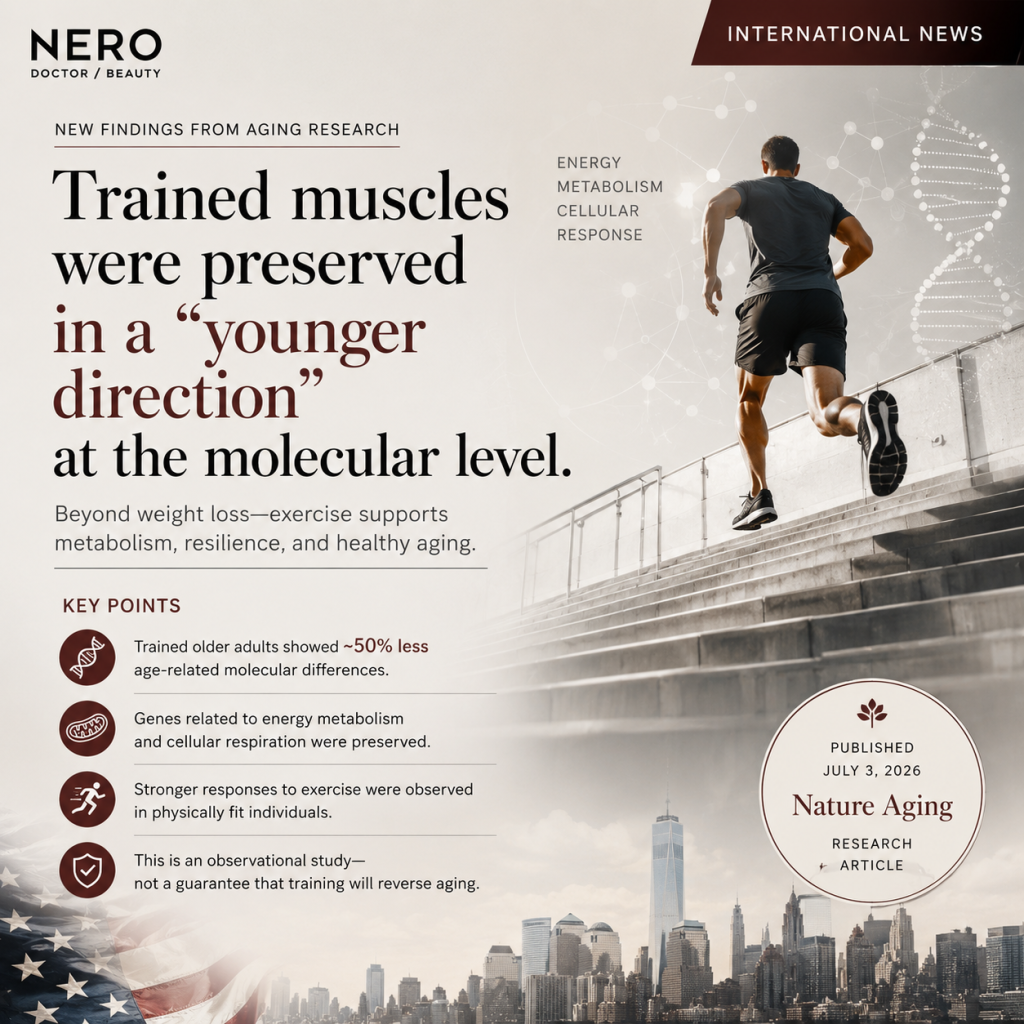
- Trained older adults showed ~50% fewer age-related molecular differences in skeletal muscle
compared to untrained peers, per a July 2026 Nature Aging study. - Genes governing energy metabolism and cellular respiration were better preserved
in those with consistent exercise habits. - Higher fitness levels correlated with stronger post-exercise immune and stress responses,
suggesting a more resilient physiological baseline. - This is an observational analysis — it does not guarantee that exercise reverses aging,
but it reframes why we exercise in the first place.
When most people think about exercise, weight loss comes to mind first.
But a landmark study published in Nature Aging on July 3, 2026 suggests
the value of physical training runs far deeper — down to the molecular architecture of muscle itself.
The research, led by Janssens GE and colleagues, examined skeletal muscle tissue
in older adults with and without long-term exercise habits.
The findings: trained individuals showed approximately 50% fewer age-related molecular differences,
with molecular patterns that more closely resembled those of younger adults.


INDEX
💪 What “Molecularly Younger” Muscle Actually Means
The phrase “molecular age” used in this article is an editorial shorthand,
not a formal term from the paper itself.
The study examines age-related molecular changes — shifts in gene expression patterns
and multi-omic markers that accumulate with aging.
Think of it as a biological readout of how “old” a cell behaves, regardless of chronological age.
The study’s core finding is not about appearance.
It’s about what’s happening inside the muscle at a molecular level.
In untrained older adults, the molecular signature of aging was clearly present —
changes in gene expression, metabolic pathway activity, and cellular stress markers.
In trained older adults, those same markers were significantly attenuated,
with patterns trending closer to those seen in younger cohorts.
Trained older adults retained molecular profiles that untrained peers had lost.
The difference in age-related molecular markers was roughly half that of the untrained group.
Exercise habit was associated with a pattern of reduced molecular aging in muscle tissue.
🔋 Energy Metabolism and Exercise Response: What the Data Showed
was measurably reduced.
In trained individuals, these same pathways remained active and intact.
including immune activation and stress pathway signaling —
suggesting the body’s adaptive machinery remains more responsive with training.
stress response, and NAD+ biology (a coenzyme central to cellular energy production).
These pathways appeared more coherently linked in trained individuals.
🏃 Reframing Exercise: Not Just for Weight Loss
What follows is NERO’s editorial interpretation of the research findings.
The study itself examined molecular characteristics of muscle, metabolic gene expression,
and acute exercise response — not aesthetic outcomes or clinical recovery.
Any connection to aesthetic medicine is our framing, not the paper’s conclusion.
represents a stronger physiological baseline — relevant not just for longevity,
but for how the body responds to any intervention, medical or otherwise.
but by recovery speed, sustained energy, and reduced fatigue.
“Exercise is associated with 50% fewer age-related molecular changes in muscle”
is a different kind of statement — one grounded in data,
and more likely to shift behavior.
carries more weight than generic wellness advice.
less fatigue, faster recovery, easier movement, and sustained activity levels.
These are general health-context interpretations —
not direct measurements from this specific study.
It does not prove that exercise reverses aging, nor does it guarantee any specific outcome.
Treat it as evidence of a direction — not a prescription.
Sustainable, consistent movement matters more than intensity or perfection.

When exercise is framed as “burning calories,” it’s easy to quit.
But when you understand that your muscle’s molecular profile may be trending younger with every session —
the motivation shifts from the scale to the body itself.
Aesthetic medicine works best in a body that’s ready for it —
though I want to be clear: that’s our editorial lens, not this paper’s conclusion.
What the science does say is worth taking seriously on its own terms.
✨ Summary
- Trained older adults showed ~50% fewer age-related molecular differences in skeletal muscle
compared to untrained peers — with patterns trending closer to younger adults. - Genes governing energy metabolism and cellular respiration were better preserved,
and multi-omic analysis revealed interconnected metabolic pathways
including mitochondrial function, lipid metabolism, and NAD+ biology. - Exercise is not just a weight-loss tool — it may be a molecular anti-aging strategy.
That said, this is observational research: it shows association, not guaranteed reversal.
Any aesthetic medicine connection is editorial interpretation, not the study’s claim.
💬 Frequently Asked Questions
As a general principle, a sustainable combination of aerobic exercise and resistance training
is broadly supported by the literature for older adults.
Consistency matters more than any single “optimal” protocol.
and found their muscle molecular profiles were meaningfully different from untrained peers.
Individual variation exists, and anyone beginning a new exercise regimen
should do so gradually and in consultation with a healthcare provider.
The connection between metabolic fitness and procedural recovery
is an editorial interpretation by NERO — not a finding of this research.
That said, a body with preserved metabolic function and recovery capacity
is generally considered a stronger physiological baseline for any intervention.
Source: Janssens GE, et al. “Delayed molecular aging, preservation of energy metabolism and enhanced exercise response in exercise-trained human muscle.” Nature Aging. Published July 3, 2026. doi:10.1038/s43587-026-01150-x. nature.com