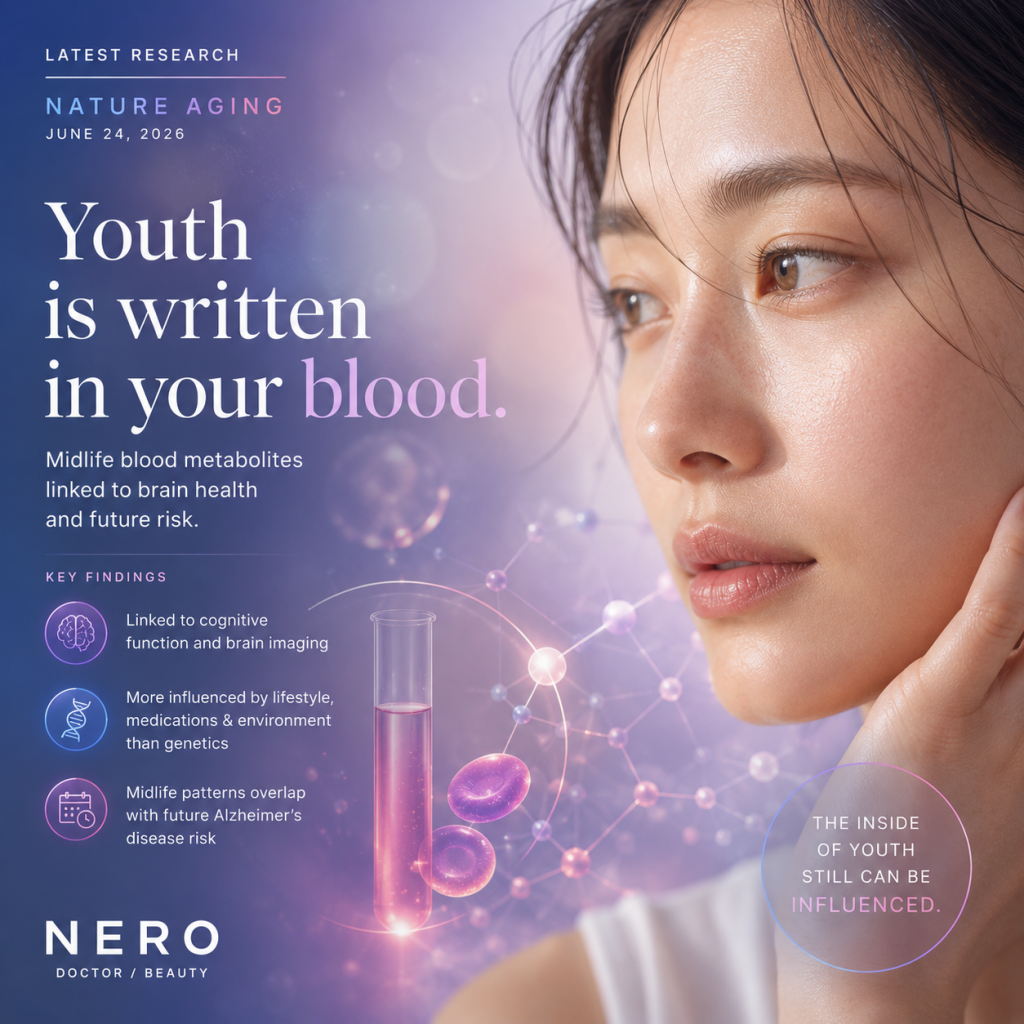
📌 Key Takeaways
- A June 2026 Nature Aging study analyzed 991 blood metabolites in ~1,000 midlife adults,
identifying 14 linked to cognition and 22 linked to brain imaging markers. - Lifestyle, medications, and environmental factors explained up to 28.6% of metabolite variation—
outweighing genetic influence alone. - Midlife metabolite patterns overlapped with those later seen in Alzheimer’s disease patients,
suggesting early blood signals may reflect future risk. - This is an observational study—not an intervention trial.
No supplement or dietary change has been proven to reverse these patterns.
Youth is not only written on the skin.
According to a landmark study published in Nature Aging on June 24, 2026,
it may also be encoded in the blood—specifically, in the chemical fingerprints known as metabolites.
The research examined how blood metabolite profiles in midlife correlate with brain health,
cognitive function, and the long-term risk of Alzheimer’s disease.
Crucially, it found that a significant portion of these metabolite patterns
is shaped not by genetics, but by daily choices—diet, medications, and environment.
Lifestyle, medications, and environment—not just genes—drive a meaningful share of these patterns.
This means “inner youth” may be partially modifiable through daily decisions.
However, this remains a correlational finding; no intervention has been tested.
- ✦Published in Nature Aging, June 24, 2026 — peer-reviewed observational analysis
- ✦Population: ~1,000 midlife adults; 991 blood metabolites analyzed
- ✦Not an intervention trial — findings reflect association, not causation
- ✦Exact figures are based on the published abstract; full data requires review of original figures


INDEX
🩸 What the Blood Reveals: Metabolites as a Mirror of Brain Health
Metabolites are small molecules produced as the body processes food, energy, and cellular activity.
The comprehensive study of these molecules is called metabolomics—
essentially a chemical fingerprint of your body’s internal state.
→ In the context of aesthetic medicine: metabolomics offers a data-driven window
into the biological environment underlying visible aging.
The study, authored by Ahmad S, Wu T, Arnold M, and colleagues,
screened 991 blood metabolites across approximately 1,000 midlife participants.
From this analysis, 14 metabolites were associated with cognitive function
and 22 were associated with brain imaging markers—
providing a detailed map of how blood chemistry relates to brain structure and performance.
lifestyle habits, medications, and clinical conditions accounted for up to 28.6% of variation—
a larger share than genetics alone.
This suggests that “inner youth” is not entirely predetermined at birth.
Daily choices may meaningfully influence the biological markers of aging.
🧠 Midlife Signals, Future Risk: The Alzheimer’s Connection
emerged as one of the metabolites most strongly associated with cognitive function.
The study reported that use of antacid medications was linked to reduced ergothioneine levels,
and that this reduction explained approximately 31.5% of the negative cognitive association
attributed to antacid use.
Important caveat: This is a correlation, not a causal proof.
Eating more mushrooms or taking ergothioneine supplements
has not been shown to reverse cognitive decline in this study.
overlapped with patterns observed in individuals who later developed Alzheimer’s disease.
This suggests that blood-based biomarkers detectable in midlife
may serve as early indicators of long-term neurological risk—
a finding with significant implications for preventive medicine.
Whether the same patterns apply to older populations remains an open question.
The findings represent basic science—they do not directly validate
any specific diet, supplement, or medication change.
🌿 Inner Youth: A New Dimension of Well-Aging
The following reflects NERO’s editorial interpretation within the context of aesthetic medicine and well-aging.
It is not a direct conclusion of the original paper.
But metabolism, inflammation, and brain health form the invisible architecture beneath.
Integrating both dimensions creates a more complete framework for well-aging.
as part of your anti-aging strategy—not just topical or procedural care.
the 40s represent a critical window for preventive intervention.
This creates a natural bridge between aesthetic medicine and preventive health.
to include metabolic and cognitive health narratives
can deepen patient engagement and clinical relevance.
No conclusion can be drawn that consuming a specific substance will rejuvenate the brain,
or that stopping a medication will reduce risk.
Any changes to medication should be discussed with a qualified physician.

“Youth is written in the blood”—it sounds poetic, but the science is real.
Aging happens not just on the surface, but in metabolism and brain chemistry too.
A well-aging strategy needs to address both dimensions.
That said, this remains a correlational finding—not an intervention trial.
Rather than chasing specific compounds or altering medications on your own,
focus on the modifiable factors: lifestyle habits you can act on today.
That’s the approach NERO recommends.
✨ Summary
- A Nature Aging study (June 2026) found that midlife blood metabolites
are associated with cognitive function, brain imaging markers,
and future Alzheimer’s disease risk. - Lifestyle, medications, and environment explained up to 28.6% of metabolite variation—
more than genetics alone—suggesting meaningful room for modifiable intervention. - Ergothioneine (found in mushrooms) was among the top cognition-linked metabolites;
antacid use was associated with reduced levels,
mediating ~31.5% of its cognitive association. - This is observational science. No dietary supplement or medication change
should be made based on this study alone.
Consult a physician before altering any treatment.
💬 Frequently Asked Questions
The research identified an association between ergothioneine levels and cognitive function—
it did not test whether supplementation improves outcomes.
No causal claim can be made from observational data alone.
The finding reflects a statistical association, not a proven harm.
Antacids serve important clinical purposes.
If you have concerns, discuss them with your prescribing physician.
established general health guidance supports a balanced diet,
regular physical activity, quality sleep, and stress management
as foundational elements of cognitive well-aging.
The 40s appear to be a meaningful window for building these habits.
Sources:
Ahmad S, Wu T, Arnold M, et al. “The blood metabolome of brain health in midlife and influences of genes, microbiome and exposome.” Nature Aging. 2026;6(7):1452–1467. PMID 42342913. doi:10.1038/s43587-026-01149-4.
nature.com / PubMed
Note: Figures (991 metabolites, 14/22 associations, 28.6%, 31.5%) are based on the published abstract. Definitive values should be verified against original figures in the full paper.