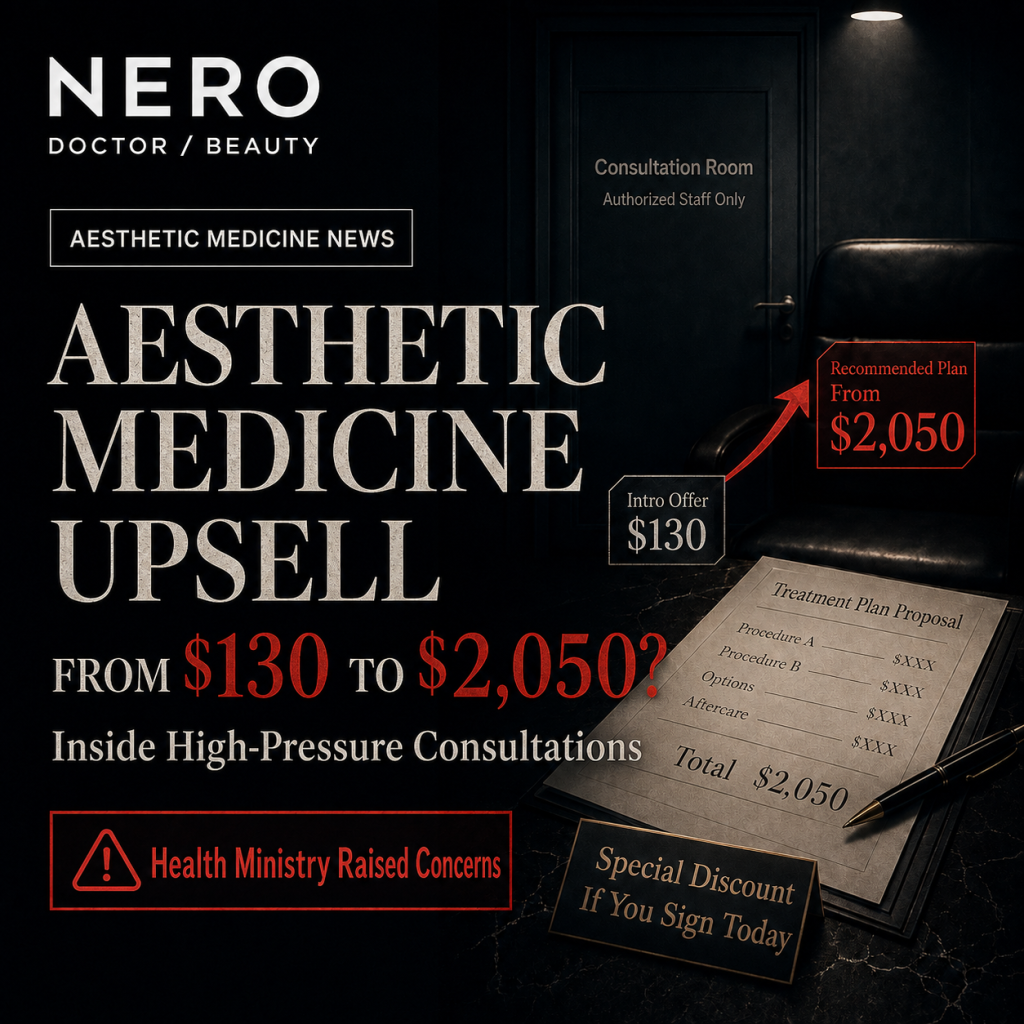
📌 Key Takeaways
- A Japanese broadcaster reported cases where treatment costs escalated from ¥19,000 to ¥300,000
through high-pressure counseling sessions led by non-physicians. - Japan’s Ministry of Health, Labour and Welfare (MHLW) issued a formal notice in 2024
flagging clinics where counselors — not doctors — determine treatment plans. - Three structural factors drive the problem: opaque pricing in private-pay medicine,
closed-room counseling environments, and revenue-first incentives. - Consumers have legal protections including cooling-off rights within 8 days
and a free national hotline (dial 188) for contract disputes.
“I booked a budget treatment, but the counselor pushed me toward a ¥300,000 contract.”
“I tried to leave, but the atmosphere made it impossible.”
“The person who decided my treatment wasn’t even a doctor.”
On August 20, 2026, Japanese broadcaster ABEMA Prime aired an investigative report
on aggressive upselling practices inside cosmetic surgery clinics.
The segment documented treatment costs inflating from ¥19,000 to ¥300,000,
high-pressure same-day contract tactics,
and counseling sessions conducted by non-licensed personnel.
This is not an isolated phenomenon.
Japan’s MHLW formally acknowledged the problem in a 2024 regulatory notice,
and the National Consumer Affairs Center of Japan (NCAC) has issued repeated warnings.
This article breaks down the structural causes, the legal framework,
and what patients can do before — and after — signing a contract.


INDEX
- What Is Upselling in Aesthetic Medicine — and When Does It Cross the Line?
- Three Structural Reasons This Keeps Happening
- The Regulatory Dimension: What Japan’s MHLW Said in 2024
- How to Refuse, Leave, and Cancel After Signing
- Five Things to Know Before Your Counseling Appointment
- Frequently Asked Questions
What Is Upselling in Aesthetic Medicine —
and When Does It Cross the Line?
Upselling — guiding a customer toward a higher-value option — is standard practice
across retail, hospitality, and healthcare.
In itself, it is not illegal.
The critical question is: who does it, how, and under what conditions?
explains a higher-tier plan with clear medical rationale,
and allows the patient to decide freely —
with the option to decline or leave at any time.
· Artificial scarcity: “Today-only pricing” to force an immediate decision
· Creating an environment where leaving or declining feels impossible
· Non-physician counselors making the final call on treatment type and pricing
· Using “monitor” discount schemes to funnel patients into high-cost contracts
Three Structural Reasons This Keeps Happening
The same procedure can cost several times more at one clinic than another.
Patients have no reliable benchmark to assess whether a quoted price is reasonable.
The social dynamics of this setting make refusal psychologically difficult.
In some cases, the “can’t leave” atmosphere is deliberately engineered.
and monitor-discount schemes used to inflate contract values.
When staff compensation is tied to sales, patient-first decision-making is structurally undermined.
The Regulatory Dimension:
What Japan’s MHLW Said in 2024
The ABEMA report highlighted counseling conducted by non-physicians —
a practice that Japan’s Ministry of Health, Labour and Welfare formally addressed
in a 2024 regulatory notice.
were carried out by physicians without independent medical judgment.
The notice called for corrective action in cosmetic medicine’s clinical governance structure.
Under Japan’s Medical Practitioners Act (Article 17),
only licensed physicians may practice medicine.
When a non-physician counselor makes the final determination on treatment type and pricing,
this may constitute a violation of that statute.
⚖️ Your Legal Right as a Patient
Asking “Did a licensed physician personally evaluate and decide this treatment plan?”
is a legally grounded question every patient is entitled to ask.
A clinic that cannot answer clearly is a clinic worth reconsidering.
The MHLW’s 2024 notice was the first formal regulatory clarification on this issue.
The core problem: enforcement jurisdiction was ambiguous.
It was unclear which authority was responsible for investigating
whether a counselor’s role crossed into unlicensed medical practice.
Cosmetic medicine in Japan operates largely on self-reporting,
and administrative inspections of private clinics are rare.
These regulatory gaps created fertile ground for aggressive sales practices.
The 2024 notice is a first step —
but effective oversight infrastructure is still being built.
— “You need to do this now or it’ll be too late”
② Being funneled into high-cost contracts through “monitor” discount framing
③ Proceeding with treatment without adequate understanding of risks or side effects
④ Being encouraged to take out credit financing or misrepresent financial information
The single most important self-protective question:
“Did a licensed physician personally examine me and explain this treatment plan?”
If the answer is no — or unclear — that is a red flag.
How to Refuse, Leave, and Cancel After Signing
“I’m here to gather information only. I will not be making any decisions today.”
The NCAC explicitly advises: do not sign a contract or undergo treatment during the same visit.
You have the right to leave at any time.
If a clinic physically or psychologically prevents you from leaving,
that behavior itself is a serious problem — and a reason never to return.
by dialing 188 (free consultation, nationwide).
Depending on the contract type, a cooling-off period or mid-term cancellation may apply.
The same applies if you signed a medical financing agreement.
body contouring, and skin treatments — qualify for a no-questions-asked 8-day cooling-off period
from the date the written contract is received, if both conditions are met:
· Service period exceeds one month
· Contract value exceeds ¥50,000
Note: Procedures classified as “medical acts” may fall outside this law’s scope.
When in doubt, call 188 before taking any action.

“Big chain clinic” does not mean “safe.”
In fact, larger organizations often have stronger structural incentives to prioritize revenue —
making systematic upselling more likely, not less.
A clinic’s TV advertising budget or brand recognition
tells you nothing about the ethical standards of its counseling room.
To those working inside the industry:
The MHLW did not issue a 2024 regulatory notice because this was a fringe problem.
It issued one because the problem had become systemic.
Clinics that invest in genuine informed consent processes,
clear physician-counselor role separation,
and transparent pricing structures
will be the ones that survive the next wave of regulatory tightening.
The rest will not.
Five Things to Know Before Your Counseling Appointment
There is no obligation to commit on the day of consultation.
“I’d like to take this home and think about it” is a consumer right, not an inconvenience.
When you hear these phrases, do not sign — leave instead.
⚠️ Critical: “Get treated today at a discount” is especially dangerous.
Once a procedure is performed, cooling-off rights may no longer apply.
Never undergo treatment on your first visit.
“I’d like to hear this from the doctor directly” is a reasonable request.
A clinic that refuses this request is a clinic worth walking away from.
Verbal-only explanations create “he said / she said” disputes.
Requesting written documentation is your right.
The National Consumer Affairs Center handles contract disputes,
cancellation questions, and medical financing issues.
The consultation is free.
- ABEMA Prime (August 20, 2026) documented cases of treatment costs rising from ¥19,000 to ¥300,000
through high-pressure counseling — and counseling conducted by non-physicians.
Japan’s NCAC has recorded similar patterns continuously; this is not an isolated issue. - Three structural factors drive the problem: opaque private-pay pricing,
closed-room counseling dynamics, and revenue-first incentives.
This is a systemic design flaw, not a matter of a few bad actors. - Japan’s MHLW 2024 regulatory notice explicitly identified cases where
counselors — not physicians — determined treatment plans as a legal concern
under the Medical Practitioners Act (Article 17). - “Today only” and “decide now or miss out” are upselling signals.
The strongest defense is not signing on the day of consultation.
After signing, dial 188 to explore cooling-off, cancellation, and refund options.
Frequently Asked Questions
“I’d like to take time to consider this” is a legitimate consumer right.
Japan’s NCAC explicitly advises against signing contracts or undergoing treatment during the same visit.
A simple test: ask whether the same price will be available next week.
A clinic’s answer to that question reveals a great deal about its integrity.
Contracts for specified continuous services (laser hair removal, body contouring, skin treatments)
that exceed one month in duration and ¥50,000 in value
qualify for an unconditional 8-day cooling-off period under Japan’s Specified Commercial Transactions Act.
Note: procedures classified as “medical acts” may fall outside this scope.
If coercion or misrepresentation was involved, cancellation may also be possible
under Japan’s Consumer Contract Act.
Medical financing agreements can also be addressed through the same hotline.
Early contact is critical — call 188 as your first step.
Japan’s NCAC has documented cases where extended sessions under psychological pressure
led to unplanned high-value contracts.
Approach any consultation — free or paid — with a firm prior decision:
“I am here to gather information only.”
Comparing consultations across multiple clinics before deciding
significantly improves your ability to make an objective judgment.
Sources:
1. ABEMA TIMES. “Cosmetic Surgery Upselling: From ¥19,000 to ¥300,000 — High-Pressure Counseling and Alleged Unlicensed Medical Advice.” ABEMA Prime. August 20, 2026. times.abema.tv
2. National Consumer Affairs Center of Japan (NCAC). “Rising Disputes in Cosmetic Medical Services.” August 30, 2023. kokusen.go.jp
3. Ministry of Health, Labour and Welfare (MHLW). “Survey on Clinical Governance in Cosmetic Medicine and Regulatory Interpretation under the Medical Care Act.” 2024. mhlw.go.jp
4. Japan Consumer Hotline: 188 (nationwide, free consultation; call charges may apply)