📌 Key Takeaways
- East Asian and Western faces differ in bone projection, melanin density, and aging patterns—
these are medical variables, not just aesthetic preferences. - Post-inflammatory hyperpigmentation (PIH) is a major complication risk for East Asian skin (Fitzpatrick III–IV),
requiring optimized laser and energy device settings. - IMCAS China 2026 highlighted a global shift from single-modality treatments
to AI-guided combination therapy tailored to East Asian morphology. - Before pursuing any trending Western procedure, patients should verify
whether the treatment is anatomically appropriate for their specific face.
“Western clinics are removing cheek volume. Japanese clinics are adding it.
Isn’t that just a matter of taste?”
Not exactly.
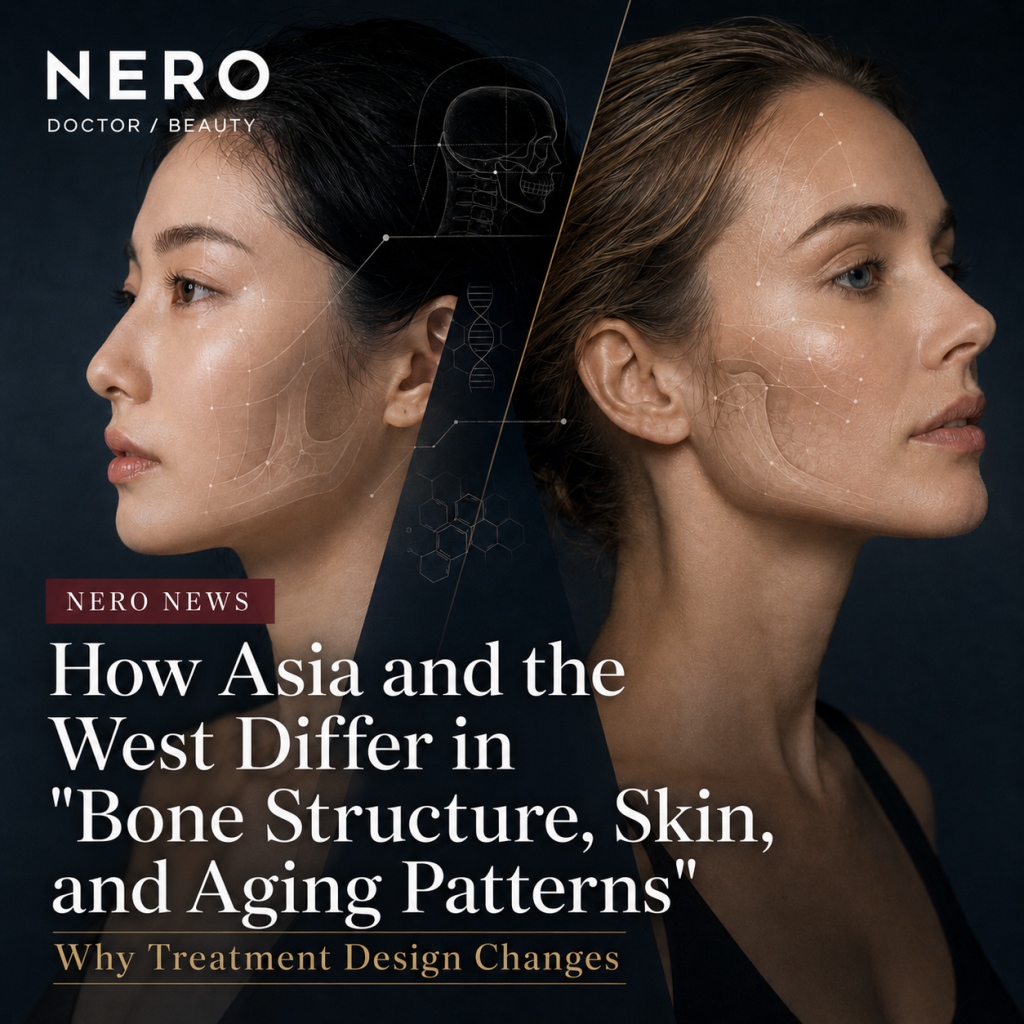
From a medical standpoint, East Asian and Western patients differ in four clinically significant ways:
skeletal structure, skin melanin content, aging trajectory, and complication risk profile.
These differences—not cultural preference alone—drive divergent treatment design philosophies.
VOGUE JAPAN framed this as an “East fills, West sculpts” cultural observation.
NERO goes further: why does treatment design itself change?
The answer lies in anatomy, skin biology, and aging science—
and understanding it lets patients think in terms of their own facial blueprint,
not just trending procedure names.


INDEX
- Four Medical Reasons Why East Asian and Western Aesthetic Treatments Differ
- What Is PIH — And Why It Matters for East Asian Laser Patients
- IMCAS China 2026: From Single Treatments to Structural Design
- Before Chasing a Western Aesthetic Trend: Four Questions to Ask Your Provider
- Summary
- Frequently Asked Questions
Four Medical Reasons Why East Asian and Western Aesthetic Treatments Differ
Dismissing the East-West gap as “different tastes” is a clinical oversimplification.
Four distinct medical variables drive the divergence in treatment design.
with lower anterior projection, squarer jaw angles,
and lower nasal bridge height compared to Western counterparts.
In Western faces, anteriorly prominent cheekbones create natural shadow and definition when reduced.
Applying the same “sculpting” logic to East Asian bone structure
does not produce equivalent visual results—
and may create unintended flattening rather than definition.
meaning higher baseline melanin than most Western skin types.
This increases susceptibility to post-inflammatory hyperpigmentation (PIH)
when laser, peeling, or RF treatments are not properly calibrated.
Uneven pigmentation and dark spots are therefore a primary aesthetic concern
in East Asian patients—not a secondary one.
Lower fluence, appropriate cooling, and staged protocols are required
(per Dermatology Times guidelines).
that East Asian patients tend to show fewer visible wrinkles at younger ages,
with aging manifesting differently than in Western counterparts.
Volume maintenance tends to be a primary aesthetic priority as aging progresses.
This supports the clinical rationale for volumizing approaches—
though facial laxity also develops with age
and cannot be reduced to volume loss alone.
aligns directionally with the anatomical tendency toward volume prioritization in East Asian aging.
Cultural preference and anatomical reality are not always in conflict—
in this case, they often point in the same direction.
What Is PIH — And Why It Matters for East Asian Laser Patients
Post-inflammatory hyperpigmentation (PIH) is one of the most clinically significant
complication risks in aesthetic medicine for East Asian patients.
Post-inflammatory hyperpigmentation (PIH) refers to brown-to-dark discoloration
that develops at sites of skin trauma—including laser, chemical peels, and friction.
It occurs more frequently in melanin-rich skin (Fitzpatrick Types III–IV),
which is common among East Asian patients.
Inadequate post-treatment care, sun exposure, or poorly calibrated device settings
(incorrect wavelength, fluence, or cooling) significantly increase PIH and burn risk.
Optimizing laser parameters specifically for East Asian skin is not optional—it is clinically necessary.
This is the medical rationale behind why international conferences such as IMCAS China
consistently emphasize East Asian-optimized laser protocols.
If you are considering any laser or energy-based treatment,
confirm that your provider has specific experience calibrating settings for East Asian skin types.
IMCAS China 2026: From Single Treatments to Structural Design
Held in Shanghai from August 27–29, 2026,
IMCAS China 2026 placed combination therapy optimized for East Asian morphology
at the center of its clinical agenda.
The implication is clear:
the question is no longer “which trending Western procedure should I get?”
It is: “How should my treatment be designed based on my specific bone structure, skin type, and aging pattern?”
Patients who adopt this framing significantly reduce their risk of poor outcomes.
Before Chasing a Western Aesthetic Trend: Four Questions to Ask Your Provider
is this procedure medically appropriate for me?”
Anatomical fit comes before trend appeal.
Essential before any laser or peeling procedure.
how will my face look in 10–20 years with this treatment?”
Long-term design matters more than current trends.
including long-term follow-up images?”
Results shown only on Western patients are not a reliable reference.

Saying the East-West gap is “just a matter of taste” is only half the story.
Bone structure, skin biology, aging trajectory, and complication risk all differ—
so of course treatment design must differ too.
“It’s trending in the West” is not a clinical justification for a procedure.
“Does it fit my anatomy?” is the question that comes first.
From an industry perspective,
what IMCAS China has been emphasizing year after year
is combination design optimized for East Asian morphology.
The era of single-modality treatments is giving way
to AI-guided diagnosis, multi-modality protocols, and long-term structural planning.
The gap between clinics that lead with “what the doctor is good at”
and clinics that start with “the patient’s facial blueprint”
will only widen from here.
Summary
- The East-West gap in aesthetic medicine is not merely cultural preference.
Four medical variables—skeletal projection, skin melanin content, aging pattern, and PIH risk—
drive divergent treatment design (PubMed PMC4819477; Plast Aesthet Res 2023). - East Asian patients tend to show fewer visible wrinkles at younger ages
and prioritize volume maintenance as aging progresses,
supporting the clinical rationale for volumizing approaches.
Meanwhile, laser and ablative treatments require East Asian-optimized settings
to minimize PIH risk. - IMCAS China 2026 confirmed a global shift toward AI-guided combination therapy—
filler + energy device + staged protocols—
tailored specifically to East Asian morphology. - Before pursuing any trending procedure,
patients should ask whether it is anatomically appropriate
for their specific bone structure, skin type, and aging pattern.
That conversation is the foundation of safe aesthetic medicine.
Frequently Asked Questions
and sun sensitivity—from Type I (very fair, always burns)
to Type VI (very dark, never burns).
Most East Asian patients fall in Types III–IV.
Your type can be assessed during a pre-treatment consultation
with a dermatologist or aesthetic physician.
Knowing your type is clinically important:
it directly determines appropriate laser wavelength, fluence, and cooling settings.
using multiple modalities rather than a single procedure.
A typical example: hyaluronic acid filler for volume restoration,
RF (radiofrequency) for skin tightening,
and low-fluence laser for brightening—applied in sequence.
This approach is increasingly available at advanced aesthetic clinics globally.
The key is finding a provider who can explain
why each element of the combination is appropriate for your specific anatomy—
not just offering a bundled package.
South Korean clinics frequently perform facial contouring surgery
(V-line jaw reduction, zygoma reduction)
reflecting a preference for sharper, more defined features.
Chinese clinics increasingly focus on mid-face volumizing and structural lift.
Japanese clinics tend to prioritize cheek volume preservation
and a “non-fatigued” appearance.
There is no single “Asian aesthetic” standard.
Applying Korean or Chinese protocols to Japanese patients—
or vice versa—requires the same anatomical scrutiny
as applying Western protocols to any East Asian patient.
Sources:
1. VOGUE JAPAN. “Comparing Plastic Surgery Trends in the East and West.” vogue.co.jp
2. Aesthetic Plastic Surgery. “Consensus on Changing Trends, Attitudes, and Concepts of Asian Beauty.” PMC4819477. pubmed.ncbi.nlm.nih.gov
3. Plastic and Aesthetic Research. “Asian facial recontouring surgery.” 2023. oaepublish.com
4. IMCAS China 2026 Official Site. imcas.com