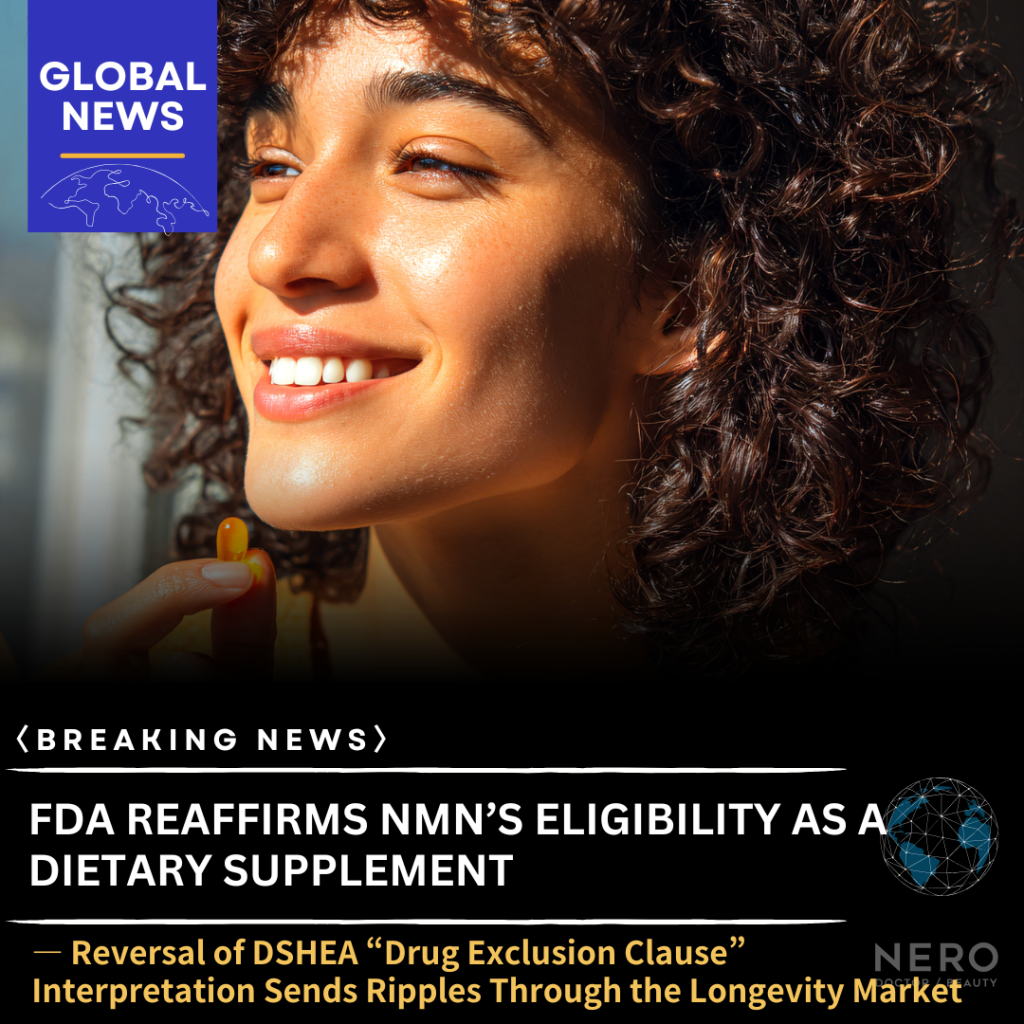
1) Turning Point from the 2022 FDA Position
NMN has attracted global attention within the NAD+ ecosystem, driven by interest in longevity, metabolic health, and cellular energy function.
The market expanded rapidly as NMN was positioned as a foundational longevity ingredient.
In 2022, however, the FDA signaled that NMN was subject to prior drug development review, a stance widely interpreted as effectively barring NMN from the supplement market. This triggered regulatory uncertainty, disrupted supply chains, and chilled investment.
The FDA has now reversed course, explicitly stating—based on its September 29, 2025 conclusion—that NMN is not excluded from the dietary supplement category.
2) Revival of NDI “Good Day Letters” and Procedural Significance
According to reported materials, the FDA’s December correspondence reaffirmed its position to companies that had previously submitted New Dietary Ingredient (NDI) notifications.
Specifically, responses issued to an NDI submission filed in May 2022—commonly referred to as “Good Day Letters”—were effectively reinstated.
The central regulatory question exposed by this episode is whether the DSHEA drug exclusion clause is applied consistently and predictably.
The NMN case illustrates how regulatory ambiguity directly affects research trajectories, capital allocation, product availability, and consumer choice.
3) Implications for the Longevity Market—and the Next Flashpoint
With NMN’s regulatory status clarified, supply-side uncertainty in the U.S. longevity market has partially eased.
At the same time, broader availability heightens familiar risks:
quality variation, contamination, exaggerated claims, and misuse of scientific evidence tend to surface as supplement categories scale.
Industry stakeholders have framed the decision as a victory, while also warning that similar regulatory ambiguity could emerge around next-generation ingredients, including peptides. This is likely to intensify calls for clearer, forward-looking regulatory guidance.
Editor’s Perspective
NMN Is Not Just an Ingredient — It Is a Stress Test for the System
At its core, the NMN controversy is less about the compound itself and more about where regulatory systems draw the line between innovation and consumer protection.
While the FDA’s reversal signals that not all innovation will be absorbed into the pharmaceutical pathway, it simultaneously underscores the necessity of self-regulation, transparency, and post-market oversight within the supplement industry.
In Japan, dietary supplements, functional food labeling, and private medical services (such as NAD+ infusions) coexist in parallel.
As the longevity sector expands, regulatory ambiguity becomes both a commercial opportunity and a source of systemic risk.
For Japan as well, NMN serves as a litmus test—forcing alignment between science, labeling, distribution, and the role of medical professionals in the longevity economy.
Summary
-
FDA reaffirmed NMN’s eligibility for dietary supplement sales
-
Shift from the 2022 position, clarified via a September 29, 2025 determination
-
December letter signaled reinstatement of NDI-related responses
-
Background includes NPA petitions, litigation, and DSHEA interpretation
-
Longevity market governance emerges as a key policy challenge in Japan as well
At NERO, we continue to report on global shifts in medical regulatory systems and the structural dynamics of private medical practice.
Under the theme of ethics and sustainability in healthcare markets, we will keep examining how far Japan—and other nations—should extend the boundaries of private medicine.