1) Expansion of Counterfeit Distribution and Its Origins
Medytox entered the Thai market in the mid-2010s, where its botulinum toxin and dermal filler products rapidly gained market share.
As legitimate demand increased, counterfeit versions targeting the brand began to proliferate, prompting Thailand’s Department of Special Investigation (DSI) to launch a large-scale crackdown in 2019.
Medytox, in cooperation with its local joint venture MediCel, pursued criminal charges against illegal sellers and intermediary brokers involved in counterfeit distribution.
2) Supreme Court Upholds Prison and Corporate Penalties
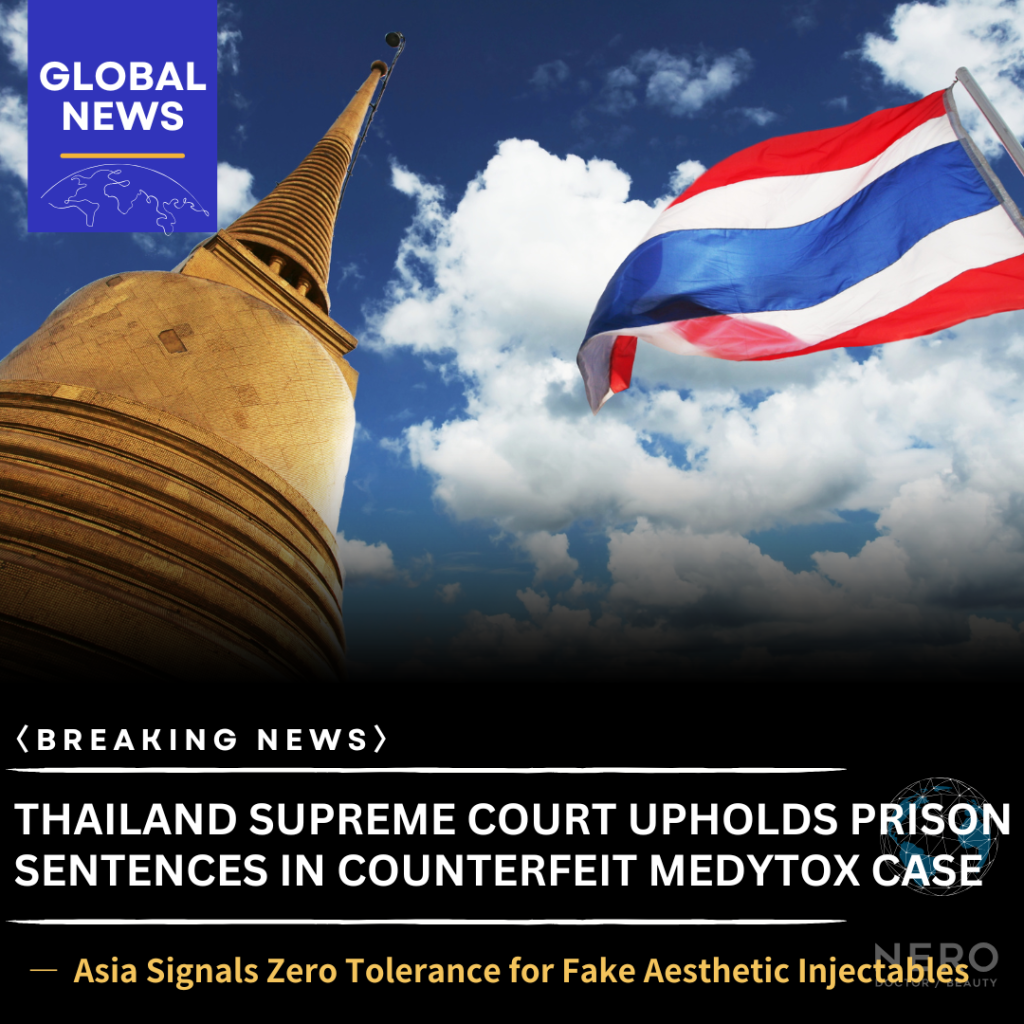
On November 27, Thailand’s Supreme Court upheld lower-court rulings, finalizing multiple custodial sentences, including:
-
3 years, 7 months, and 10 days
-
2 years, 7 months, and 10 days
In addition to prison terms, corporate entities involved in the counterfeit trade were fined, underscoring a judicial stance that extends liability beyond individuals to organizations.
This dual-track punishment represents an exceptionally strict enforcement precedent within the Asian aesthetic medicine sector.
3) Medytox’s Official Statement
A Medytox spokesperson described the case as:
“A typical example of criminals exploiting established brand value.”
The company reiterated its guidance to international customers, strongly urging verification of:
Medytox emphasized that only authentic products circulate within Korea, while stressing the ongoing importance of counterfeit prevention across Southeast Asia.
4) Broader Implications for Asia’s Aesthetic Medicine Market
Thailand is widely recognized as a high-demand aesthetic medicine market, but one that remains vulnerable to non-authorized distribution.
The Supreme Court ruling sends a clear warning signal to the region’s supply chains and may accelerate regulatory tightening and enforcement actions across Asia.
Editor’s Perspective
Parallel Imports, Lawless Zones, and Journalism as the Last Line of Medical Safety
This ruling goes far beyond a single criminal case.
It exposes the structural fragility of Asia’s aesthetic medicine supply chains, where parallel imports and counterfeit products often operate in legal grey zones.
Not only in Southeast Asia but also in Japan, unchecked parallel distribution has led to:
-
Untraceable lot numbers
-
Unknown temperature control
-
Removal of seals and QR codes
-
No post-treatment accountability
-
“Hit-and-run” sales structures
-
Predatory pricing tactics driven solely by cost
Ultimately, these products are injected — via physicians — into the bodies of patients who have no way of knowing the risks.
In many cases, even physicians struggle to distinguish counterfeits, placing medical safety and ethical foundations under severe strain.
Thailand’s Supreme Court ruling represents a symbolic moment where this hidden crisis surfaced at the judicial level.
For Japan, the implications are clear:
greater transparency in authorized distribution, reconstruction of agency systems, and strengthened supply-chain surveillance are urgently required.
At NERO, we view investigative reporting as a critical safeguard for safety and ethics in aesthetic medicine.
Making structural problems visible — and continuously pointing toward reform — remains the only viable path to preserving integrity in the private medical sector.
Summary
-
Thailand’s Supreme Court confirmed prison sentences for brokers distributing counterfeit Medytox products
-
Counterfeit injectables expanded alongside market growth in the late 2010s
-
Medytox has collaborated with the DSI on enforcement since 2019
-
Corporate fines represent a rare judicial precedent in Asia
-
Strengthening counter-counterfeit and parallel-import controls will be a central issue across Asian markets, including Japan
At NERO, we continue to report on global transformations in medical regulation and the structural dynamics of private healthcare.
Under the theme of ethics and sustainability in medical markets, we will keep questioning how far private medicine should expand — and where its boundaries must be drawn.