📌 Key Takeaways
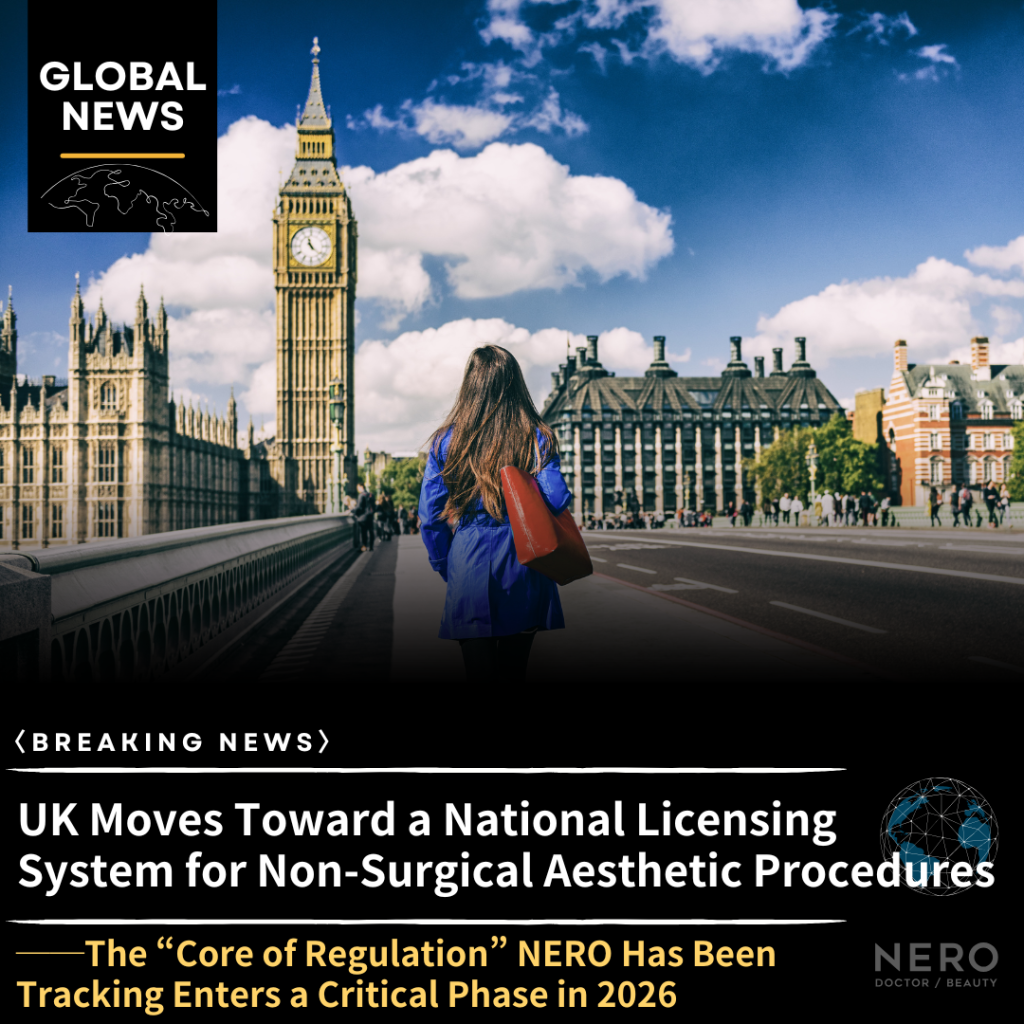
The UK is advancing the design of a national licensing system for non-surgical aesthetic procedures, positioning 2026 as a regulatory inflection point
High-risk procedures are expected to be restricted to qualified practitioners, alongside stricter age and safety requirements
In Scotland, a separate legislative bill is under parliamentary review, indicating concrete legal progress
NERO has tracked this regulatory shift from an early stage, previously reporting on the UK’s large-scale move to regulate aesthetic treatments
The development raises comparisons with markets such as Japan, where regulatory gray zones still remain
The UK’s approach to regulating non-surgical aesthetic procedures is entering a more concrete and structured phase as 2026 approaches.
Treatments such as botulinum toxin injections and dermal fillers — often described as “non-surgical” — are increasingly being recognized as procedures that carry medical risk and accountability.
As NERO has previously reported in its early coverage of the UK’s regulatory shift, this is not a sudden policy change, but the culmination of a longer institutional process.
For countries like Japan, the key question is whether regulation will continue to be reactive, or evolve into a preventive, system-based framework.


INDEX
Regulatory Update ①|UK Government Advances System Design
The UK government has clarified its intention to incorporate non-surgical aesthetic procedures into a formal national licensing framework.
This marks a shift away from voluntary guidance toward structural regulation.
Targeted procedures include:
-
Botulinum toxin injections
-
Dermal fillers
-
Energy-based aesthetic devices
Although labeled “non-surgical,” these interventions involve clear and documented medical risks.
Following public consultation, the framework is expected to define:
-
Practitioner licensing requirements
-
Facility standards
-
Age restrictions
-
Oversight by local authorities
High-risk procedures, in particular, are widely expected to be restricted to medically qualified professionals.
Regulatory Update ②|Scotland’s Bill Moves Through Parliament
In Scotland, the Non-Surgical Cosmetic Procedures Bill is currently under parliamentary review.
The legislation aims for implementation around 2026, potentially positioning Scotland as an early adopter of binding regulation.
The bill seeks to legally establish:
-
Mandatory registration of practitioners and facilities
-
Minimum age requirements (18+)
-
Risk-based categorization of aesthetic procedures
This legislative track demonstrates how regulatory approaches within the UK may diverge in speed, but not in direction.
Public Opinion and Structural Risk
Data referenced by UK professional bodies indicates that complications related to dermal fillers account for a disproportionate share of adverse events.
Many of these cases are linked to procedures performed by unqualified or insufficiently trained providers.
Persistent safety incidents, unclear accountability, and inconsistent standards have become key drivers behind the licensing initiative.
The emerging consensus is clear:
“Non-surgical” does not mean “non-medical.”
Editor’s Perspective|Rethinking the Regulatory “Gray Zone”
— Is Japan Still a Country That Regulates Only After Accidents?
The UK’s regulatory trajectory reflects a fundamental shift in perspective.
Non-surgical aesthetic procedures are being repositioned within a medical safety and accountability framework, rather than treated as a cosmetic exception.
By contrast, Japan continues to face:
-
De facto tolerance of injections by non-physicians
-
Regulatory debate triggered primarily after incidents occur
-
Ambiguous boundaries of responsibility
This structural ambiguity affects patient safety, market trust, and the long-term sustainability of aesthetic medicine.
From 2026 onward, a country’s ability to design preventive regulatory systems may become a defining factor in global competitiveness.
Summary
-
The UK is advancing toward a national licensing system for non-surgical aesthetic procedures
-
High-risk treatments are likely to be restricted to qualified practitioners, with stronger safety and age controls
-
Scotland’s legislation is already in active parliamentary review
-
Public safety data and professional consensus are accelerating regulation
-
Japan faces a strategic choice between reactive regulation and preventive system design
NERO’s Mission
NERO reports on global developments in aesthetic medicine
through the lens of structure, ethics, and long-term consequence.
Rather than amplifying surface-level trends,
we examine how medical practices are regulated, commercialised, and normalised —
and what is reshaped when innovation moves faster than existing frameworks.
As aesthetic medicine expands beyond traditional clinical boundaries,
NERO focuses on the grey zones where definitions blur, responsibilities shift,
and medical decision-making becomes increasingly complex.
In an era of accelerating innovation,
NERO remains committed to transparency, critical scrutiny,
and responsible reporting —
so readers can understand not only what is new,
but what deserves closer examination before it becomes standard practice.