📌 Key Takeaways
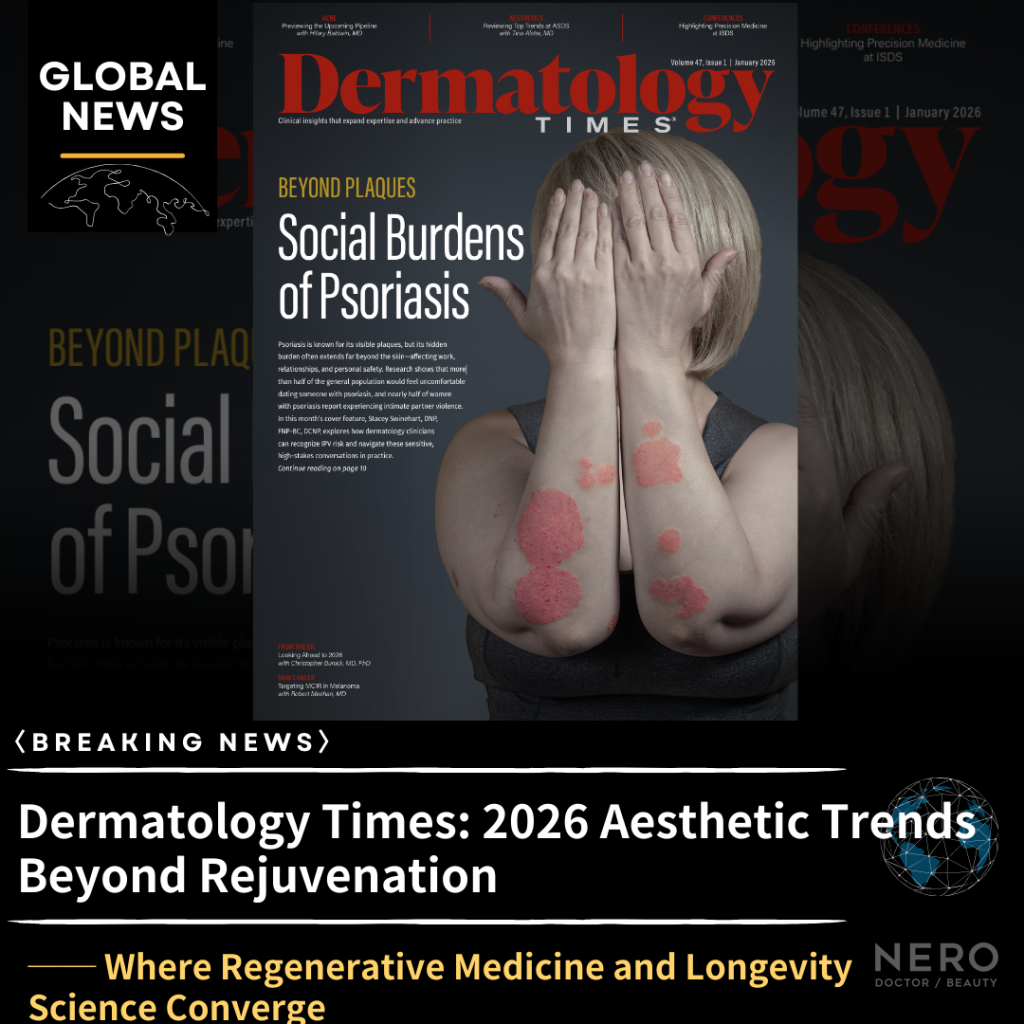
A leading U.S. medical media outlet has released its 2026 global aesthetic medicine trends
The focus is shifting from surface-level improvement to intervention in the aging process itself
Next-generation resurfacing, lasers, and AI-driven technologies are advancing clinical practice
“Undetectable results” are becoming the ultimate measure of value
The integration of regenerative medicine and longevity science is accelerating worldwide
A Clear Turning Point for Global Aesthetic Medicine
In 2026, aesthetic medicine is entering a decisive turning point.
What was once centered on making patients “look younger” is now evolving into a form of medicine that seeks to intervene in how aging itself progresses.
According to Dermatology Times (published January 23, 2026), coverage from the American Society for Dermatologic Surgery (ASDS) Annual Meeting in Chicago highlights how dermatology and aesthetic medicine are rapidly converging with regenerative medicine and longevity science at the clinical level.
INDEX
- From Surface Care to the “Depth of Aging”
- Laser Coring and the Redefinition of Treatment Depth
- A New Baseline: Devices for All Skin Types
- AI and Imaging Are Redefining “Skin Quality”
- The Ultimate Goal: Making Treatment Invisible
- Where Regenerative Medicine Meets Longevity Science
- Editor’s Perspective — Aesthetic Medicine Is Graduating from the “Rejuvenation Industry”
- Summary
From Surface Care to the “Depth of Aging”
One of the most symbolic technological advances of 2026 is next-generation resurfacing.
New platforms such as Acclaro are designed to induce more precise and deeper collagen remodeling than conventional technologies. These systems are enabling realistic treatment of areas that were previously difficult to address, including:
-
Fine perioral wrinkles
-
Enlarged pores
—while keeping recovery time to a minimum.
Across global clinical settings, a shared philosophy is emerging:
“Deliver efficacy without interrupting daily life.”
Laser Coring and the Redefinition of Treatment Depth
Laser coring using platforms such as UltraClear was also highlighted as a key technology to watch in 2026.
Its ability to handle everything from no-downtime laser peels to deeper resurfacing treatments within a single platform is seen as a major advantage.
At the same time, experts expressed caution regarding recovery time and safety, emphasizing that optimizing the balance between efficacy and invasiveness will be a critical theme going forward.
A New Baseline: Devices for All Skin Types
A defining feature of 2026 device development is versatility.
Systems capable of adapting to:
-
Skin tone
-
Treatment depth
-
Clinical indication
are increasingly viewed as essential—not only for patient safety, but also from a medical management and scalability perspective.
AI and Imaging Are Redefining “Skin Quality”
Artificial intelligence is no longer experimental—it is already embedded in aesthetic practice.
AI-assisted laser systems that adjust pulse spacing and treatment endpoints are improving:
-
Reproducibility
-
Predictability
-
Safety
In parallel, advanced imaging technologies are enabling quantitative evaluation of pores, texture, and skin quality. As a result, “skin quality” itself is shifting from a subjective impression to an objective metric.
The Ultimate Goal: Making Treatment Invisible
Perhaps the most defining trend of 2026 is the pursuit of results that do not appear “treated.”
Experts emphasized that outcomes depend less on products or devices and more on:
-
Who designs the treatment
-
How intervention is planned
-
How much intervention is applied
Even issues such as filler migration are increasingly framed not as product failures, but as problems of overcorrection and improper technique.
Where Regenerative Medicine Meets Longevity Science
The most forward-looking discussions focused on the fusion of aesthetic medicine with regenerative and longevity science.
As understanding deepens around cellular senescence, DNA damage, and molecular aging pathways, aesthetic medicine is expanding its scope—from cosmetic improvement to preventive intervention in the aging process itself.
Experts suggested that genetic testing and systemic anti-aging strategies may eventually integrate seamlessly with aesthetic care.
Editor’s Perspective — Aesthetic Medicine Is Graduating from the “Rejuvenation Industry”
What these trends collectively reveal is that aesthetic medicine is no longer merely cosmetic.
The central question is shifting from how young one looks to how aging is understood, slowed, and designed around.
Aesthetic medicine, regenerative medicine, preventive care, and longevity science are no longer separate disciplines. They are being reorganized into a unified medical framework that supports long-term quality of life.
Summary
-
Global aesthetic medicine is transitioning toward aging-process intervention
-
Key technological axes are depth, reproducibility, and visualization
-
Natural-looking results are a matter of design and planning, not taste
-
Integration with regenerative and longevity science is accelerating
NERO’s Mission
NERO reports on global developments in aesthetic medicine
through the lens of structure, ethics, and long-term consequence.
Rather than amplifying surface-level trends,
we examine how medical practices are regulated, commercialised, and normalised —
and what is reshaped when innovation moves faster than existing frameworks.
As aesthetic medicine expands beyond traditional clinical boundaries,
NERO focuses on the grey zones where definitions blur, responsibilities shift,
and medical decision-making becomes increasingly complex.
In an era of accelerating innovation,
NERO remains committed to transparency, critical scrutiny,
and responsible reporting —
so readers can understand not only what is new,
but what deserves closer examination before it becomes standard practice.