📌 Key Takeaways
IMCAS World Congress 2026 welcomed 21,764 participants, the largest attendance in its history
The congress prioritized safety, anatomy, complications, and validation over novelty
Regenerative medicine, exosomes, and AI were positioned firmly in an evaluation phase
Cadaver dissection, ultrasound, and anatomical fundamentals dominated the program
The value axis has shifted from “rejuvenation” to how aging itself is understood and managed
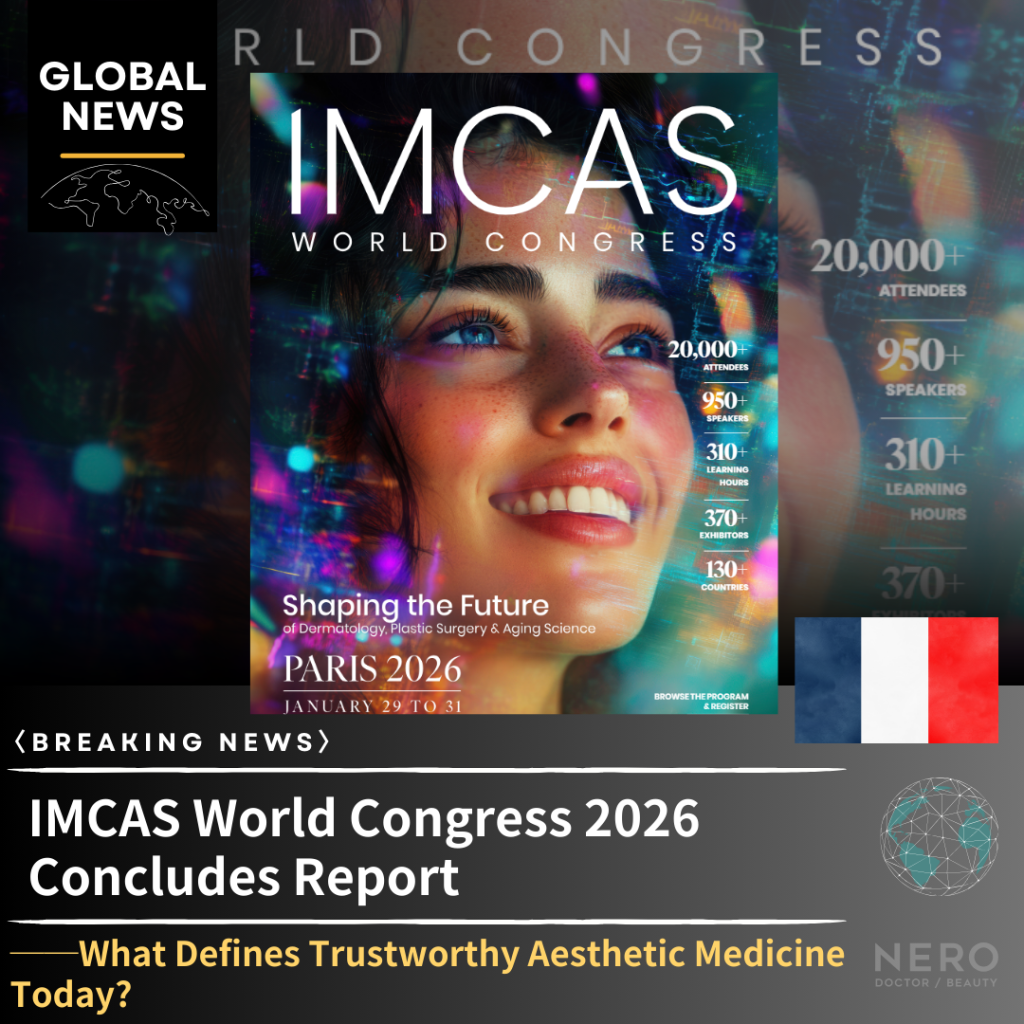
Held from January 29 to 31, 2026 in Paris, IMCAS World Congress has officially concluded.
NERO reported early in the congress that aesthetic medicine was transitioning from a technology race to a discipline grounded in safety, structure, and aging science.
This final report synthesizes official data, post-congress analyses, and the full academic program.
The conclusion is unambiguous:
IMCAS 2026 challenged the global industry to redefine what “being chosen” truly means.
INDEX
1. The Numbers That Define IMCAS 2026
IMCAS 2026 was not merely a large-scale exhibition:
-
21,764 attendees
-
1,145 speakers
-
225 sessions
-
402 exhibiting companies
-
64% non-sponsored scientific sessions
Commercial messaging remained secondary to scientific discourse—reinforcing IMCAS’s role as a venue where global standards are implicitly set.
2. The End of the Technology Arms Race
The most prevalent topics at IMCAS 2026 included:
-
Cadaver dissection workshops
-
Facial vascular danger zones
-
Injection-related complications
-
Ultrasound-guided visualization
-
Energy-based device safety
The message was clear:
avoiding harm now outweighs achieving brilliance.
Aesthetic medicine has entered an era where prevention of failure defines excellence.
3. Regenerative Medicine Moves From Dream to Scrutiny
While regenerative therapies remained prominent, the framing had changed.
Sessions consistently asked:
-
Where is the evidence?
-
What risks remain unquantified?
-
Can quality and outcomes be reliably reproduced?
The industry has moved from “Can we use it?” to
“Can we responsibly explain and defend its use?”
4. Aging Science and AI Redefine the Field’s Core
Topics once considered peripheral now dominated the congress:
-
Aging science
-
AI and robotics
-
GLP-1 therapies and facial aging
-
Nutrition, epigenetics, and longevity strategies
Aesthetic medicine is no longer about reversing appearance—it is about designing long-term interaction with aging biology.
What Did IMCAS 2026 Ultimately Teach Us?
IMCAS is not only for physicians or industry professionals.
The standards it establishes directly influence how patients worldwide will choose care.
Repeatedly emphasized was not:
“What treatment should we do?”
but rather:
“What kind of medicine deserves to be chosen over time?”
Translated into patient-centered criteria:
-
Can safety be explained, not just claimed?
-
Are risks and limits discussed transparently?
-
Does the conversation focus on anatomy, management, and experience rather than buzzwords?
Treatments marketed as “world-first” or “trending on social media” without these foundations are no longer aligned with global academic consensus.
Editor’s Perspective
IMCAS 2026 Chose Medicine That Endures
IMCAS 2026 delivered a quiet but decisive verdict.
Only aesthetic medicine that is:
-
Safe in practice
-
Scientifically defensible
-
Trustworthy over the long term
will continue to be chosen.
As private medical care expands in Japan and globally, the criteria demonstrated at IMCAS 2026 may well define the market’s future.
Summary
-
IMCAS 2026 confirmed the global direction of aesthetic medicine
-
Safety, structure, and aging science have replaced pure innovation races
-
Regenerative medicine and AI are now under rigorous evaluation
-
Only medicine that fulfills its explanatory responsibility will remain viable
NERO’s Mission
NERO reports on global developments in aesthetic medicine
through the lens of structure, ethics, and long-term consequence.
Rather than amplifying surface-level trends,
we examine how medical practices are regulated, commercialised, and normalised —
and what is reshaped when innovation moves faster than existing frameworks.
As aesthetic medicine expands beyond traditional clinical boundaries,
NERO focuses on the grey zones where definitions blur, responsibilities shift,
and medical decision-making becomes increasingly complex.
In an era of accelerating innovation,
NERO remains committed to transparency, critical scrutiny,
and responsible reporting —
so readers can understand not only what is new,
but what deserves closer examination before it becomes standard practice.