📌 Key Takeaways
- AUA, SUFU, and AUGS released a new guideline on Genitourinary Syndrome of Menopause (GSM)
- Low-dose vaginal estrogen therapy is clearly positioned as the first-line treatment
- Evidence supports benefits for OAB and recurrent UTIs
- No increased risk of breast cancer, cardiovascular disease, or dementia was observed
- Energy-based devices are not classified as standard treatment
- FemZone care is shifting from trend-driven expansion to evidence-based medical structure
INDEX
- AUA × SUFU × AUGS Release Joint Guideline — A Medical Axis Emerges
- What Is GSM — And Why Clarify It Now?
- What the Guideline Clarifies — First-Line Therapy and Safety
- How Other Treatments Are Positioned
- Shared Decision Making at the Core
- Why This Matters Now
- Editor’s Perspective — Understand Before Adding
- Summary
AUA × SUFU × AUGS Release Joint Guideline — A Medical Axis Emerges
FemZone care has been expanding rapidly across both medical and aesthetic fields.
Energy-based devices, injectables, and femtech products have multiplied, offering new options — and new confusion.
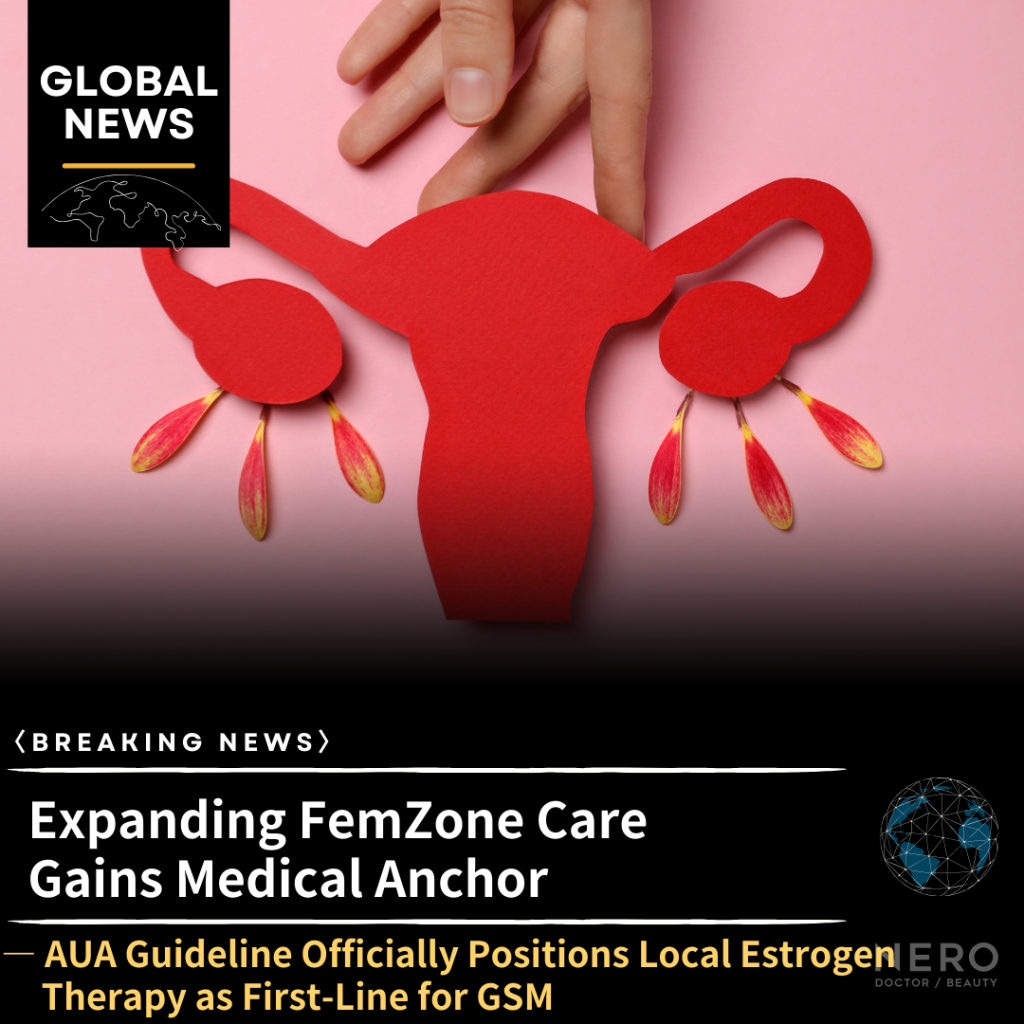
In 2026, a joint guideline led by the American Urological Association (AUA) introduced a clear medical anchor.
The guideline explicitly states that low-dose local vaginal estrogen therapy should be considered the primary treatment for GSM.
This is not a rejection of innovation.
Rather, it represents the moment when a rapidly growing market gains a defined medical center of gravity.
What Is GSM — And Why Clarify It Now?
Genitourinary Syndrome of Menopause (GSM) refers to a spectrum of symptoms caused by hormonal decline after menopause.
These include:
-
vaginal dryness
-
dyspareunia
-
urinary leakage
-
frequent urination
-
overactive bladder (OAB)
-
recurrent urinary tract infections
Importantly, the guideline emphasizes that GSM should not be dismissed as an inevitable consequence of aging.
Instead, it is defined as a diagnosable and treatable medical condition.
Another major shift:
Diagnosis is based on symptoms, not hormone levels.
The starting point becomes what patients feel — not just what laboratory numbers show.
What the Guideline Clarifies — First-Line Therapy and Safety
The joint guideline identifies low-dose vaginal estrogen as the therapy with the strongest clinical evidence.
Improvements were reported in:
-
dryness
-
irritation
-
pain during intercourse
-
recurrent UTIs
Equally significant is the clarification of safety.
Previous concerns regarding:
-
breast cancer
-
cardiovascular disease
-
dementia
-
endometrial cancer
were addressed, with the guideline stating that low-dose local therapy does not increase these risks.
Routine endometrial surveillance was also deemed unnecessary in most cases — a major shift for clinical practice.
How Other Treatments Are Positioned
The guideline carefully distinguishes between treatment tiers.
Conditional options
-
Vaginal DHEA
-
Ospemifene
Supportive care
-
Moisturizers and lubricants
Energy-based devices (CO₂ laser, Er:YAG, RF)
These are not positioned as standard therapy due to insufficient evidence.
They may be considered experimental approaches under cautious shared decision-making.
This distinction is critical in a rapidly expanding market.
The guideline does not prohibit innovation —
but it clarifies what currently stands on firm medical ground.
A central pillar of the guideline is Shared Decision Making (SDM).
Treatment should not be uniform.
Instead, clinicians are encouraged to consider:
-
patient values and goals
-
sexual health
-
psychosocial context
Referrals to pelvic floor physical therapy or sexual counseling are also recommended when appropriate.
GSM is framed as a chronic condition, requiring continuous reassessment rather than one-time intervention.
Why This Matters Now
The FemZone field is expanding quickly — a natural evolution of healthcare and aesthetic medicine.
However, as options increase, the medical foundation can become less visible.
This guideline reframes fem care not as a trend, but as an evidence-based medical domain.
Committee chair Melissa R. Kaufman, MD (Vanderbilt University) emphasized that urologists should take an active role in this area.
This signals a structural shift:
GSM is no longer solely a gynecological issue or an aesthetic topic —
it is now clearly positioned within urology as well.
Editor’s Perspective — Understand Before Adding
The growth of femzone treatments is a positive sign of expanding patient care.
But before adding devices, injections, or new products, a key step remains:
medical classification of symptoms.
Is it truly GSM caused by hormonal decline?
The guideline functions as a map for a rapidly expanding market.
Fem care is entering a new phase:
Not “add first,” but understand first.
Summary
-
Local estrogen therapy officially defined as first-line for GSM
-
Diagnosis based on symptoms rather than hormone levels
-
Safety clarified regarding major health risks
-
Energy-based devices not classified as standard treatment
-
GSM recognized as a chronic condition requiring long-term management
FemZone care continues to grow —
and evidence is becoming the new foundation.
NERO’s Mission
NERO reports on global developments in aesthetic medicine
through the lens of structure, ethics, and long-term consequence.
Rather than amplifying surface-level trends,
we examine how medical practices are regulated, commercialised, and normalised —
and what is reshaped when innovation moves faster than existing frameworks.
As aesthetic medicine expands beyond traditional clinical boundaries,
NERO focuses on the grey zones where definitions blur, responsibilities shift,
and medical decision-making becomes increasingly complex.
In an era of accelerating innovation,
NERO remains committed to transparency, critical scrutiny,
and responsible reporting —
so readers can understand not only what is new,
but what deserves closer examination before it becomes standard practice.