
📌 Key Takeaways
- The UK Parliament’s Women and Equalities Committee called for tight restrictions on “liquid BBL” and liquid breast augmentation procedures
- Non-surgical treatments such as Botox, dermal fillers, lasers, and chemical peels may require formal licensing systems
- The current aesthetic market was described as a “Wild West” lacking adequate regulation
- The focus is shifting from what is performed to who is allowed to perform it
- The debate may influence global aesthetic medicine governance — including markets like Japan
INDEX
- What Happened — A Regulatory Turning Point in the UK
- What Is a “Liquid BBL” — And Why Is It Controversial?
- From Procedures to Providers — Why Non-Surgical Treatments Are Under Scrutiny
- Why This Matters Globally — Not Just in the UK
- Editor’s Perspective — Regulation Is Catching Up With Market Speed
- Summary
What Happened — A Regulatory Turning Point in the UK
On February 18, 2026, the UK Parliament’s Women and Equalities Committee released a report recommending stronger regulatory control over certain aesthetic procedures considered “high harm.”
Among the most notable targets were:
-
Liquid BBL (injectable buttock augmentation)
-
Liquid breast enhancement
While not an immediate legal ban, the proposal suggests limiting these treatments strictly to appropriately qualified medical professionals — a move widely interpreted as a de facto prohibition on non-medical providers.
The Committee also urged the introduction of licensing requirements across the non-surgical aesthetic sector.

Source: UK Parliament Women and Equalities Committee (2026)
What Is a “Liquid BBL” — And Why Is It Controversial?
A Liquid BBL refers to buttock enhancement performed through injectable fillers rather than surgical fat transfer.
Because the procedure is:
-
Non-surgical
-
Relatively fast
-
Highly promoted on social media
it has expanded rapidly in global markets.
However, regulators have raised concerns over:
-
Vascular complications from large-volume injections
-
Infection risks
-
The growing presence of unlicensed providers
The UK debate highlights not only medical risk, but also the structural gap between market expansion and regulatory oversight.
From Procedures to Providers — Why Non-Surgical Treatments Are Under Scrutiny
The Committee’s report goes beyond liquid BBL.
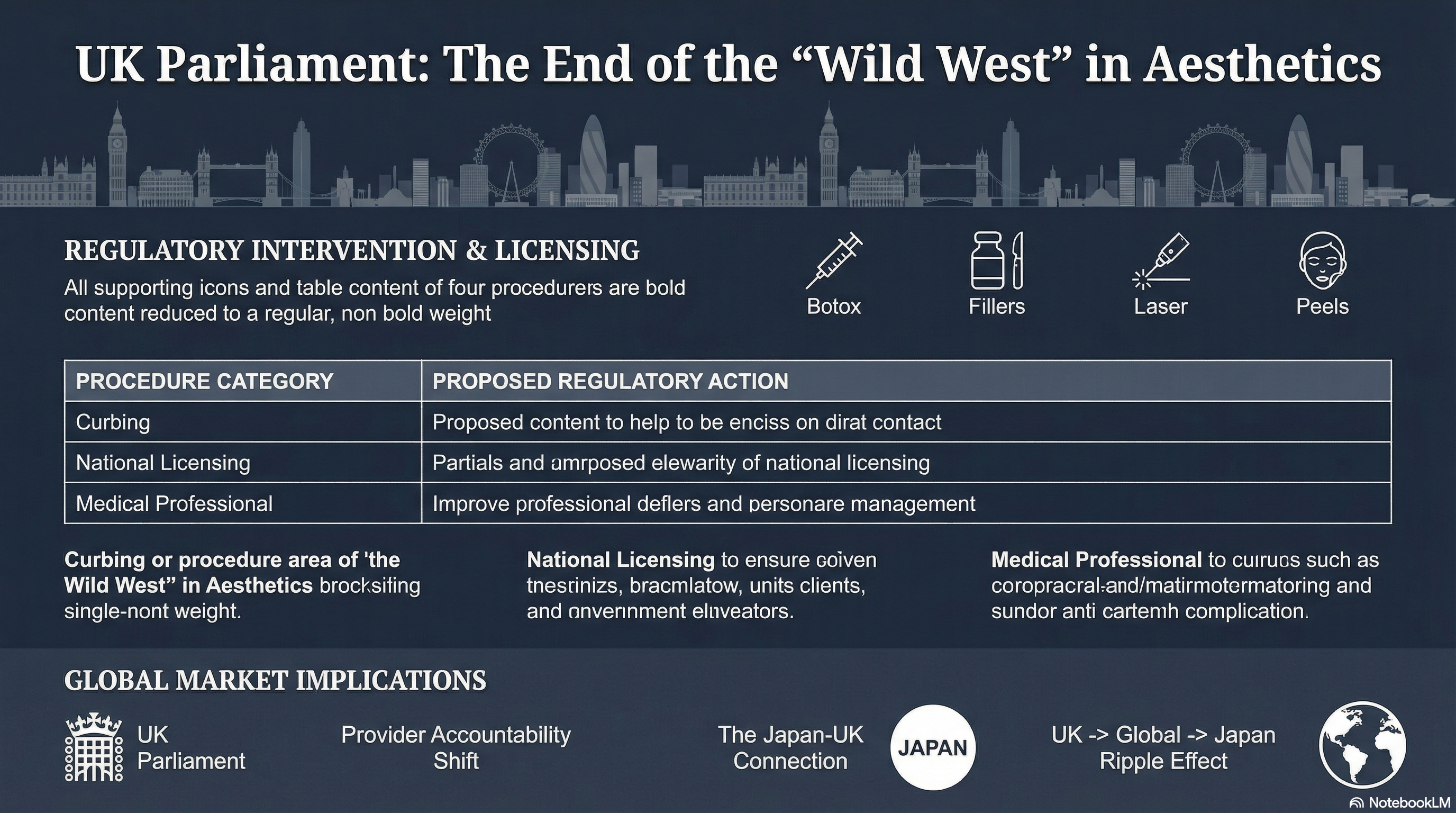
It calls for a national licensing framework covering:
-
Botulinum toxin injections
-
Dermal fillers
-
Laser treatments
-
Chemical peels
In describing the current landscape as a “Wild West,” lawmakers emphasized that aesthetic procedures have become widely accessible without consistent training standards or accountability.
This signals a broader shift in global regulation:
👉 The key question is no longer what treatment is done,
but who is qualified to perform it.
Why This Matters Globally — Not Just in the UK
Non-surgical aesthetic medicine has transformed into a routine, maintenance-driven industry worldwide.
As treatments become:
-
Faster
-
Less invasive
-
More subscription-like
regulators are increasingly focusing on safety governance rather than market growth alone.
Even in countries where physician-only injection rules already exist, structural pressures remain:
-
Social media marketing
-
Price competition
-
Parallel product distribution
-
Rapid consumer demand
The UK discussion reflects a global trend toward redefining professional responsibility in aesthetic medicine.
Editor’s Perspective — Regulation Is Catching Up With Market Speed
This news is not a rejection of aesthetic medicine.
Instead, it represents a shift in how societies manage expanding beauty-health markets.
As procedures become normalized, the challenge becomes maintaining clinical integrity without stifling innovation.
The UK’s proposal may mark the beginning of a new phase:
From trend-driven aesthetics to governance-driven aesthetics.
Summary
-
UK Parliament proposes strong restrictions on liquid BBL and other high-risk injectable procedures
-
Licensing systems for non-surgical aesthetics are under discussion
-
Market described as a “Wild West” due to regulatory gaps
-
Global focus shifting toward provider qualifications and safety governance
-
Potential implications for international aesthetic medicine markets
NERO’s Mission
NERO reports on global developments in aesthetic medicine
through the lens of structure, ethics, and long-term consequence.
Rather than amplifying surface-level trends,
we examine how medical practices are regulated, commercialised, and normalised —
and what is reshaped when innovation moves faster than existing frameworks.
As aesthetic medicine expands beyond traditional clinical boundaries,
NERO focuses on the grey zones where definitions blur, responsibilities shift,
and medical decision-making becomes increasingly complex.
In an era of accelerating innovation,
NERO remains committed to transparency, critical scrutiny,
and responsible reporting —
so readers can understand not only what is new,
but what deserves closer examination before it becomes standard practice.