📌 Key Takeaways
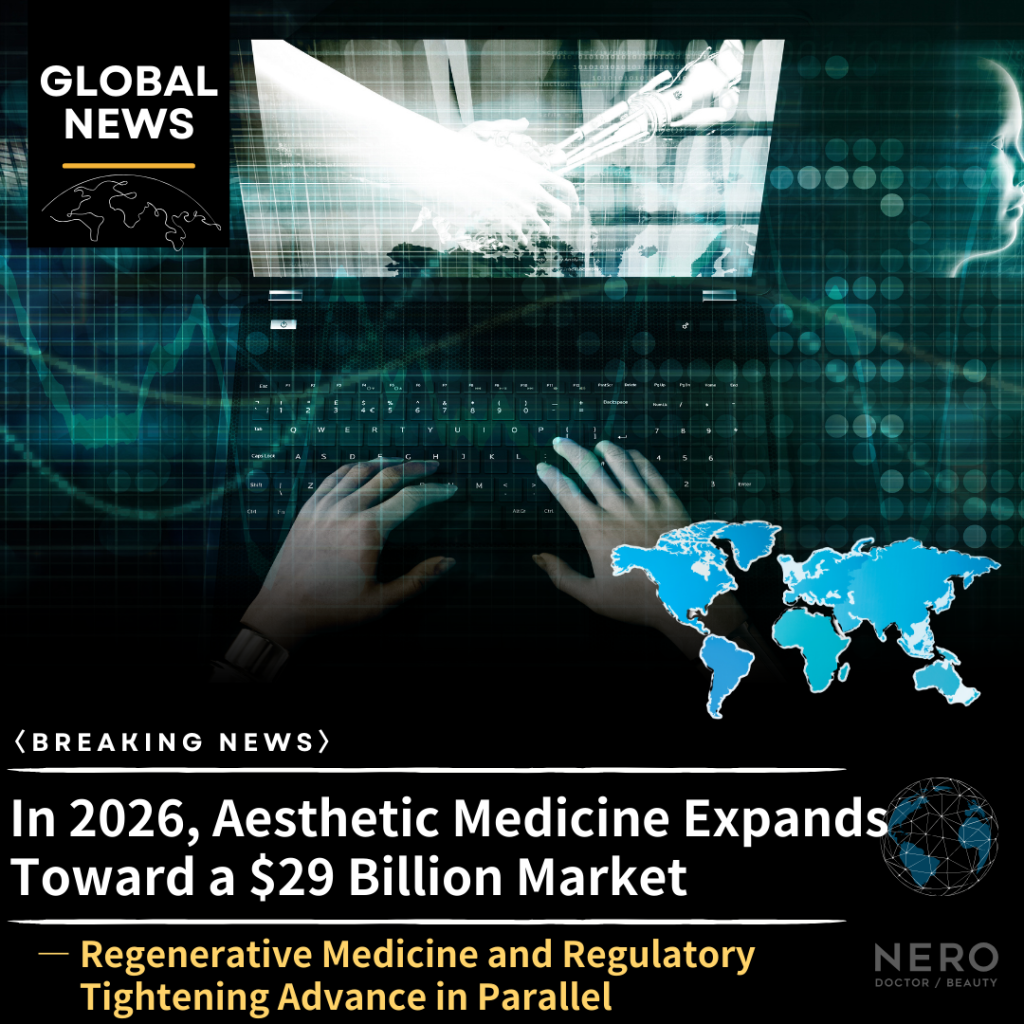
✔ The global aesthetic injectables market is projected to reach approximately $29 billion by 2032✔ 2026 marks a turning point as the shift toward regenerative medicine accelerates
✔ Simultaneously, the UK is advancing tighter regulations on high-risk aesthetic procedures
✔ AI-driven diagnostics are becoming increasingly standardized


INDEX
A Clear Inflection Point in 2026
In 2026, aesthetic medicine reaches a distinct crossroads.
The market continues to expand.
At the same time, regulatory oversight intensifies.
This simultaneous growth and control signals a broader transformation:
the industry is moving from an era of volume to one of quality and design.
This is not merely a trend.
It is a structural shift.
From Filler-Centric Practice to Regenerative Design
For years, hyaluronic acid fillers have driven market growth.
However, 2026 sees regenerative approaches gaining mainstream traction:
-
Polynucleotides
-
Exosomes
-
Biostimulatory injectables
The objective is no longer simply to “fill.”
It is to stimulate fibroblasts and promote endogenous collagen production.
The philosophy of aesthetics itself is evolving.
A $29 Billion Market — But the Nature of Growth Is Changing
According to the latest industry analysis, the global aesthetic injectables market is projected to grow:
2026: approximately $15.4 billion
2032: approximately $29.1 billion
CAGR: approximately 11%
Yet the true significance lies beyond the numbers.
Growth drivers are shifting toward:
-
Advanced formulation science
-
Enhanced physician training
-
Real-world evidence generation
-
Digital patient engagement
The competition is no longer about volume —
it is about quality differentiation.
AI Diagnostics and Personalization
The adoption of AI-powered skin diagnostics is accelerating.
Deep-layer skin analysis, collagen density measurement, and data-driven treatment planning are becoming standardized.
From “experience” to measurable data.
Clinical decision-making in aesthetics is entering a data-centric era.
Regulatory Tightening: The Parallel Current
Alongside market expansion, regulatory discussions are intensifying in the United Kingdom.
High-risk procedures — including liquid BBL and regenerative injectables — are increasingly expected to be restricted to licensed medical professionals.
This is not a brake on industry growth.
Rather, it represents a recalibration toward systemic safety.
📌 Why 2026 Represents a Structural Turning Point
2026 is not simply another year of expansion.
It is the convergence of:
-
Mainstream regenerative medicine
-
Standardization of AI diagnostics
-
Regulatory restructuring
-
Sustained market growth
Within this convergence, the criteria for what is “chosen” in aesthetic medicine are shifting.
Editor’s Perspective
The $29 billion projection naturally draws attention.
But that is not the core story.
Aesthetic medicine is moving
from “what to inject”
to “how to design.”
Regeneration.
Safety.
Data.
2026 will likely be remembered as the year when this philosophical transition became visible.
Sources
ResearchAndMarkets.com
Aesthetic Injectables Industry Report 2026–2032
(Originally published via Globe Newswire, February 23, 2026)
Save Face (UK)
Aesthetic Trends 2026: The Rise of Regenerative Medicine & Safety
NERO’s Mission
NERO reports on global developments in aesthetic medicine
through the lens of structure, ethics, and long-term consequence.
Rather than amplifying surface-level trends,
we examine how medical practices are regulated, commercialised, and normalised —
and what is reshaped when innovation moves faster than existing frameworks.
As aesthetic medicine expands beyond traditional clinical boundaries,
NERO focuses on the grey zones where definitions blur, responsibilities shift,
and medical decision-making becomes increasingly complex.
In an era of accelerating innovation,
NERO remains committed to transparency, critical scrutiny,
and responsible reporting —
so readers can understand not only what is new,
but what deserves closer examination before it becomes standard practice.