📌 Key Takeaways
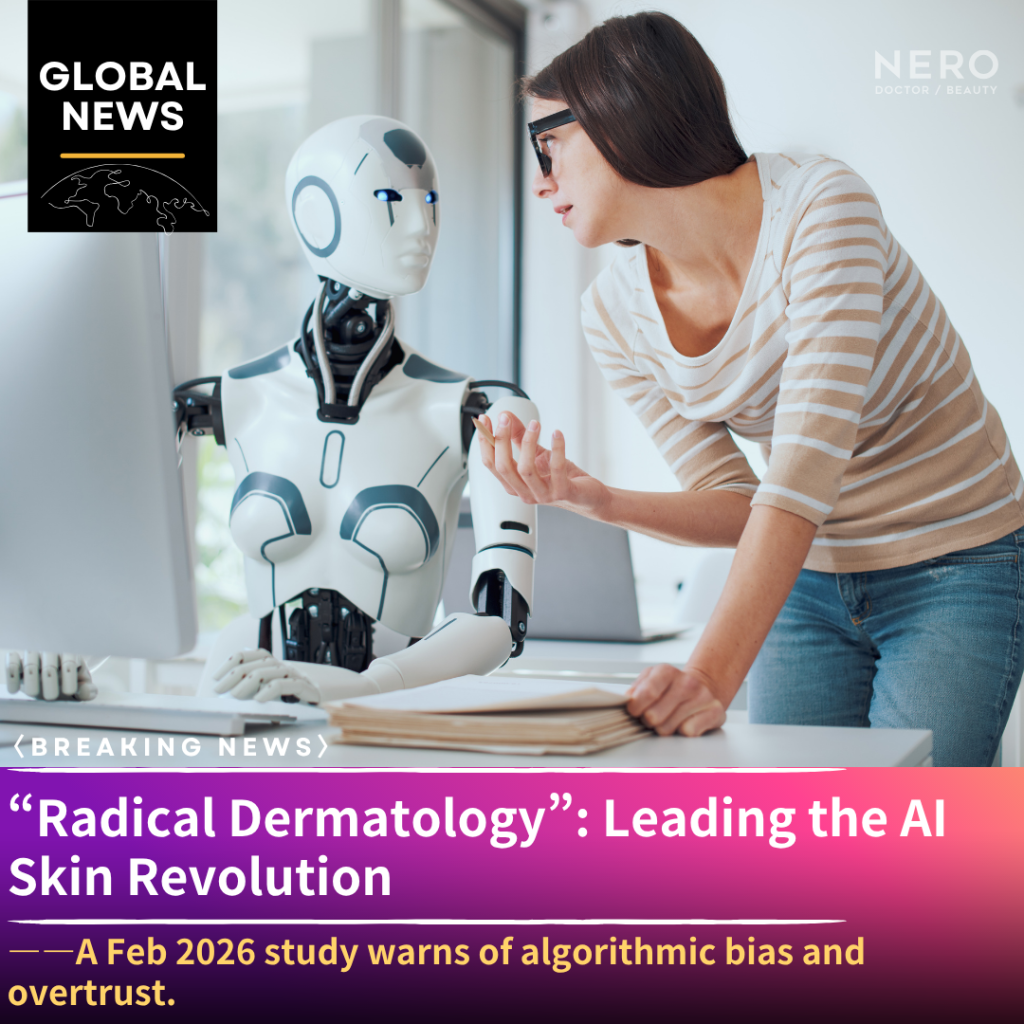
- A peer-reviewed paper published in JMIR Dermatology on February 20, 2026 (du Crest D et al., DOI: 10.2196/79044)
proposes the concept of “Radical Dermatology,” arguing that dermatologists must lead
the AI-driven transformation of skin health — not merely react to it. - The study identifies three core risks in AI skin diagnosis:
① Algorithmic bias against non-white skin tones
② Unequal digital access across populations
③ Culturally homogeneous model design that excludes diverse skin types. - Three key opportunities are also outlined:
① Improved diagnostic accuracy ② Reduction of geographic healthcare gaps ③ Personalized care via Skin Digital Twins.
The 2026 consensus: AI augments dermatologists — it does not replace them. - Globally, AI skin diagnosis apps are proliferating rapidly,
yet most consumers cannot verify what data trained the model
or whether it was optimized for their skin type.
A landmark peer-reviewed study published in JMIR Dermatology on February 20, 2026,
introduces a concept the authors call “Radical Dermatology” — a call to action for the field.
The paper’s central argument: “Big Tech is reshaping skin health whether dermatologists engage or not.
The profession must lead this transformation.”
Drawing on insights from the Skin and Digital Summit (2023–2025),
the authors map both the promise and the peril of AI-powered skin tools
with a clarity rarely seen in academic dermatology literature.


INDEX
What Is AI Skin Diagnosis — and What Can It Actually Do?
As of 2026, “AI skin diagnosis” encompasses three distinct service types,
each with very different accuracy levels and appropriate use cases.
① Smartphone App (Consumer-Grade): Analyzes selfie photos to estimate skin conditions
such as hyperpigmentation, dullness, pore size, and estimated skin age.
Widely offered by beauty brands and cosmetic apps — best treated as reference information only.
② Clinic-Integrated Systems: Medical-grade skin scanners (e.g., VISIA by Canfield Scientific)
used alongside physician consultation.
Standardized lighting and imaging conditions yield significantly higher accuracy
than consumer apps.
③ Large Language Model (LLM)-Based: Users submit photos or symptom descriptions
to tools like ChatGPT for a “diagnosis.”
Both WHO and JMIR Dermatology explicitly warn against using LLMs
as substitutes for physician evaluation — misinformation risk is high.
Three Risks Identified by the 2026 Peer-Reviewed Study
⚠️ Risk 1: Algorithmic Bias
The majority of AI skin diagnosis models were trained predominantly
on Western, lighter-skinned datasets.
Reduced accuracy for Asian, Black, and Latino skin tones has been documented.
Many apps marketed to specific ethnic groups have not disclosed
the racial diversity of their training data.
⚠️ Risk 2: Misinformation and Overtrust
As documented in WHO case studies on AI skin health apps,
a growing number of users treat AI-generated outputs as equivalent to physician diagnoses.
This overtrust creates real danger: missed malignant lesions and inappropriate self-treatment
are among the documented consequences.
⚠️ Risk 3: Data Privacy
Facial photos and biometric skin data constitute sensitive personal information.
For most consumer apps, it remains unclear where uploaded images are stored
and how they may be used commercially.
Biometric data that warrants medical-grade protection
is frequently handled under standard commercial privacy terms.
Three Opportunities the Study Also Highlights
✅ Opportunity 1: Enhanced Diagnostic Accuracy and Personalization
When AI integrates patient demographics, lifestyle data, and skin imaging,
it can detect subtle changes that human physicians might overlook.
AI-assisted dermatology is already demonstrating measurable improvements
in early-stage lesion detection in clinical settings.
✅ Opportunity 2: Bridging Geographic Healthcare Gaps
In regions with dermatologist shortages — including rural areas across Asia, Africa,
and Latin America — AI-based initial screening tools could be life-saving.
The technology holds particular promise as a triage layer
before specialist referral in underserved communities.
✅ Opportunity 3: Skin Digital Twins for Individualized Care
A 2025 paper in Frontiers in Digital Health (DOI: 10.3389/fdgth.2025.1534859)
proposes the concept of a “Skin Digital Twin” — a continuously updated digital replica
of an individual’s skin, enabling fully personalized treatment recommendations.
As of 2026, this remains in the research and development phase,
but represents the field’s most ambitious vision for precision dermatology.

An AI skin diagnosis tool is not an objective instrument —
it is a mirror of its designers’ assumptions and data choices.
The right question is not “Did the AI say so?”
but “What data was this AI trained on,
and does it reflect skin types like mine?”
For users with Asian, darker, or less-represented skin tones,
this question is not academic — it directly affects diagnostic reliability.
“An AI flagged it” and “A physician diagnosed it”
are not the same statement.
AI is a precision tool —
not a clinical authority.
Summary
- The February 2026 JMIR Dermatology paper introduces “Radical Dermatology,”
urging dermatologists to lead — not follow — the AI transformation of skin health. - Three documented risks: ① Algorithmic bias ② Misinformation and overtrust ③ Data privacy vulnerabilities
- Three documented opportunities: ① Enhanced diagnostic accuracy ② Geographic access equity ③ Skin Digital Twin for personalized medicine
- Treating AI output as equivalent to physician diagnosis is a documented safety risk.
Consumers should ask: “What data trained this model, and was my skin type represented?”
Frequently Asked Questions
Decisions about diagnosis and treatment — particularly distinguishing benign from malignant lesions
or identifying the cause of inflammation — require physician evaluation.
These tools are best used as a starting point, not a conclusion.
① Does the training dataset include diverse skin tones relevant to your ethnicity?
② Is the tool developed or reviewed by licensed dermatologists?
③ Does the tool explain the basis for its outputs?
The label “AI-powered” alone is not a quality indicator.
that operates under standardized lighting and imaging conditions,
making it significantly more reliable than consumer smartphone apps.
It is a validated tool for tracking skin changes over time.
However, any interpretation of results — particularly linking changes to treatment outcomes —
should always be confirmed with the treating physician.
Sources:
du Crest D, Madhumita M et al. “AI and Digital Tools in Dermatology: Addressing Access and Misinformation.” JMIR Dermatology 2026;9:e79044. DOI: 10.2196/79044
Haykal D. “Digital twins in dermatology: a new era of personalized skin care.” Frontiers in Digital Health 2025. DOI: 10.3389/fdgth.2025.1534859
“Transforming Skin Quality Evaluation With AI.” Journal of Cosmetic Dermatology 2026. PMC.
“Emerging and Pioneering AI Technologies in Aesthetic Dermatology.” Cosmetics 2024;11(6):206. PMC.