📌 Key Takeaways
- The 2026 facelift paradigm has shifted from pulling skin to repositioning deep facial structures—
deep plane facelift, which releases and repositions the SMAS layer and retaining ligaments, is becoming the global benchmark. - ASPS surgeons report a rise in “prejuvenation”—preventive cosmetic surgery among patients in their 20s and 30s—
reflecting a cultural shift from correcting aging to designing against it. - Post-GLP-1 weight loss (Ozempic, Wegovy, Mounjaro) is generating a new surgical category:
facial volume restoration, neck lifts, and body contouring for excess skin. - Site-specific, minimally invasive procedures—isolated neck lifts, blepharoplasty, brow lifts—
are growing as patients seek targeted refinement over full-face transformation.
The International Society of Aesthetic Plastic Surgery (ISAPS) reported 34.9 million cosmetic procedures performed globally in 2023—a record high.
Face and head surgeries remained the top category for the 14th consecutive year.
But in 2026, the nature of those procedures is changing fundamentally.
Driven by a cultural backlash against the “wind-tunnel look” and overly tightened faces,
aesthetic surgery is converging on a new standard: anatomically accurate rejuvenation.
The question is no longer how much to pull—but what to put back where it belongs.


INDEX
Why the Traditional Facelift Is Becoming Obsolete
Conventional facelifts worked by incising the skin surface, pulling it upward, and excising the excess.
The short-term results could be dramatic—but the long-term picture was less flattering.
Within a few years, patients often faced sagging skin layered over old scars,
along with the telltale “pulled” or “surprised” expression that became synonymous with overdone surgery.
The technique treated the symptom—loose skin—without addressing the cause.
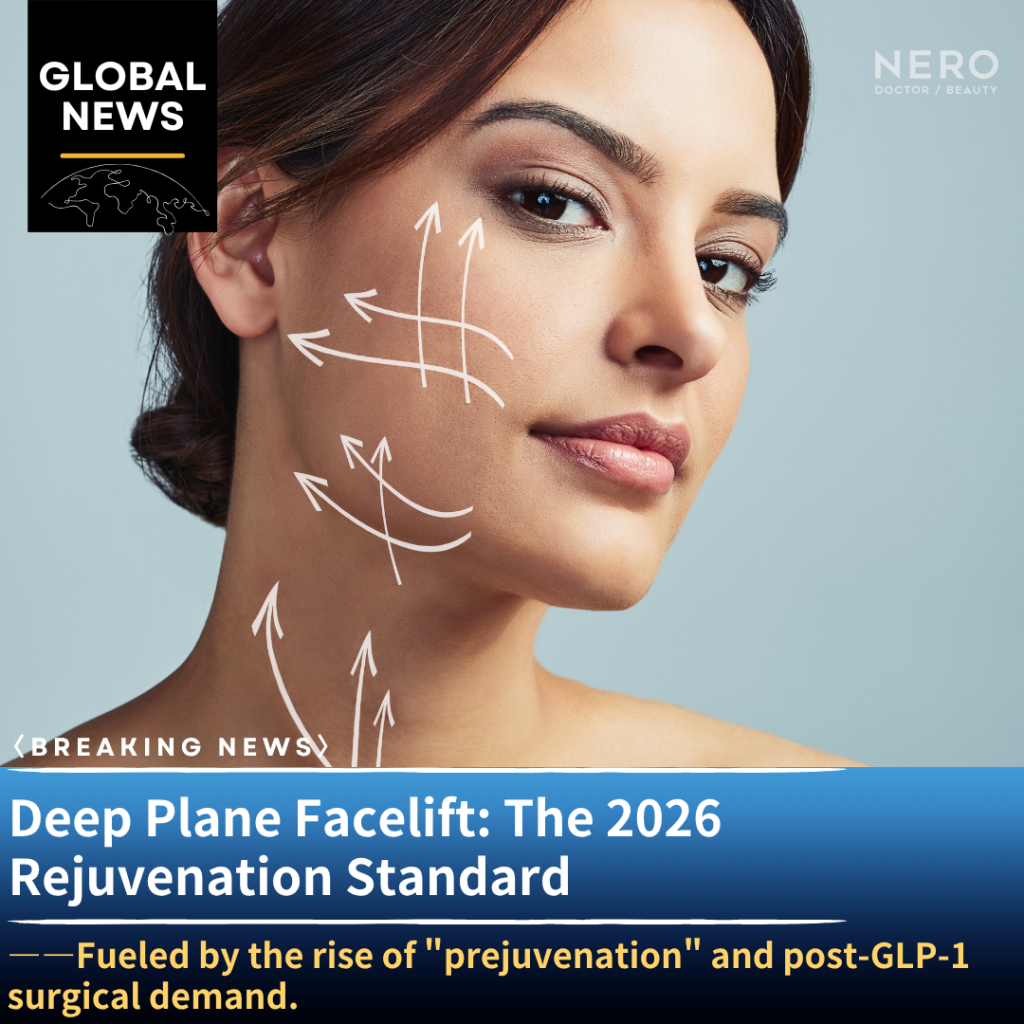
Deep plane facelift operates not on the skin surface,
but on the SMAS layer (superficial musculoaponeurotic system)—
the fibromuscular layer connecting facial muscles to the overlying skin—
along with the retaining ligaments that anchor facial tissue to bone.
Aging doesn’t simply stretch the skin.
It causes descent of deep facial structures.
Deep plane technique accesses that root cause directly,
repositioning tissues to their anatomically correct location.
The result: natural-looking rejuvenation with reported longevity of 10–15 years.
Patients frequently describe the outcome as “I don’t look like I had surgery”—
because the face moves naturally when the structure, not the skin, has been corrected.
Three Forces Reshaping Aesthetic Surgery in 2026
① Deep Plane Adoption — The Globalization of “Underdone” Surgery
ASPS surgeons describe the 2026 facelift trend as
“targeted correction, structural support, and preservation of natural expression.”
The shift is away from comprehensive full-face transformation
toward precision procedures targeting the jawline, neck, and periorbital area.
Deep plane technique is the technical foundation enabling this philosophy.
② Prejuvenation — Preventive Surgery Enters the 20s and 30s
“Culturally, the U.S. continues to see younger entry points into cosmetic surgery.
Patients in their late 20s, 30s, and early 40s are choosing
preventive, proactive procedures before aging becomes visible.”
— Dr. Hamilton, ASPS (December 2025)
The value shift: from “fix it when it breaks” to “design before it does.”
Prejuvenation is not about vanity—it reflects a growing understanding
that early structural intervention may reduce the need for more invasive correction later.
③ Post-GLP-1 Surgical Demand — A New Category Emerges
Rapid weight loss from GLP-1 medications (Mounjaro, Wegovy, Ozempic)
is generating a distinct set of aesthetic concerns:
facial volume loss, excess skin on the neck, abdomen, and arms.
“Ozempic Face” facelifts and post-weight-loss body contouring
are among the fastest-growing surgical categories entering 2026.
This is not a niche trend—it reflects a structural shift in the patient population
seeking aesthetic surgery.

The term “deep plane” is appearing more frequently in clinics worldwide—
but the technique demands years of specialized training to execute correctly.
A clinic claiming to offer deep plane facelift
is only as credible as the surgeon’s documented experience.
Before consulting, NERO recommends asking:
“How many deep plane procedures does this surgeon perform annually?”
“Are there before-and-after photos showing results at 5+ years post-op?”
These are not optional questions—they are the minimum standard of due diligence.
The question is no longer
“where do we pull?”
It’s “what do we put back—
and where does it belong?”
- Deep plane facelift—repositioning the SMAS layer and retaining ligaments—
is becoming the global standard for natural, long-lasting rejuvenation (10–15 years).
“Underdone” is the new design philosophy. - Prejuvenation is rising among patients in their 20s and 30s.
The cultural shift: design against aging before it appears,
rather than correcting it after the fact. - Post-GLP-1 surgical demand—facial volume restoration and excess skin repair—
is one of the fastest-growing new categories in aesthetic surgery entering 2026. - When evaluating a surgeon, confirm their annual case volume for deep plane procedures
and request long-term before-and-after documentation (5+ years).
Frequently Asked Questions
Deep plane goes deeper—releasing the retaining ligaments that tether facial tissue to bone,
then repositioning the entire composite flap.
The result is generally considered more natural and longer-lasting,
but the technique is significantly more complex and time-intensive.
Which approach is appropriate depends on the patient’s anatomy and aging pattern—
a thorough consultation with a qualified surgeon is essential.
before proceeding with any body contouring or facial restoration surgery.
Operating during active weight loss risks further skin laxity after the procedure,
potentially compromising the surgical outcome.
Timing should be planned in close coordination with both the prescribing physician
and the operating surgeon.
For most patients in their 20s, it refers to non-invasive or minimally invasive interventions—
such as neuromodulators, skin quality treatments, or structural assessments—
rather than full surgical procedures.
Surgical prejuvenation (e.g., early brow lift or blepharoplasty) is considered
on a case-by-case basis, based on anatomy and documented progression of aging.
A board-certified plastic surgeon consultation is the appropriate starting point.
Sources
American Society of Plastic Surgeons (ASPS), “Looking into the future: Plastic surgery trends for 2026,” December 29, 2025 /
International Society of Aesthetic Plastic Surgery (ISAPS), “ISAPS Global Survey 2023,” 2024 /
IAPAM, “Top Aesthetic Medicine Trends to Watch in 2026,” March 26, 2026 /
PubMed, “Trends in Surgical and Nonsurgical Aesthetic Procedures: A 14-Year Analysis of ISAPS,” DOI: 10.1097/PRS.0000000000011530 /
La Belle Vie Cosmetics, “2026 Plastic Surgery Trends,” January 30, 2026