📌 Key Takeaways
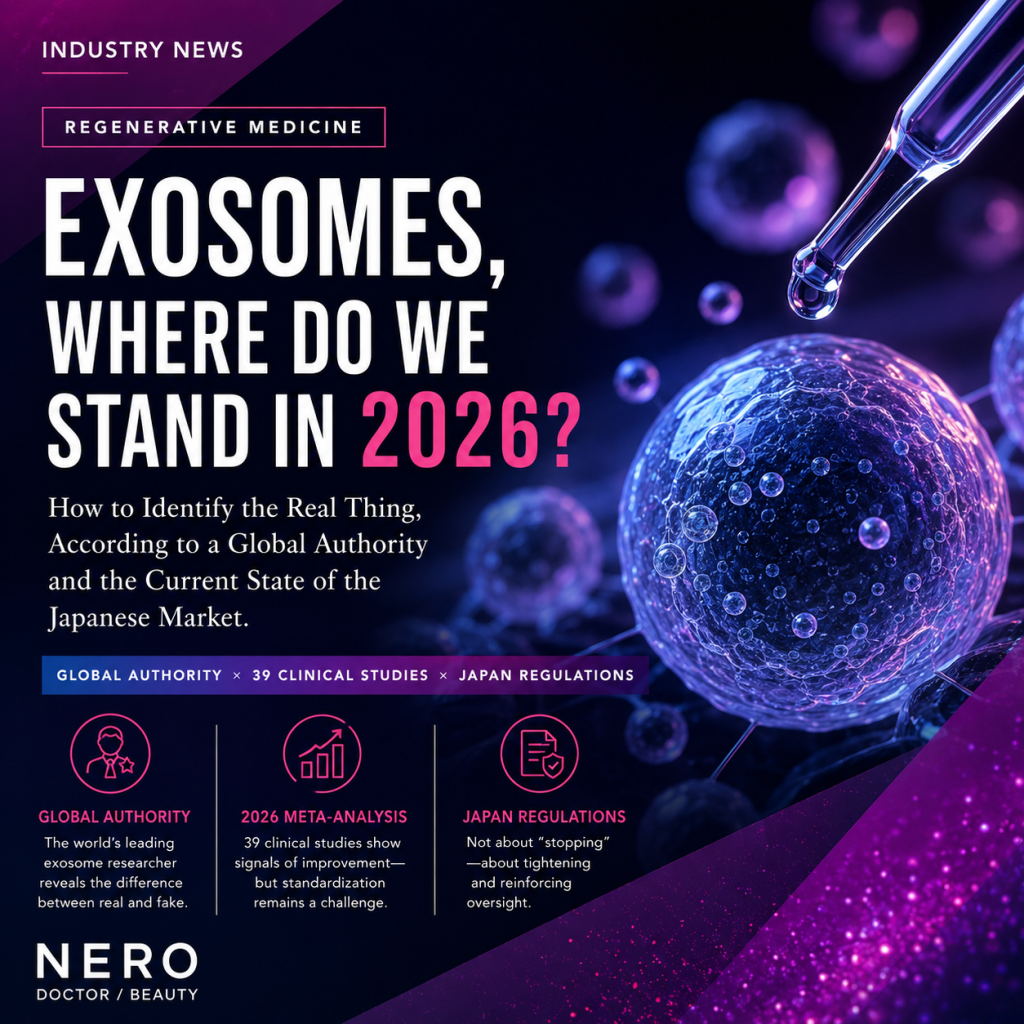
- A 2026 systematic review of 39 human clinical trials reported a 20.2% reduction in facial wrinkles
and a 23.6% improvement in hair density —
but flagged significant standardization gaps across studies. - Zero exosome products have received FDA approval for cosmetic use as of 2026.
Japan’s Ministry of Health (MHLW) has issued four consecutive regulatory notices since 2024,
tightening oversight without imposing a full ban. - Prof. Takahiro Ochiya (Tokyo Medical University), ranked #1 globally in exosome research,
warns that “high-concentration exosome” claims are often scientifically meaningless
without specifying cell origin, purification method, and functional activity. - Three questions every patient should ask before booking an exosome treatment —
covering GMP manufacturing, legal compliance, and honest disclosure of unknowns.
“Do exosomes actually work?”
It’s one of the most common questions NERO receives.
Clinic advertisements promise “rejuvenation through high-concentration exosomes” and “skin regeneration via stem cell-derived formulas.”
Prices range from a few hundred to several thousand dollars.
And clinics often contradict each other.
To cut through the noise, NERO cross-referenced three primary sources:
① The expert perspective of Prof. Takahiro Ochiya (Tokyo Medical University), ranked #1 globally in exosome research
② A 2026 meta-analysis covering 39 human clinical trials (PubMed PMID: 41800726)
③ Japan’s MHLW regulatory actions from 2024 through 2026
The conclusion: exosomes have moved from “hype-driven” to “data is growing, but standardization remains incomplete.”
Not a finished therapy. Not a fraud.
Knowing precisely where the field stands is the starting point for any informed decision.


INDEX
What the World’s Top Exosome Researcher Warns About Market Claims
Prof. Takahiro Ochiya holds a specially appointed professorship at Tokyo Medical University.
According to the university’s official profile, he is ranked #1 globally among extracellular vesicle (exosome) researchers.
NERO has published a dedicated feature article based on his insights.
Two core warnings from Prof. Ochiya stand out above all others.
What matters is cell origin, purification method, and functional biological activity.
A product labeled “high-concentration” but manufactured through crude purification
offers no guarantee of efficacy or safety.
Conditioned medium is a mixture of everything secreted by cultured cells —
it is fundamentally different from purified, isolated exosomes.
Knowing which one a clinic is actually using is the minimum baseline for evaluation.
Prof. Ochiya’s position is not that exosomes don’t work.
His point is that “research-grade exosomes and products that merely borrow the name are entirely different things.”
Receiving treatment without understanding that distinction carries real risk.
Japan’s MHLW Is Not Banning Exosomes — It’s Tightening the Rules
A review of Japan’s Ministry of Health, Labour and Welfare (MHLW) update page reveals
a sustained pattern of regulatory action on exosomes and cell-secreted products
from 2024 through 2026.
Reading this sequence of actions, the MHLW’s stance is clearly not a blanket prohibition.
It is a sustained effort to reassess provider eligibility, facility standards, and safety management.
How Far Has the Global Evidence Actually Advanced?
A 2026 systematic review and meta-analysis (PubMed PMID: 41800726) analyzed 39 human clinical trials —
26 focused on skin and 13 on hair —
and also noted 9 ongoing clinical trials in the U.S., Iran, and China.
The international research community’s verdict is clear:
“Data is accumulating — but standardization is not yet sufficient to call this a finished therapy.”
This assessment aligns precisely with Prof. Ochiya’s warnings about the Japanese market.
Three Questions to Ask Before Your Appointment
and each carries a different level of clinical evidence.
Clinics that can also explain their purification process and GMP compliance
are more likely to understand what they’re actually administering.
may require a formal treatment plan submission under the Act on the Safety of Regenerative Medicine.
Ask: “Under what legal framework is this treatment being provided?
Is there a registered plan or reference number I can verify?”
between well-evidenced treatments and those still in research phases.
A clinic that openly says “standardization is still incomplete”
or “long-term safety data remains limited”
is demonstrating a level of honesty worth trusting.

When we produced the feature with Prof. Ochiya,
the line that stayed with me most was this:
“Even I — someone who researches exosomes —
am cautious about the products circulating in the market.”
That’s the world’s leading expert speaking.
And yet the same market is flooded with ads promising
“rejuvenation through high-concentration exosomes.”
The fact that Japan’s MHLW is tightening — not banning —
is an important signal for the industry.
NERO doesn’t tell you not to seek treatment before the regulatory framework is complete.
But we do believe that being the kind of patient who asks
“Why this product? Who manufactures it?”
is the most powerful form of self-protection available.
Summary
- Prof. Takahiro Ochiya (Tokyo Medical University) warns that “high-concentration exosome” claims
are often scientifically meaningless.
Cell origin, purification method, and functional activity define quality —
and stem cell conditioned medium is not the same as purified exosomes. - Japan’s MHLW issued four consecutive regulatory actions from 2024 to 2026,
covering safety notices, facility audits, manufacturing guideline revisions, and self-audit requests.
The direction is tightening oversight, not prohibition. - A 2026 international systematic review reported measurable improvement signals
but explicitly cited protocol heterogeneity, lack of standardization,
and zero FDA-approved products as persistent limitations. - Three pre-appointment checkpoints:
① Confirm cell origin, purification method, and GMP status.
② Verify the legal framework and any required registration.
③ Choose clinics that honestly disclose what remains unknown.
Can you share the product’s cell origin, purification method, manufacturing details,
and any required registration or plan number?”
A clinic that can answer this clearly is where trust begins.
Frequently Asked Questions
However, Japan’s MHLW has issued repeated safety alerts,
strengthened oversight requirements, and requested facility self-audits from 2024 through 2026.
The regulatory direction is enhanced supervision, not prohibition.
For patients, the practical safety check is to ask:
“Under what legal framework is this treatment offered,
and is there a registered treatment plan on file?”
“Salmon-derived” products typically contain PDRN (polydeoxyribonucleotide),
a nucleic acid fragment — which is a distinct substance from exosomes (extracellular vesicles).
The term “salmon exosome” is often used loosely and can be misleading.
Stem cell-derived exosomes require complex cell culture manufacturing processes.
Rather than asking which is “better,” the priority is understanding exactly what substance is being used.
carry different systemic absorption risks compared to injections or IV administration.
Some clinical studies have reported findings in this area.
That said, no FDA-approved exosome products exist for cosmetic topical use either.
Key factors to verify include cell origin, manufacturing quality, and storage conditions —
exosomes are biologically fragile and highly sensitive to handling.
Ask your provider whether the product comes from a verified, reputable supplier.
Sources:
1. NERO DOCTOR/BEAUTY Feature. “Do Exosomes Really Work? The Science Behind the Buzzword, Explained by a World Authority.” Supervised by Prof. Takahiro Ochiya, Tokyo Medical University. nero-drbeauty.com/special-article/exosome/
2. Japan Ministry of Health, Labour and Welfare. “Regenerative Medicine Updates.” mhlw.go.jp (Verified August 2026)
3. MHLW Administrative Notice. “On Medical Practices Using Stem Cell Conditioned Medium and Exosomes.” July 31, 2024. PDF
4. PubMed PMID: 41800726. Systematic Review + Meta-Analysis of 39 Human Exosome Clinical Trials. 2026.
5. PubMed PMID: 41800722. Review on Exosome Manufacturing Quality and Standardization. 2026.
6. PubMed PMID: 41572953. Regeneration in Aesthetic Medicine: Mechanisms, Evidence, and Clinical Boundaries. J Cosmet Dermatol. 2026.