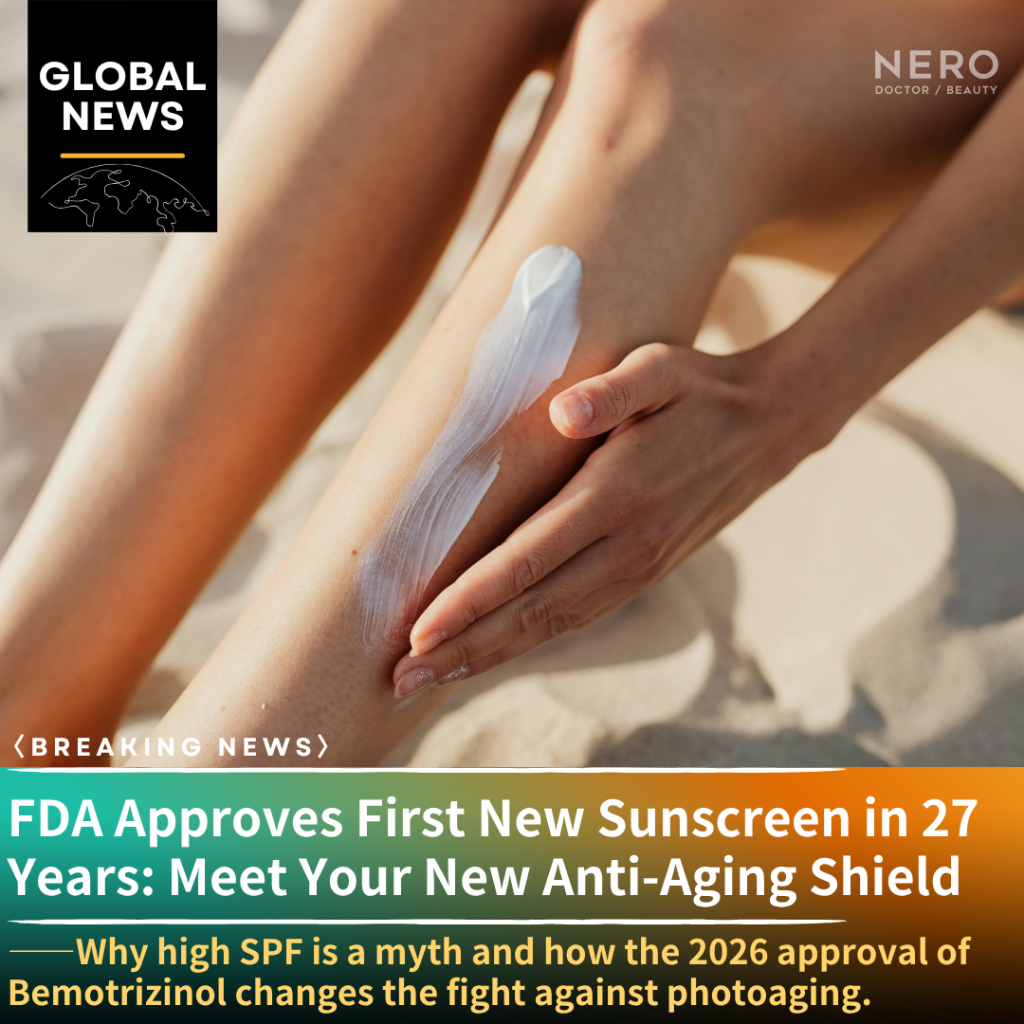
📌 Key Takeaways
- In June 2026, the FDA approved bemotrizinol (PARSOL® Shield) —
the first new sunscreen active ingredient approved in the U.S. since 1999. - EWG’s 2026 Sunscreen Guide found that ~80% of products (2,234 out of 2,784)
fail to meet its safety and efficacy standards. - “High SPF = safe” is a myth.
SPF only measures UVB protection — UVA, the primary driver of skin aging, is often underprotected. - The evidence-based baseline: SPF 30+, broad-spectrum coverage,
reapplied every 2–3 hours.
Every summer, the sunscreen aisle presents the same overwhelming array of numbers and labels.
SPF 30. SPF 100. Broad Spectrum. Mineral. Chemical. PA++++.
Most people reach for what they used last year and move on.
This year, there’s a meaningful reason to pause.
In June 2026, the U.S. FDA approved bemotrizinol — the first new sunscreen active ingredient
cleared for the American market in 27 years.
In the same month, the Environmental Working Group (EWG) released its 2026 annual sunscreen guide,
finding that roughly 80% of products on the market fail to meet its safety benchmarks.


INDEX
Why the U.S. Went 27 Years Without a New Sunscreen Ingredient
1999
(27 years ago)
Oxybenzone era
2026
June
Bemotrizinol (PARSOL® Shield)
20%
550 of 2,784 products
80% below standard (2026 survey)
For decades, sunscreen innovation in the United States was effectively frozen.
While Europe, Japan, and Australia had access to a broader range of UV filters —
including bemotrizinol — the FDA’s regulatory framework made it prohibitively difficult
to introduce new active ingredients.
That changed with the passage of the SAFE Sunscreen Standards Act in late 2025,
which streamlined the approval pathway for ingredients already proven safe
in other major regulatory markets.
The June 2026 approval of bemotrizinol was the direct result.
Bemotrizinol is an organic UV filter with a long safety record in Europe, Japan, and Australia.
Marketed under the trade name PARSOL® Shield, it offers broad-spectrum coverage
with particular strength in the UVA-I range — the deep-penetrating wavelengths
most responsible for photoaging.
Expect to see “PARSOL Shield” listed on U.S. sunscreen labels in the near future.
UVB vs. UVA: Which One Is Actually Aging Your Skin?
One of the most persistent misunderstandings in sun protection:
SPF only measures protection against UVB rays.
UVA — the primary driver of premature skin aging — is largely invisible on most product labels.
Yet it penetrates deeper, passes through glass, and is present year-round at consistent intensity.
or “Broad Spectrum” label (U.S.)
Research suggests that up to 80% of visible skin aging is attributable to UV exposure —
primarily UVA.
A sunscreen strategy focused solely on SPF numbers
leaves the most damaging wavelength largely unaddressed.
SPF 100 Is Not Twice as Protective as SPF 50
⚠️ The difference between SPF 50 and SPF 100 is just 1%. EWG warns that very high SPF numbers create a false sense of security.
How to Choose Sunscreen in 2026: 5 Evidence-Based Rules
SPF: Minimum SPF 30 for daily use; SPF 50 for extended outdoor activity.
Beyond SPF 50, the marginal gain in UVB protection is negligible —
while the ingredient load increases.
UVA protection: Look for “Broad Spectrum” (U.S.) or PA++++ (Japan/Asia).
This is the most critical factor for preventing photoaging.
SPF alone tells you nothing about UVA defense.
Reapply every 2–3 hours — immediately after swimming or heavy sweating.
No sunscreen, regardless of SPF, maintains full efficacy without reapplication.
Use enough: approximately 1–2g for the face (about ⅓ teaspoon).
Under-application is one of the most common errors —
and it significantly reduces the effective SPF you actually receive.
Check ingredients at EWG’s Skin Deep database (ewg.org/skindeep).
Oxybenzone, in particular, has been flagged for potential endocrine-disrupting activity.
Mineral filters (zinc oxide, titanium dioxide) are generally considered lower-risk.

What the U.S. finally did in 2026 —
Europe and Japan had done decades earlier.
The flip side: American sunscreens have long lagged behind
in ingredient sophistication.
That gap is now closing.
But the principle of balanced UVA protection
matters regardless of which market you shop in.
Choosing a higher SPF matters far less
than applying enough and reapplying consistently.
- The FDA approved bemotrizinol (PARSOL® Shield) in June 2026 —
the first new U.S. sunscreen active ingredient since 1999.
Expect it on American product labels soon. - EWG’s 2026 guide found ~80% of sunscreens fail safety standards.
“High SPF” is not a proxy for comprehensive protection. - UVA is the primary driver of visible skin aging.
Broad Spectrum labeling (U.S.) or PA++++ (Asia) is non-negotiable. - Apply 1–2g to the face and reapply every 2–3 hours.
Consistent reapplication outperforms any SPF number.
The June 2026 FDA approval now allows it to be used in U.S. formulations as well.
Check ingredient labels or brand websites to confirm whether a specific product contains it.
by sensitive skin and children.
Chemical sunscreens tend to have lighter textures,
but certain ingredients — particularly oxybenzone — have been flagged by EWG
for potential endocrine-disrupting effects.
The best sunscreen is the one you’ll actually use correctly and consistently.
The key is applying the right amount (1–2g for the face)
evenly and consistently, then reapplying every 2–3 hours.
Reapplication frequency matters more than chasing a higher SPF number.
Sources
– U.S. Food and Drug Administration. “Sunscreen: How to Help Protect Your Skin from the Sun.” FDA.gov. Updated June 2026.
– The Skin Cancer Foundation. “The Skin Cancer Foundation Responds to FDA Approval of First New Sunscreen Active Ingredient in More Than 25 Years.” June 9, 2026.
– Environmental Working Group. “EWG’s 20th Annual Guide to Sunscreens.” May 19, 2026.
– HealthCentral. “New Sunscreen Laws: What the Latest Formulas Are.” March 24, 2026. (SAFE Sunscreen Standards Act overview.)