📌 Key Takeaways
- “Humanmaxxing” — the practice of combining biohacking, longevity science, and advanced medicine
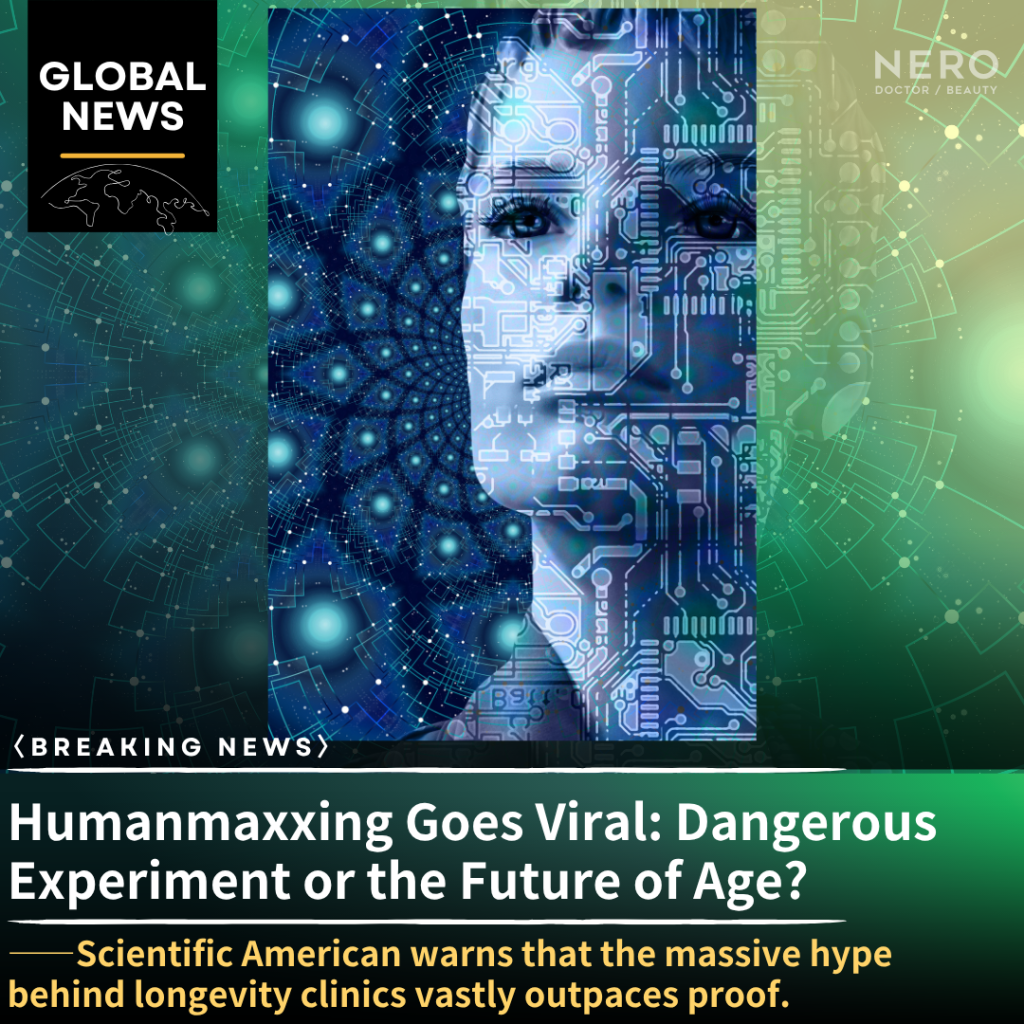
to maximize human potential — went viral after Fox News coverage on June 28, 2026. - That same week, Scientific American published a warning:
“No proven medical intervention exists that targets aging itself
to extend human lifespan.” (June 16, 2026) - Exosome therapy, NMN, and peptide injections — popular in aesthetic clinics globally —
share the same structural problem:
animal data exists, but large-scale human RCTs remain scarce. - The only reliable self-defense: ask for the evidence before you consent,
not after.
“My clinic recommended an exosome IV drip. Does it actually work?”
“Is NMN infusion really meaningful for anti-aging?”
“I heard peptide injections can reverse aging — is there science behind that?”
These are honest questions — and in June 2026, the global media landscape
gave two very different answers at the same time.
On one side: Fox News (June 28) amplifying the rise of Humanmaxxing.
On the other: Scientific American (June 16) publishing a sharp scientific warning.
Both appeared in the same week. That collision is worth examining closely.


INDEX
What Is Humanmaxxing? Bryan Johnson and the Biohacking Frontier
Humanmaxxing is the practice of combining biohacking, longevity science,
and advanced medical interventions to “maximize human potential” —
as reported by Fox News on June 28, 2026.
Its most prominent figure is tech entrepreneur Bryan Johnson,
who spends millions of dollars annually on his longevity project “Blueprint.”
Dave Asprey, who calls himself the “father of biohacking,”
has publicly stated his goal is to live to 180.
These practices spread rapidly on social media,
carrying the message that biological age can be reversed.
Scientific American’s Warning: “A Dangerous Experiment”
On June 16, 2026, Scientific American published:
“Silicon Valley’s longevity biohackers are engaged in a dangerous experiment.”
Andrew Steele, an independent longevity researcher based in London, stated:
“There is currently no proven medical intervention
that targets aging itself to extend human lifespan.”
This is not a fringe opinion.
It reflects the current scientific consensus:
enthusiasm for longevity interventions has outpaced the clinical evidence.
The gap between what is being sold and what has been proven
is the central issue — not just in Silicon Valley, but globally.
Exosomes, NMN, and Peptides: The Same Structural Problem
You might assume Humanmaxxing is a Western phenomenon.
But aesthetic clinics across Asia — including Japan —
offer treatments with the exact same evidence gap.
Here is where the science currently stands:
Current Evidence Levels by Treatment
Illegal under U.S. federal law; zero FDA approvals.
Regulatory gray zone in Japan. No large-scale human RCTs.
Anti-aging effects demonstrated in animal models.
Human clinical trials on skin aging and aesthetic outcomes remain scarce.
Primarily animal model data. Not FDA-approved.
No large-scale human proof of efficacy.
Supported by large-scale epidemiological research.
Promising as a biological age estimator.
Proof of intervention effects is still emerging.
“It’s Trending” Is Not Evidence — 3 Questions to Ask Your Clinic
Whether your physician can answer these clearly
is itself a meaningful data point.

The fact that Scientific American and Fox News covered biohacking
in the same week — with completely opposite tones — is not a coincidence.
2026 is the year where uncritical enthusiasm for unproven interventions
and rigorous scientific pushback are both peaking simultaneously.
The debate around exosomes, NMN, and peptides in aesthetic medicine
follows exactly the same structure.
“It’s trending” is not evidence. Verifying the evidence before you consent
is the only reliable way to protect yourself.
- “Humanmaxxing” — biohacking meets longevity science —
went viral via Fox News in June 2026. - Scientific American responded the same week:
“No proven medical intervention exists to extend human lifespan
by targeting aging itself.”
Enthusiasm and scientific caution are peaking simultaneously. - Exosome therapy, NMN, and peptide treatments share the same evidence gap:
animal data and early signals exist,
but large-scale human RCTs are limited. - The standard for safe aesthetic medicine is simple:
verify the evidence first, then decide.
Frequently Asked Questions
In the United States, human-derived exosomes are illegal under federal law with zero FDA approvals.
In Japan, the regulatory status remains a gray zone as of 2026.
If you are considering this treatment, ask your physician for a clear explanation
of the current evidence and the known risk profile before making a decision.
However, large-scale human clinical trials specifically examining
skin aging and aesthetic outcomes remain very limited as of 2026.
The accurate framing is: “Not proven ineffective” does not equal “proven effective.”
If you choose to supplement, consult a physician
and stay within established safety parameters.
① Does a randomized controlled trial (RCT) in humans exist for this treatment?
② Is it approved or cleared by the FDA, MHLW, or an equivalent regulatory body?
③ Can your physician cite the specific studies supporting it?
④ Does the clinic avoid absolute claims like “guaranteed results” or “zero side effects”?
Building this habit of verification is the most reliable form of self-protection.
Sources:
• Fox News. “Humanmaxxing is the latest wellness trend pushing human optimization.” June 28, 2026.
• Scientific American. “Silicon Valley’s longevity biohackers are engaged in a dangerous experiment.” June 16, 2026. scientificamerican.com
• Hone Health. “26 Longevity Trends That Will Define 2026.” June 2026. (Survey of 200+ physicians)