📌 Key Takeaways
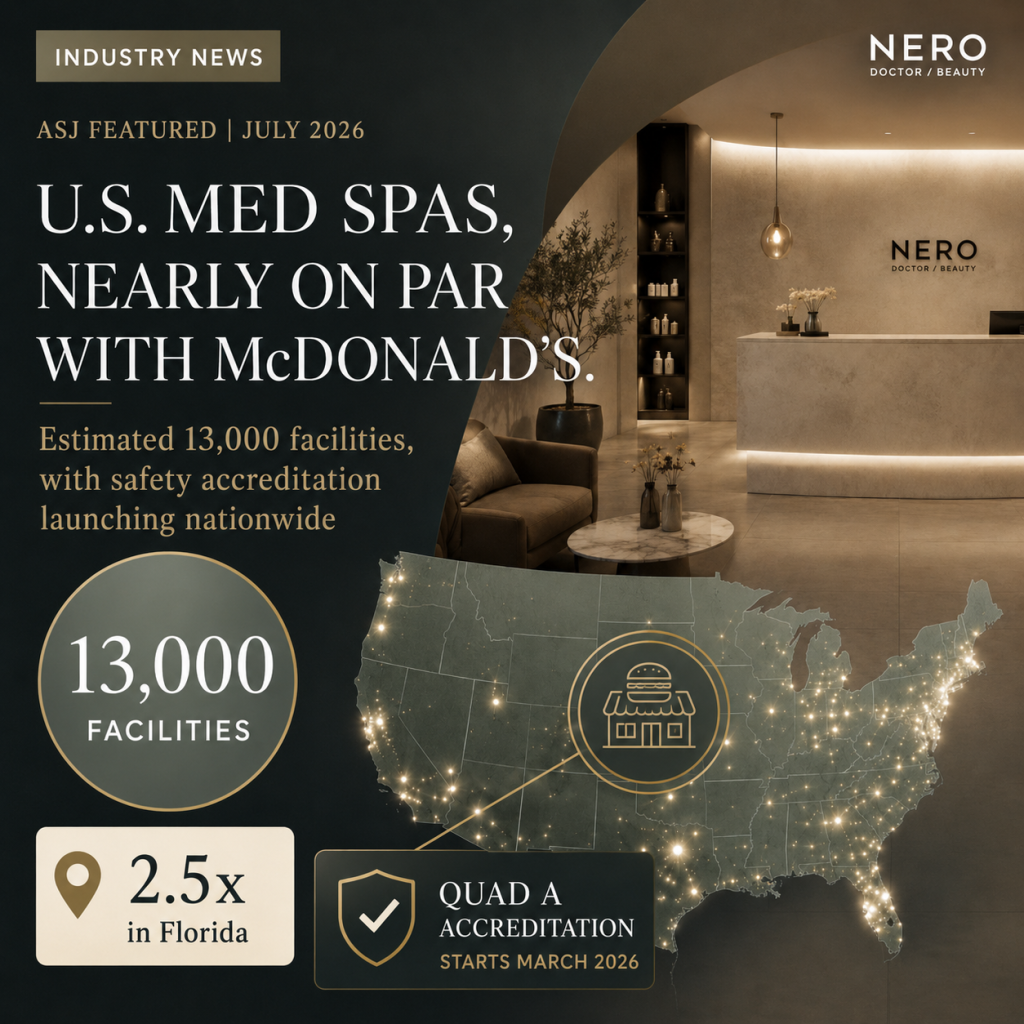
- The U.S. has an estimated 13,000 med spas as of 2026 —
roughly equal to the number of McDonald’s locations nationwide.
In Florida alone, med spas outnumber McDonald’s by 2.5x. - QUAD A, a leading U.S. healthcare accreditation body,
launched a voluntary national med spa certification program in March 2026,
covering infection control, emergency protocols, and practitioner credentials. - The core problem is not zero regulation —
it’s the lack of consistent, nationwide safety standards
across a fragmented, state-by-state regulatory landscape. - Accreditation is one signal, not a guarantee.
Patients everywhere should develop the habit of asking
the right questions before any aesthetic procedure.
There are now roughly as many med spas in the United States as there are McDonald’s restaurants.
The estimated count: 13,000 facilities by end of 2026.
In Florida, med spas outnumber McDonald’s by a factor of 2.5.
That statistic is not a punchline.
It reflects a decade of explosive growth in non-surgical aesthetic medicine —
and a regulatory framework that has struggled to keep pace.
A peer-reviewed paper published in the Aesthetic Surgery Journal (July 2026 issue)
examines the safety implications of this growth
and the significance of a new national accreditation program
that began rolling out in March 2026.


INDEX
What Is a Med Spa — and Why Does the Distinction Matter?
A med spa is a standalone facility that offers medical aesthetic treatments —
such as Botox, dermal fillers, and laser procedures —
in a spa-like environment.
Unlike a physician’s office or hospital-affiliated clinic,
med spas operate under varying state laws
and may be staffed by physicians, nurse practitioners (NPs),
physician assistants (PAs), registered nurses (RNs),
or licensed estheticians — depending on the state.
Oversight standards, sanitation requirements,
and emergency response protocols vary significantly by facility.
comparable to total McDonald’s locations nationwide
The rapid expansion of med spas reflects genuine consumer demand.
Treatments once available only in a physician’s office —
Botox, fillers, laser resurfacing —
are now accessible in more convenient, less clinical settings.
But the speed of growth has outpaced regulatory infrastructure.
The Aesthetic Surgery Journal paper puts it plainly:
“The world of med spas today is essentially the Wild West of retail medicine.”
March 2026: QUAD A Launches National Med Spa Accreditation
To be precise: med spas are not entirely unregulated.
Each state has its own licensing and supervision requirements.
Many facilities operate under physician oversight or delegation frameworks
involving NPs, PAs, and RNs.
The problem is not the absence of rules —
it is the absence of consistent, nationwide standards.
That is the gap the new QUAD A program is designed to address.
QUAD A (formerly known as the Accreditation Association for Ambulatory Health Care, AAAHC)
is a U.S.-based third-party accreditation body
for outpatient surgical centers and healthcare facilities.
It is widely regarded as the gold standard
for ambulatory surgery center accreditation.
The new med spa program builds on that track record —
but participation remains voluntary.
It is not a mandatory requirement for all med spas.
What QUAD A Accreditation Evaluates
What Patients Should Ask Before Any Aesthetic Procedure
The U.S. accreditation debate has direct relevance beyond American borders.
In many countries — including those with robust healthcare systems —
the aesthetic medicine sector operates with similar inconsistencies:
rapid growth, variable oversight, and limited patient-facing transparency.
Whether or not a formal accreditation system exists in your country,
the following questions apply universally.
a licensed physician, nurse practitioner, RN, or unlicensed practitioner?
adverse events during or after treatment?
approved by the relevant regulatory authority,
with a verifiable supply chain?
with adequate time for questions?

The “more med spas than McDonald’s” figure is not a joke.
Aesthetic clinics operating outside hospital systems
have proliferated globally — and the variance in safety standards
is a real, documented problem.
In the absence of formal accreditation,
the most powerful safety mechanism is an informed patient
who knows what questions to ask.
The fact that QUAD A accreditation is voluntary matters.
A non-accredited facility is not automatically unsafe.
An accredited facility is not automatically risk-free.
Accreditation is one data point — not a verdict.
What NERO wants readers to take away is not
“check for the certificate” —
it’s “develop the habit of questioning facility safety”
before every procedure.
Summary
- The U.S. has an estimated 13,000 med spas by end of 2026 —
rivaling McDonald’s nationally, and outnumbering them 2.5x in Florida.
The Aesthetic Surgery Journal describes the sector as
“the Wild West of retail medicine” —
not because regulation is absent,
but because standards have been inconsistent and fragmented. - In March 2026, QUAD A launched a voluntary national accreditation program
for med spas, evaluating facilities on infection control,
emergency preparedness, practitioner credentials,
and quality assurance. - The safety gap in aesthetic medicine is not unique to the U.S.
Patients globally should verify practitioner qualifications,
adverse event protocols, product approval status,
and informed consent practices before any procedure. - Accreditation is a useful signal — not a guarantee.
The most durable safety mechanism is a patient
who habitually asks the right questions.
such as Botox, dermal fillers, and laser procedures —
in a spa-like setting.
Unlike a physician’s office or hospital-affiliated clinic,
med spas are governed by state-level rules that vary widely,
and may be staffed by a range of licensed professionals
under different supervision frameworks.
that evaluates healthcare facilities against defined safety standards.
Its med spa program — launched in March 2026 — assesses facilities on
infection prevention, emergency response, practitioner credentials,
and quality assurance.
Accreditation is voluntary and signals a facility’s commitment to standardized safety —
but it is not a guarantee of zero risk.
patients should ask: Who is performing the procedure and what are their credentials?
Is there a protocol for managing adverse events?
Are the products used regulatory-approved with a verified supply chain?
Is informed consent obtained before treatment?
These questions apply universally — in the U.S., Japan, and beyond.
Sources:
1. Singer R, Jewell M, Saltz R, Fiala T. “Med Spas: Patient Safety and Accreditation.” Aesthetic Surgery Journal. 2026;46(7):786-789. doi:10.1093/asj/sjag085.
2. QUAD A. “MedSpas: Patient Safety and Accreditation.” QUAD A Blog. June 2026.