📌 Key Takeaways
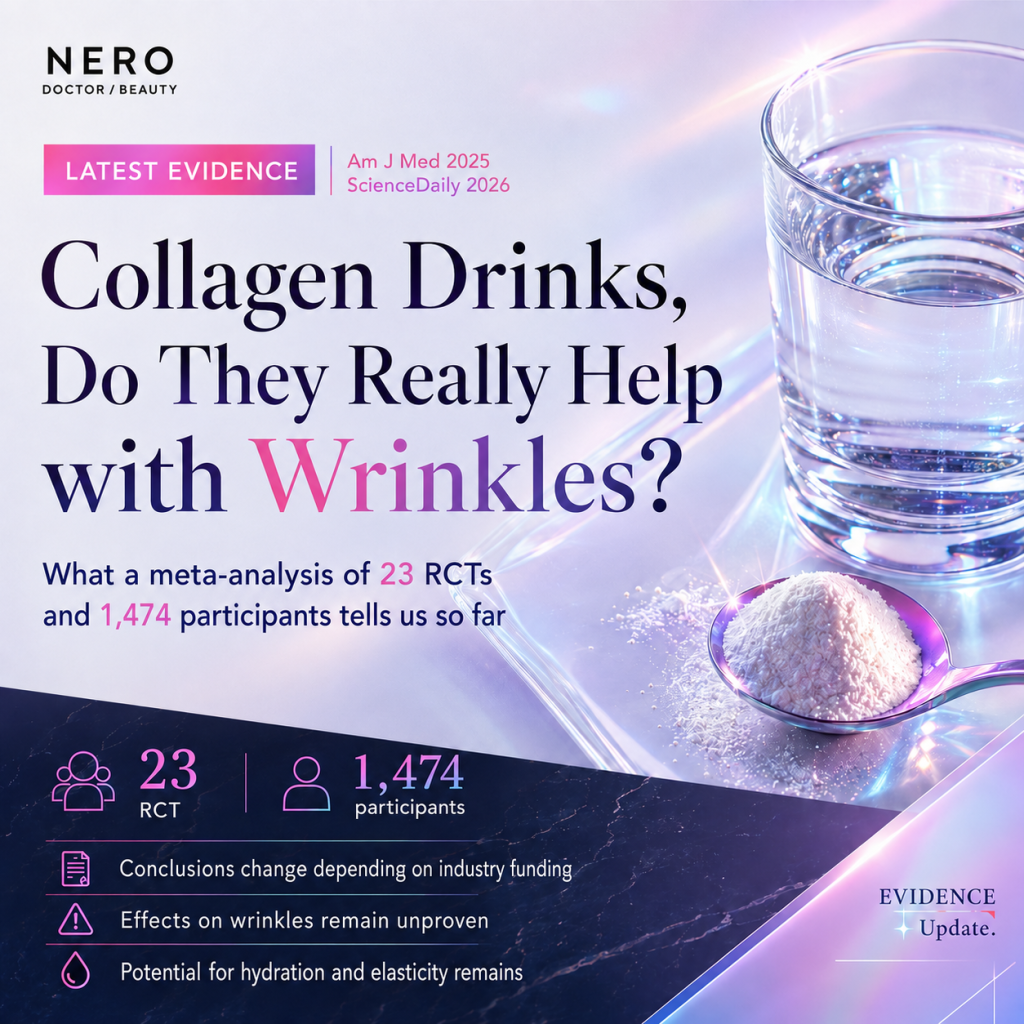
- A 2025 meta-analysis in The American Journal of Medicine (23 RCTs, 1,474 subjects)
found that when limited to high-quality, industry-independent studies,
oral collagen showed no significant benefit for hydration, elasticity, or wrinkles. - Studies showing positive effects were predominantly industry-funded and low-quality,
raising serious concerns about funding bias in collagen supplement research. - Collagen is broken down into amino acids during digestion
and does not reach the skin intact — a key biological limitation
explained by dermatologists at Tufts University School of Medicine. - For wrinkle concerns, evidence-backed alternatives include retinoids, SPF protection,
medical lasers, and dermal fillers — all supported by independent research.
You take a collagen drink every morning.
Maybe you mix collagen powder into your smoothie.
“My skin feels smoother” — but you’ve quietly wondered whether it’s real.
In 2025, The American Journal of Medicine published a meta-analysis
covering 23 randomized controlled trials (RCTs) and 1,474 subjects (PMID 40324552).
The conclusion was neither a simple “it works” nor “it doesn’t.”
In fact, the authors’ final verdict was sharper than either:
“There is currently no clinical basis to support collagen supplements
for the prevention or treatment of skin aging.”
Studies supporting benefits tended to be low-quality and industry-funded,
and the interplay between research quality and funding source
may have generated an illusion of efficacy.
The claim that “drinking collagen reduces wrinkles”
is not supported by high-quality, industry-independent research at this time.
That said, the potential for modest effects on hydration and elasticity
has not been entirely ruled out.
This article separates what may be possible from what remains unproven.


INDEX
- The Striking Finding from Am J Med 2025: Industry Funding Flipped the Results Across 23 RCTs
- “It Doesn’t Reach Your Skin Intact” — A Tufts Dermatologist Explains Collagen Digestion
- Separating “Possible” from “Unproven”: What the Evidence Actually Allows Us to Say
- Evidence-Backed Alternatives for Wrinkle Concerns: What Independent Research Actually Supports
- Summary
- Frequently Asked Questions
- Sources
The Striking Finding from Am J Med 2025:
Industry Funding Flipped the Results Across 23 RCTs
The most important finding of this meta-analysis
lies in the contrast between the overall analysis and the subgroup analysis.
Source: Lis DM, et al. Am J Med. 2025;138(9):1264-1277. PMID 40324552
What does this mean in practice?
Many of the studies showing collagen supplements “work”
were funded by pharmaceutical or supplement industry interests.
When those studies were excluded and only neutral, independent research was examined,
the apparent benefits disappeared.
This is the phenomenon known as industry funding bias.
Industry funding bias refers to the tendency for research results
to skew in favor of the financial interests of the sponsoring company.
It can influence study design, data interpretation,
and which results are selected for publication.
It can occur even in peer-reviewed journals.
This is why subgroup analyses by funding source are critical in meta-analyses.
When evaluating medical consensus, a key question is:
“Has the effect been demonstrated in independent studies free from industry funding?”
“It Doesn’t Reach Your Skin Intact” —
A Tufts Dermatologist Explains Collagen Digestion
Farah Moustafa, MD, a dermatologist at Tufts University School of Medicine,
explained the issue in ScienceDaily (January 29, 2026).
“Oral collagen supplements are not currently recommended
as a treatment for skin aging.
Collagen is broken down during digestion and absorption,
so it does not reach the skin in its original form.”
“Some studies show modest improvements in skin hydration and elasticity,
but those supporting benefits tend to be low-quality or industry-funded.
High-quality, industry-independent studies have not confirmed these effects.”
Collagen is broken down by digestive enzymes in the stomach into amino acids.
“Drinking collagen” does not mean collagen arrives at your skin intact.
The amino acids released may theoretically be used in the skin’s own collagen synthesis,
but the same is true of any dietary protein.
The specific benefit of consuming collagen over other protein sources
has not been established in independent research at this time.
Separating “Possible” from “Unproven”:
What the Evidence Actually Allows Us to Say
NERO does not conclude that “all collagen claims are false.”
A more precise breakdown looks like this:
Shown across multiple studies — though predominantly industry-funded ones.
This cannot be dismissed as entirely meaningless.
Hydrolyzed collagen peptides stimulating fibroblasts
is one proposed mechanism, though direct confirmation
from independent sources reviewed here remains limited.
Not confirmed in high-quality, industry-independent studies.
“Drinking collagen because I’m worried about wrinkles”
is a rationale with weak evidentiary support
under the current evidence base.
Evidence-Backed Alternatives for Wrinkle Concerns:
What Independent Research Actually Supports
For those concerned about wrinkles,
the following approaches have been repeatedly demonstrated
in independent research — unlike collagen supplements.
in stimulating collagen production and promoting epidermal renewal.
Among topical ingredients, retinoids carry some of the strongest evidence
for addressing skin aging.
is the most evidence-backed strategy for wrinkle prevention.
Consistent sunscreen use has been shown in independent research
to slow the progression of skin aging.
These should be selected after consulting with a qualified physician
to assess indications and risks.

I don’t want to reduce this topic to a binary “works or doesn’t work.”
What the Am J Med 2025 meta-analysis actually revealed
is the need to ask more specific questions:
What outcome? In what quality of study? Funded by whom?
“Possible modest benefit for hydration and elasticity.”
“Wrinkle reduction: unproven at this time.”
That is the accurate reading of the current evidence.
For industry professionals, the concept of industry funding bias
deserves serious attention — and it extends well beyond collagen.
It runs through aesthetic medicine and supplements broadly.
When communicating to patients that “this ingredient has proven benefits,”
the habit of asking “Has this been shown in industry-independent research?”
is what protects long-term credibility.
Summary
- The 2025 meta-analysis in The American Journal of Medicine (23 RCTs, 1,474 subjects, PMID 40324552)
showed statistically significant improvements in hydration, elasticity, and wrinkles in the overall analysis.
However, the authors’ final conclusion was:
“There is no clinical basis to support collagen supplements for the prevention or treatment of skin aging.”
When limited to high-quality, industry-independent studies, no benefits were confirmed. - Farah Moustafa, MD, Assistant Professor of Dermatology at Tufts University School of Medicine,
stated that “collagen is broken down during digestion and does not reach the skin intact”
(ScienceDaily, January 29, 2026).
Studies supporting efficacy tend to be low-quality or industry-funded,
and oral collagen is not currently recommended as a treatment for skin aging. - “Modest potential for hydration and elasticity” has not been entirely ruled out.
However, “wrinkle improvement” has not been confirmed
in high-quality, industry-independent research —
and should be categorized as unproven at this time. - For wrinkle concerns, evidence-backed options include
retinoids (strong independent evidence), UV protection (strongest evidence for prevention),
medical lasers, and dermal fillers —
all supported by research independent of supplement industry funding.
Frequently Asked Questions
However, if you are taking it specifically to reduce wrinkles,
you should understand that the current evidence does not support that rationale.
If your expectation is modest improvement in hydration or skin feel,
and you experience no adverse effects,
continuing is a personal choice NERO does not categorically oppose.
But that is a separate question from whether wrinkle reduction has been proven.
it did not sufficiently test differences by brand, quality, or dosage.
There is currently no evidence that a premium-priced product
has been confirmed effective in independent research.
Price and brand prestige do not necessarily correlate with evidentiary quality.
Oral collagen faces the fundamental barrier of digestive breakdown.
Injectable approaches — delivering collagen or collagen-stimulating agents
directly into the dermis — operate through a separate biological pathway
and are evaluated independently.
Biostimulators such as poly-L-lactic acid (Sculptra)
and calcium hydroxylapatite (Radiesse)
stimulate the body’s own collagen production
and represent a distinct category of aesthetic medicine.
Sources
1. Lis DM, et al. “Effects of Collagen Supplements on Skin Aging: A Systematic Review and Meta-Analysis of Randomized Controlled Trials.” Am J Med. 2025;138(9):1264-1277. PMID 40324552. amjmed.com
2. ScienceDaily. “Dermatologists say collagen supplements aren’t the skin fix people expect.” January 29, 2026. sciencedaily.com (Comment by Dr. Farah Moustafa, Tufts University)
3. European Journal of Clinical Nutrition. “Efficacy and safety of hydrolyzed collagen supplementation on skin health outcomes.” 2026. nature.com