📌 Key Takeaways
- A cross-sectional study of 692 community-dwelling adults aged 65+ in Japan found that greater oral frailty deficits correlated with decline across more domains of WHO-defined Intrinsic Capacity (IC).
- Oral frailty was assessed across four functional dimensions:
chewing ability, tongue-lip motor function, oral dryness, and swallowing. - Homebound status partially mediated the relationship between oral frailty and IC decline —
but dietary diversity did not show a clear moderating effect in this study. - This is a cross-sectional study. Causal direction cannot be established.
The findings point to an association, not a proven mechanism.
Most people understand that oral health matters.
Fewer understand why it matters beyond cavities and cosmetics.
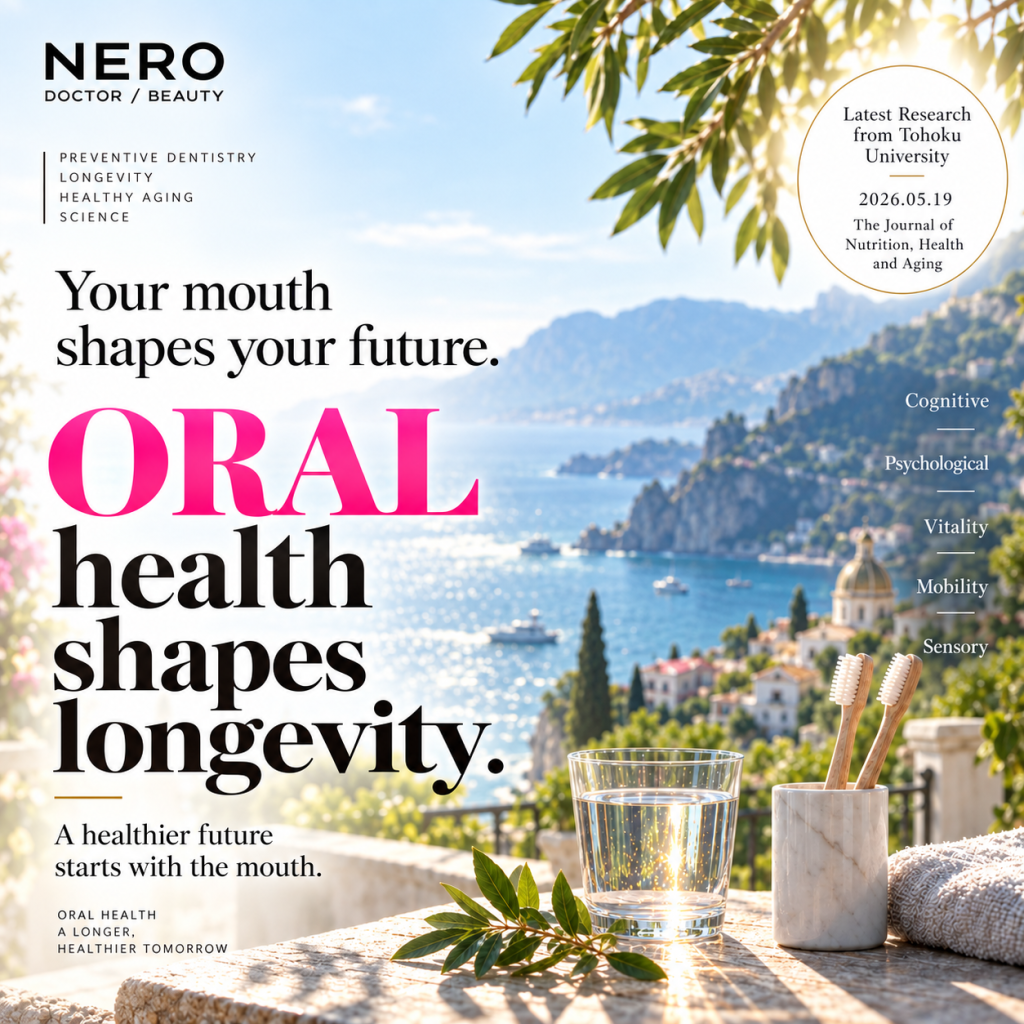
A study published May 19, 2026 in The Journal of Nutrition, Health and Aging offers a more systemic answer.
Researchers at Tohoku University Graduate School of Dentistry, led by Assistant Professor Takamasa Komiyama, examined 692 community-dwelling older adults across 11 municipalities in Akita and Miyagi prefectures, Japan.
Their finding: the more oral functional deficits a person had,
the more domains of WHO-defined Intrinsic Capacity showed decline.
This is not a study about tooth aesthetics.
It is a study about whether the mouth — as a functional system —
is connected to broader aging trajectories involving mobility, cognition, and psychological health.
NERO examines what the data confirms, and where caution is warranted.


INDEX
What Is Oral Frailty? Function Over Appearance
Oral frailty is not simply about tooth count.
It describes a decline in oral function — the mechanical and physiological capacity of the mouth to perform its core roles.
In this study, oral frailty was evaluated using two validated indices:
relevant to speech articulation and perioral muscle strength.
a factor in digestion, infection resistance, and swallowing safety.
The study used two composite indices: a 4-item international expert index,
and the OF-5 (the same 4 items plus current tooth count), widely used in Japanese clinical settings.
Tongue pressure was also assessed as a standalone indicator.
The key finding: participants with deficits in more of these functional components
also showed decline across a greater number of IC domains.
What Is Intrinsic Capacity? The WHO Framework for Healthy Ageing
Intrinsic Capacity is the framework proposed by the World Health Organization
as part of its Healthy Ageing initiative.
Rather than measuring disease alone, IC evaluates an individual’s composite functional abilities across five domains:
① Vitality: Nutritional status, energy, and physical reserves.
② Cognitive: Memory, executive function, and attention.
③ Psychological: Presence of depression, anxiety, or emotional dysregulation.
④ Locomotion: Gait, balance, and fall risk.
⑤ Sensory: Vision and hearing capacity.
Higher IC scores indicate a greater ability to function independently and actively,
regardless of chronological age.
What the Study Confirmed — and What It Did Not
This distinction matters.
Research coverage often collapses findings and implications into a single claim.
The Tohoku study is more nuanced than that.
· Homebound status partially mediated the relationship between oral frailty and IC decline —
suggesting that reduced social participation may be one pathway linking oral function to broader aging.
· Among IC domains, the association with psychological health was particularly notable,
per the primary source data from Tohoku University.
Claims that “eating a varied diet preserves IC” are not supported by these findings.
· Causal direction is unknown. As a cross-sectional study, it cannot determine whether oral frailty causes IC decline,
or whether declining IC makes individuals more susceptible to oral frailty.
· The sample is drawn from specific municipalities in northeastern Japan.
Generalizability to other populations requires caution.
Aesthetic dentistry — whitening, ceramic veneers, orthodontics — centers on appearance.
This study shifts the frame: oral function (chewing, swallowing, saliva, tongue pressure)
may be connected to mobility, cognition, and psychological health in ways that matter for longevity.
“A beautiful smile” and “a functioning mouth” are not the same clinical goal.
The latter may carry greater weight in the context of healthy ageing.
(NERO editorial perspective)

Preventive dentistry remains underutilized in many countries —
including Japan, where the cultural default is still “go to the dentist when it hurts.”
What this study points to is that oral functional decline
may be connected to mobility loss and cognitive change.
The shift from “dentistry for aesthetics” to “dentistry for function”
is not just a clinical preference — it may be a longevity imperative.
For clinics operating in the aesthetic dentistry space —
whitening, alignment, ceramics —
the demand signal worth watching is this:
chewing, swallowing, saliva production, and tongue strength
are becoming longevity metrics, not just clinical checkboxes.
Preventive dentistry × functional longevity
is a space most clinics have not yet entered.
Summary
- Published May 19, 2026 in The Journal of Nutrition, Health and Aging (DOI: 10.1016/j.jnha.2026.100880).
Lead author: Assistant Professor Takamasa Komiyama, Tohoku University Graduate School of Dentistry.
Cross-sectional study of 692 community-dwelling adults aged 65+ across 11 municipalities in Akita and Miyagi, Japan. - Participants with more oral frailty deficits — across chewing, tongue-lip motor function,
oral dryness, and swallowing — showed decline in a greater number of WHO IC domains
(vitality, cognitive, psychological, locomotion, sensory).
The association with psychological health was particularly strong per primary source data. - Homebound status partially mediated the oral frailty–IC relationship.
Dietary diversity did not demonstrate a clear moderating effect in this study. - Causal direction cannot be determined from a cross-sectional design.
The appropriate reading: oral functional maintenance may be associated with broader functional capacity —
a meaningful intersection of preventive dentistry and functional longevity. (NERO editorial perspective)
Tooth count is one component (included in the OF-5 index),
but functional decline can occur even with a full set of teeth.
The concept is broader than structural dentition.
vitality, cognition, psychological health, locomotion, and sensory function.
It shifts the focus from disease diagnosis to functional reserve —
how well a person can function regardless of their age or medical history.
Higher IC is associated with greater independence and quality of life in older adults.
It demonstrates an association between oral frailty and IC decline —
not a causal relationship.
It is equally possible that declining overall function contributes to oral frailty,
rather than the reverse.
Longitudinal research is needed to establish direction of effect.
Sources:
1. Komiyama T, Ohi T, E. Sato, M. Sato, Hattori Y. “Oral health, dietary variety, homebound status, and intrinsic capacity among community-dwelling older adults.” The Journal of Nutrition, Health and Aging. 2026. DOI: 10.1016/j.jnha.2026.100880 — Cross-sectional study. Causal direction and dietary diversity moderation effect not confirmed.
2. Tohoku University Press Release. “Association between oral frailty and intrinsic capacity clarified.” June 3, 2026. tohoku.ac.jp