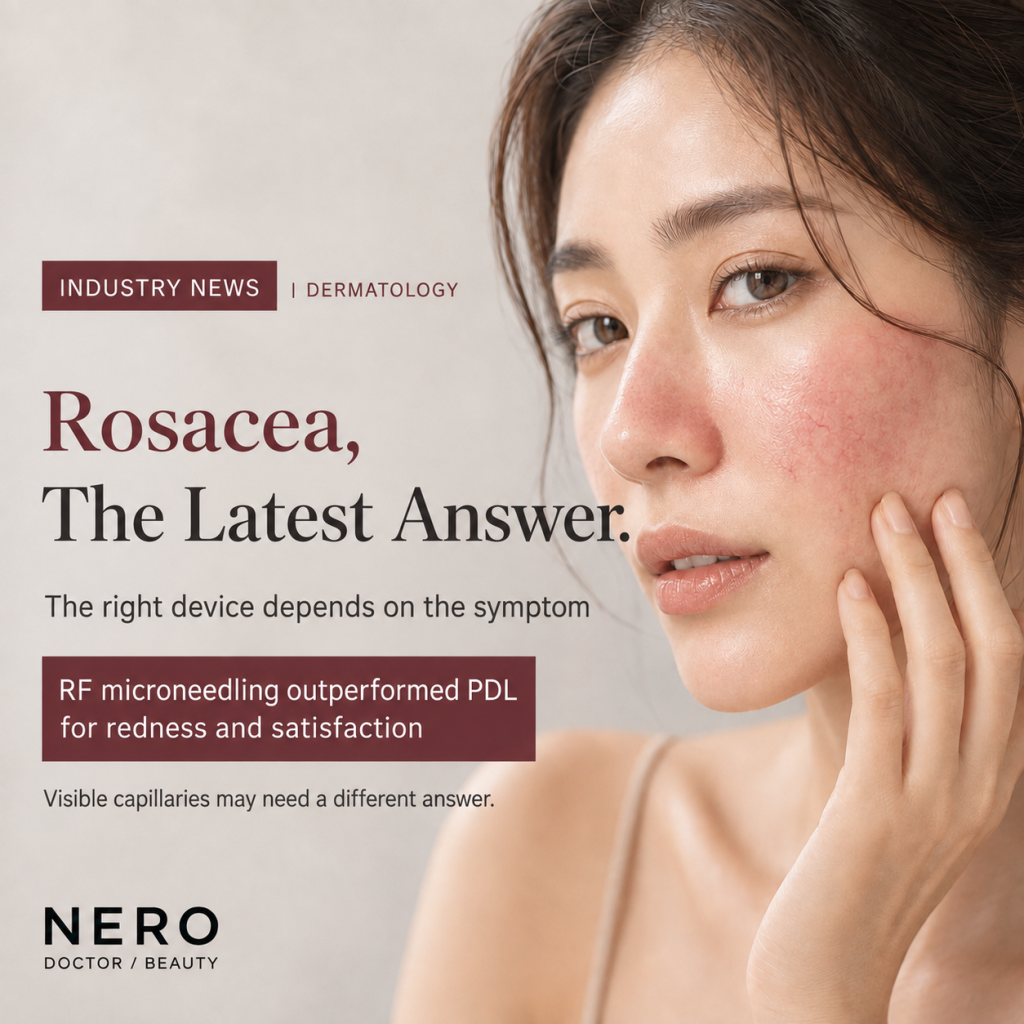
📌 Key Takeaways
- A November 2025 network meta-analysis from Hamburg University Medical Center
is the first study to cross-compare 10 device-based rosacea treatments
using RCT-level evidence. - RF microneedling significantly outperformed pulsed dye laser (PDL)
for both erythema reduction (MD –1.44) and patient satisfaction (MD –1.32). - For visible telangiectasia (broken capillaries),
oxymetazoline combined with PDL showed the strongest results (MD –0.58). - The optimal device depends on your specific symptom profile—
redness, visible vessels, or both require different treatment strategies.
“My cheeks are always red.”
“I can see capillaries through my skin—concealer doesn’t help.”
“My nose has been red for years and I don’t know what to do.”
These are among the most common complaints heard in aesthetic dermatology.
Yet until recently, patients and clinicians had little comparative data
to guide device selection for rosacea.
In November 2025, researchers at Hamburg University Medical Center published
what may be the first systematic review and network meta-analysis
to cross-compare laser and energy-based devices for rosacea treatment.
The findings challenge some long-held assumptions—
and offer a clearer framework for symptom-specific decision-making.


INDEX
What Is Rosacea—and How Is It Different from General Facial Redness?
the central face—cheeks, nose, forehead, and chin.
Core features include transient flushing, persistent erythema,
telangiectasia (visible dilated capillaries), inflammatory papules and pustules,
and in some cases phymatous changes (e.g., rhinophyma).
Prevalence estimates range from under 1% to 22% depending on population,
diagnostic criteria, and region.
The condition carries significant psychosocial burden,
with documented associations with reduced self-esteem and quality of life.
Key distinction: “Facial redness” is a lay term covering many causes—
sensitive skin, eczema, contact dermatitis, alcohol flush, and more.
Rosacea is a specific diagnostic category requiring clinical evaluation
by a dermatologist or aesthetic physician.
Device-based treatments target what topical skincare cannot fully address:
persistent vascular changes and chronic inflammation in the dermis.
This study focused specifically on that clinical tier—
which devices work, and for which symptoms.
Why This Study Is a First: Understanding Network Meta-Analysis
and enables indirect comparisons between treatments
that were never directly tested against each other.
For example: if Trial A compared Treatment X vs. Y,
and Trial B compared Treatment Y vs. Z,
an NMA can estimate the relative effect of X vs. Z.
This allows a broader comparative picture
than any single head-to-head trial could provide.
Prior to this publication, individual studies had demonstrated efficacy
for PDL, IPL, and RF microneedling separately.
But no study had placed 10 treatment approaches on the same comparative platform.
Nguyen et al. reviewed 25 RCTs qualitatively
and incorporated a subset into three sub-networks for quantitative NMA.
Results by Symptom: The Right Device Depends on What You’re Treating
The study evaluated outcomes across three primary axes.
The findings differ meaningfully by symptom type.
treatment comparisons involve indirect estimation.
varied across included studies.
did not differ significantly across treatments.
cannot be determined from this study alone.
Why Would RF Microneedling Outperform a Vascular Laser for Redness?
The intuitive assumption is that a vascular laser—
one designed specifically to target blood vessels—
should be the gold standard for redness.
The data suggest a more nuanced picture.
It targets and destroys abnormal blood vessels directly—
a precise, vessel-specific mechanism.
However, it commonly causes post-treatment purpura (bruising),
which contributes to downtime and may affect satisfaction scores.
The thermal stimulus promotes collagen remodeling
and is thought to modulate inflammatory cytokines—
addressing the chronic inflammatory environment of rosacea
rather than destroying individual vessels.
This approach generally involves less visible bruising,
which may partly explain the higher satisfaction scores.
Note: this mechanistic interpretation is based on existing literature,
not directly tested in this study.

Rosacea presents differently in every patient—
slow persistent redness, sudden flushing, visible capillaries, a red nose.
What this study gives us is a starting framework:
RF microneedling for diffuse erythema and satisfaction,
oxymetazoline + PDL for visible telangiectasia.
Symptom-specific selection, not one-size-fits-all.
Rosacea is a condition to be managed, not cured.
Device treatment is one layer of a broader strategy
that must include daily sun protection, trigger avoidance
(alcohol, spicy food, heat, stress),
and consistent skincare.
At NERO, we report not just what to choose—
but how to live with it long-term.
Summary
- Nguyen et al. (JDDG, published November 21, 2025) conducted
the first systematic review and NMA cross-comparing 10 device-based rosacea treatments
across 25 RCTs, organized into 3 sub-networks. - RF microneedling significantly outperformed PDL
on both erythema reduction (MD –1.44) and patient satisfaction (MD –1.32).
Adverse event rates did not differ significantly across treatments. - For telangiectasia, oxymetazoline + PDL combination showed the strongest effect (MD –0.58),
with RF microneedling ranking differently on this specific outcome. - Study limitations include heterogeneity in device parameters and protocols,
indirect comparisons, and inability to individualize by rosacea subtype.
Clinical consultation with a dermatologist remains essential.
and daily skincare—not just the device treatment?”
Frequently Asked Questions
rosacea, seborrheic dermatitis, atopic eczema, contact dermatitis, and others.
Receiving laser or energy-based treatment without a confirmed diagnosis
can worsen certain conditions.
A dermatologist or aesthetic physician can determine whether rosacea is present,
identify the subtype, and design an appropriate treatment plan.
Sylfirm X, Secret RF, Profound, and Morpheus8 are all RF microneedling platforms,
but they differ in needle type, RF frequency, insulated vs. non-insulated needles,
and depth of energy delivery.
This study evaluated RF microneedling as a class—
it does not establish superiority of any specific brand.
Ask your provider which device they use and why it suits your skin concern.
Common triggers include alcohol, spicy foods, hot beverages, UV exposure,
emotional stress, intense exercise, and sudden temperature changes.
Individual sensitivity varies significantly—
keeping a trigger diary and sharing it with your physician is recommended.
Daily broad-spectrum sunscreen (mineral formulas with zinc oxide or titanium dioxide
tend to be better tolerated) is also strongly advised.
Source: Nguyen L, Sorbe C, Seeber N, Schneider SW, Herberger K. “Laser and energy-based devices for treating rosacea — a systematic review and network meta-analysis.” J Dtsch Dermatol Ges (JDDG). 2026 Jan;24(1):24–32. Epub 2025 Nov 21. doi:10.1111/ddg.15961. PMID: 41273013. PMC: PMC12800891. Wiley / PMC12800891