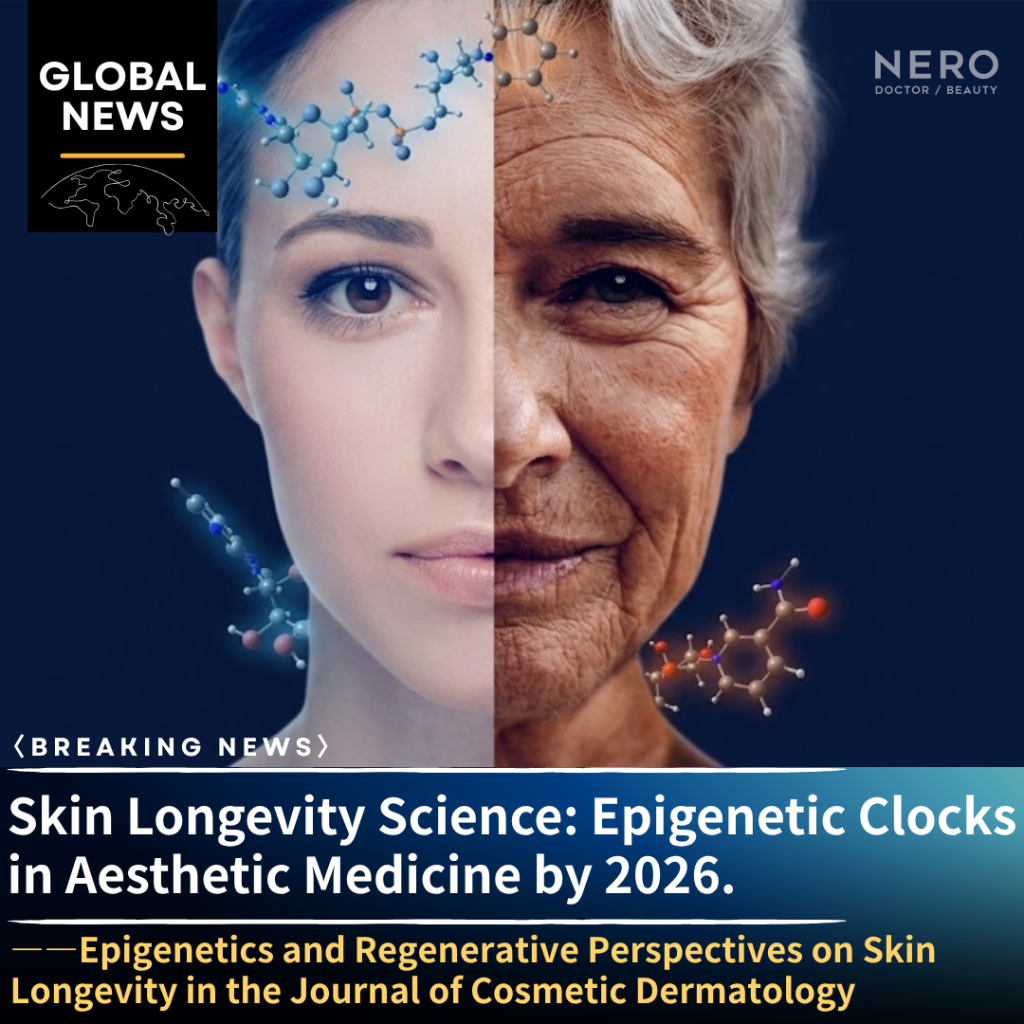
📌 Key Takeaways
- In March 2026, the Journal of Cosmetic Dermatology published a landmark paper on “skin longevity from an epigenetic and regenerative perspective” (Tulane University Dermatology, DOI: 10.1111/jocd.70788).
- Aesthetic medicine is shifting from “correcting visible aging” to “reducing the skin’s biological age” — skin-specific epigenetic clocks may soon quantify regenerative capacity in clinically meaningful ways.
- This is not about an overnight change in treatments — it signals a fundamental shift in what aesthetic medicine is for.
- Six pillars define the skin longevity framework: regenerative medicine, mitochondrial function, epigenetic regulation, immune balance, microbiome, and AI-driven personalization.
The phrase “skin age” has long been a staple of cosmetics advertising.
But in 2026, science is giving it an entirely new — and far more precise — meaning.
A peer-reviewed paper published in March 2026 by researchers at Tulane University
argues that aesthetic dermatology is undergoing a paradigm shift:
from treating how skin looks older, to addressing why skin is older at the cellular level.


INDEX
What Is an Epigenetic Clock?
Epigenetics refers to the system that controls which genes are switched on or off —
without altering the underlying DNA sequence itself.
As we age, these on/off patterns shift in measurable, predictable ways.
Researchers have developed algorithms that read these patterns
to estimate the biological age of a cell or tissue — this is the epigenetic clock.
Next-generation clocks like GrimAge and DunedinPACE go further:
they can predict cardiovascular disease risk, mortality, and cognitive decline
beyond what chronological age alone reveals.
The 2026 paper argues that a skin-specific epigenetic clock —
one calibrated to dermal tissue — could evaluate skin’s regenerative capacity
in a biologically meaningful way for the first time.
The Goal of Aesthetic Medicine Is Changing
Traditional aesthetic medicine has focused on visible outcomes:
smoothing wrinkles, lifting sagging tissue, restoring volume, minimizing pores.
The paradigm shift described in this paper operates at a deeper level.
Traditional Aesthetic Medicine
Correct the appearance of aging.
Fill wrinkles. Lift sagging. Restore volume.
Skin Longevity Medicine
Regulate the cellular and molecular dysfunction of aging — upstream.
Reactivate aged fibroblasts. Correct epigenetic aging signals.
Reduce the skin’s biological age.
reactivating fibroblasts and promoting tissue regeneration
linked to photobiomodulation and NAD+ supplementation
still in research phase, but the most transformative frontier
chronic low-grade inflammation accelerates skin aging
dysbiosis degrades barrier function and accelerates aging
based on genomic, biomarker, and behavioral data
How This Changes What You’re Choosing — Right Now
Biostimulators. Exosomes. PRP. These treatments already exist in clinics worldwide.
But the framework in which you choose them is shifting.
Selecting a biostimulator as a skin longevity intervention —
aimed at reactivating fibroblasts and modifying epigenetic aging signals —
implies a different treatment frequency, combination strategy, and outcome expectation
than choosing the same treatment for a short-term cosmetic result.
The treatment may be identical. The medical rationale is not.

From “how old do I look?” to “how old is my skin?”
This is not a semantic distinction —
it is a redefinition of what medicine is trying to achieve.
When skin-specific epigenetic clocks enter routine clinical practice,
aesthetic consultations may begin with:
“Your skin’s biological age is 35.”
That is the future this paper is pointing toward.
The era of concealing aging is ending.
The era of designing aging has begun.
- A March 2026 peer-reviewed paper in Journal of Cosmetic Dermatology formally defines “skin longevity” as a clinical framework.
- Skin-specific epigenetic clocks are moving toward making biological skin age a quantifiable, clinically actionable metric.
- The goal of aesthetic dermatology is shifting from correcting appearance to regulating upstream cellular and molecular aging dysfunction.
- Six pillars — regenerative medicine, mitochondrial function, epigenetic regulation, immune balance, microbiome, and AI — define the skin longevity model.
Skin biological age reflects the actual functional state of your skin cells —
how well fibroblasts regenerate collagen, how efficiently mitochondria produce energy,
and how aging-related epigenetic changes have accumulated.
Two people of the same chronological age can have significantly different skin biological ages
depending on genetics, UV exposure, lifestyle, and prior treatments.
to estimate the biological age of a tissue.
Established clocks like GrimAge and DunedinPACE predict disease risk and mortality
beyond what chronological age reveals.
The 2026 paper argues that a skin-specific version of this clock
could evaluate skin’s regenerative capacity in a clinically meaningful way —
though this application is still in the research phase.
do target fibroblast reactivation and tissue regeneration,
which aligns with the skin longevity framework.
However, the key distinction is clinical intent and protocol design.
Using these treatments within a structured skin longevity program
(with biomarker tracking and personalized frequency)
is conceptually different from a one-off cosmetic procedure.
The science is advancing faster than standardized clinical protocols,
so patients should discuss this framework explicitly with their provider.
Sources
Haykal S, Farris PK. “Reprogramming Skin Aging: A Regenerative and Epigenetic Perspective on Cutaneous Longevity.” Journal of Cosmetic Dermatology 2026;25(3):e70788. DOI: 10.1111/jocd.70788
Honey Health. “26 Longevity Trends That Will Define 2026.” March 25, 2026.
Dermatology Times. “Highlighting Upcoming Aesthetic Innovations in 2026.” February 2026.