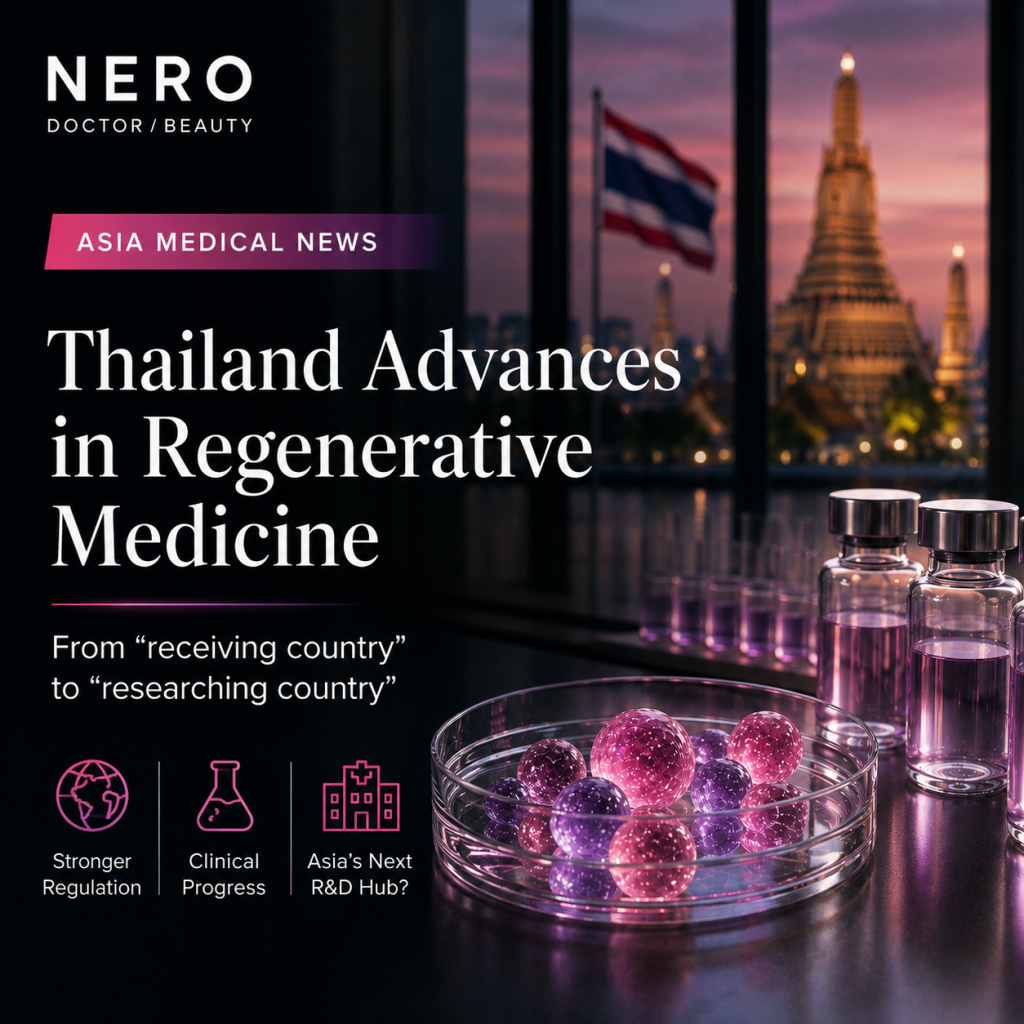
📌 Key Takeaways
- In 2025, Thailand launched the ATMP Sandbox Model as national policy,
creating a one-stop regulatory system under the Thai FDA
for cell and gene therapy trials and approvals. - Three ATMP products are already formally registered with the Thai FDA;
a domestically developed CD19-targeted CAR-T therapy (Genepeutic Bio)
has advanced to Phase II trials, with over 10 Thai patients treated. - Thailand’s strategy is not about attracting foreign patients—
it’s about becoming a research, manufacturing, and clinical trial hub
for advanced therapies in Southeast Asia. - “Stem cell beauty drips” marketed in aesthetic clinics
are categorically different from regulated ATMPs.
Regulatory approval, GMP manufacturing, and clinical trials
are the dividing line between the two.
When most people hear “regenerative medicine,”
they picture either miracle anti-aging injections
or dubious overseas clinic advertisements.
Thailand is writing a different story.
A peer-reviewed paper published in Clinical and Translational Science
(Viprakasit et al., 2026; PMC13077664)
documents how Thailand is systematically building the regulatory framework,
clinical infrastructure, and manufacturing capacity
for Advanced Therapy Medicinal Products (ATMPs)—
positioning itself as Southeast Asia’s cell and gene therapy hub.
This is not the “stem cell tourism” narrative.
This is institutional infrastructure.
And that distinction matters enormously.


INDEX
- What Are ATMPs? Cell Therapy, Gene Therapy, and Tissue Engineering—Explained
- Thailand’s ATMP Sandbox: When a Regulator Becomes a Partner
- Where Thailand Stands Now: 3 Products Registered, Domestic CAR-T Enters Phase II
- From “Receiving Country” to “Developing Country”: Thailand’s New Medical Identity
- Summary
- Frequently Asked Questions
What Are ATMPs? Cell Therapy, Gene Therapy, and Tissue Engineering—Explained
ATMP stands for Advanced Therapy Medicinal Products—
an umbrella term for treatments based on cells, genes, or tissue engineering.
They are governed by an entirely different regulatory and manufacturing framework
than the “stem cell infusions” often marketed in aesthetic medicine.
and administered back into the body.
Key examples: CAR-T cell therapy (engineered immune cells that attack cancer),
hematopoietic stem cell transplantation.
using AAV viral vectors, CRISPR-Cas, or similar technologies.
Key examples: Zolgensma for spinal muscular atrophy (SMA),
gene correction for beta-thalassemia.
to regenerate tissues or organs.
Key examples: Bioengineered skin grafts, cartilage regeneration products.
“Stem cell beauty injections” offered at aesthetic clinics
are not ATMPs in the regulatory sense.
Most have not undergone ATMP regulatory review,
GMP-compliant manufacturing, or Phase I–III clinical trials.
Thailand’s ATMP framework discussed here operates
at an entirely different level—national regulatory approval,
controlled manufacturing, and structured clinical evidence.
Thailand’s ATMP Sandbox: When a Regulator Becomes a Partner
In 2025, the Thai government formally announced the ATMP Sandbox Model
as national policy
(Viprakasit et al., Clinical and Translational Science, 2026; PMC13077664).
A sandbox is a controlled regulatory environment
where standard approval processes are partially relaxed
to allow experimental products to reach clinical trials and patients faster,
while maintaining safety oversight.
The concept originated in fintech and autonomous vehicles—
and is now being applied to advanced medicine.
The Thai ATMP Sandbox has three defining features:
The Thai FDA, the Medical Council of Thailand,
and the Department of Health Service Support operate in coordination.
Investigator-Initiated Trials (IIT), IND applications,
and Phase I–III approvals are processed through a unified pathway.
The Thai FDA is shifting from a purely review-based authority
to one that provides early-stage consultation and fast-track support.
Regulation is being repositioned
not as a brake, but as a competitive asset.
The paper states the sandbox
“targets registration of at least two ATMP products by 2026.”
This is a stated goal, not a confirmed outcome.
Where Thailand Stands Now: 3 Products Registered, Domestic CAR-T Enters Phase II
Thailand’s ATMP progress is not aspirational—
it is already producing measurable results.
(for clinical trial or commercial use)—
covering hematologic genetic diseases (including beta-thalassemia),
hematologic malignancies, and spinal muscular atrophy (SMA).
has advanced to Phase II trials.
Target population: relapsed/refractory CD19-positive B-cell malignancies.
Over 10 Thai patients have already received the treatment.
CAR-T (Chimeric Antigen Receptor T-cell) therapy involves
extracting a patient’s own immune T-cells,
genetically engineering them to recognize and attack cancer cells,
and reinfusing them into the patient.
CD19 is a protein expressed on B-cell blood cancers;
CD19-targeted CAR-T has demonstrated efficacy
in leukemia and certain lymphomas.
Approved CAR-T products (Kymriah, Yescarta) exist in the U.S., EU, and Japan,
but cost hundreds of thousands of dollars per treatment.
Thailand developing a domestic CAR-T product
could meaningfully reduce access costs across Asia.
From “Receiving Country” to “Developing Country”: Thailand’s New Medical Identity
Thailand has long been synonymous with medical tourism—
attracting international patients with high-quality, lower-cost care.
That model is built on price, quality, and hospitality.
The ATMP Sandbox signals a different ambition entirely.
(The following analysis reflects NERO’s editorial interpretation,
not a direct claim of the source paper.)
Competitiveness is defined by price × quality × hospitality.
and clinical implementation are completed within Thailand.
Competitiveness is defined by regulatory quality × manufacturing infrastructure × trial capacity.
This is a shift from price competition to institutional competition.
Within Asia, South Korea has established dominance
in aesthetic dermatology, laser technology, and cosmetic exports.
Thailand appears to be pursuing a different vector—
building medical competitiveness through ATMP regulatory infrastructure
and domestic CAR-T implementation.
(NERO editorial interpretation; not a direct claim of the source paper.)
The Thai FDA’s evolving role—
from pure reviewer to early-stage development partner—
represents a fundamental reframing of what a regulator does.
In many markets, regulation is treated as friction.
Thailand’s sandbox model treats it as infrastructure.
Secondary reporting also notes that the Thai FDA
and Japan’s PMDA (Pharmaceuticals and Medical Devices Agency)
held discussions in July 2026 on regulatory coordination
for ATMPs and clinical research.
(Verification via official Thai FDA sources is recommended.)

The “stem cell anti-aging drip” sold at aesthetic clinics
and the ATMP framework being built in Thailand
exist in entirely different regulatory universes.
What I want readers to understand is this:
not everything that calls itself regenerative medicine is the same.
Whether a product has passed regulatory review,
GMP-certified manufacturing, and clinical trials
is the line that separates legitimate advanced therapy
from unverified commercial claims.
For industry observers, the more important insight is this:
regulation, designed well, creates competitive advantage—
not just compliance burden.
Thailand’s ATMP Sandbox—
where the Thai FDA acts as a development partner,
not just a gatekeeper,
and where one-stop trial approvals reduce time-to-clinic—
offers a reference model worth studying
for any country rethinking its regenerative medicine policy.
Summary
- In 2025, Thailand launched the ATMP Sandbox Model as national policy.
The Thai FDA, Medical Council of Thailand, and Department of Health Service Support
operate a unified one-stop system for IIT, IND applications,
and Phase I–III trial approvals
(Viprakasit et al., Clinical and Translational Science, 2026; PMC13077664). - Three ATMP products are formally registered with the Thai FDA
(for clinical trial or commercial use),
covering hematologic diseases, blood cancers, and SMA.
Genepeutic Bio’s domestic CD19-targeted CAR-T has entered Phase II,
with over 10 Thai patients treated (same source). - The sandbox targets registration of at least two additional ATMP products by 2026—
a stated goal, not a confirmed outcome.
Thailand’s core strategic shift is from “attracting patients”
to “conducting research, manufacturing, and trials domestically”
(NERO editorial interpretation). - “Stem cell beauty injections” in aesthetic medicine
are categorically different from regulated ATMPs.
Regulatory approval, GMP manufacturing, and clinical trial evidence
are the defining criteria—not the label “regenerative medicine.”
Frequently Asked Questions
not a consumer treatment offering.
The CAR-T therapy described here is in Phase II trials
for patients with specific blood cancers,
not available as a general or aesthetic treatment.
If you are considering any “regenerative medicine” treatment in Thailand or abroad,
verify whether the product is formally registered with the Thai FDA or equivalent authority,
and what clinical trial evidence supports it.
This is non-negotiable due diligence.
and Yescarta (axicabtagene ciloleucel)
are approved in the United States, European Union, and Japan
for specific hematologic malignancies
such as acute lymphoblastic leukemia and large B-cell lymphoma.
These are not aesthetic or anti-aging treatments.
Patient eligibility is strictly defined,
and treatment costs can reach hundreds of thousands of dollars per course,
though insurance coverage varies by country.
ATMPs undergo national regulatory review, GMP-certified manufacturing,
and structured Phase I–III clinical trials before reaching patients.
Many “stem cell” or “regenerative” offerings at aesthetic clinics
have not completed this process.
In some jurisdictions, notification or registration requirements exist,
but registration does not equal proven efficacy.
If you are considering a stem cell aesthetic procedure,
ask your provider: What cells? How processed?
What clinical evidence supports this specific application?
These are the questions that matter.
Sources:
1. Viprakasit V, Tulalamba W, Suksangpleng T, Ekwattanakit S. “Thailand’s Emerging Role in the Cell and Gene Therapy Revolution: A Review of Progress and Potential.” Clinical and Translational Science. 2026;19(4):e70561. pmc.ncbi.nlm.nih.gov (Primary source. Perspective/Review article.)
2. Thai FDA. ATMP Regulatory and Registration Guidance. fda.moph.go.th
3. Nation Thailand. “Thailand Makes History With Landmark Stem Cell Decree.” May 27, 2026. nationthailand.com (Secondary source.)