📌 Key Takeaways
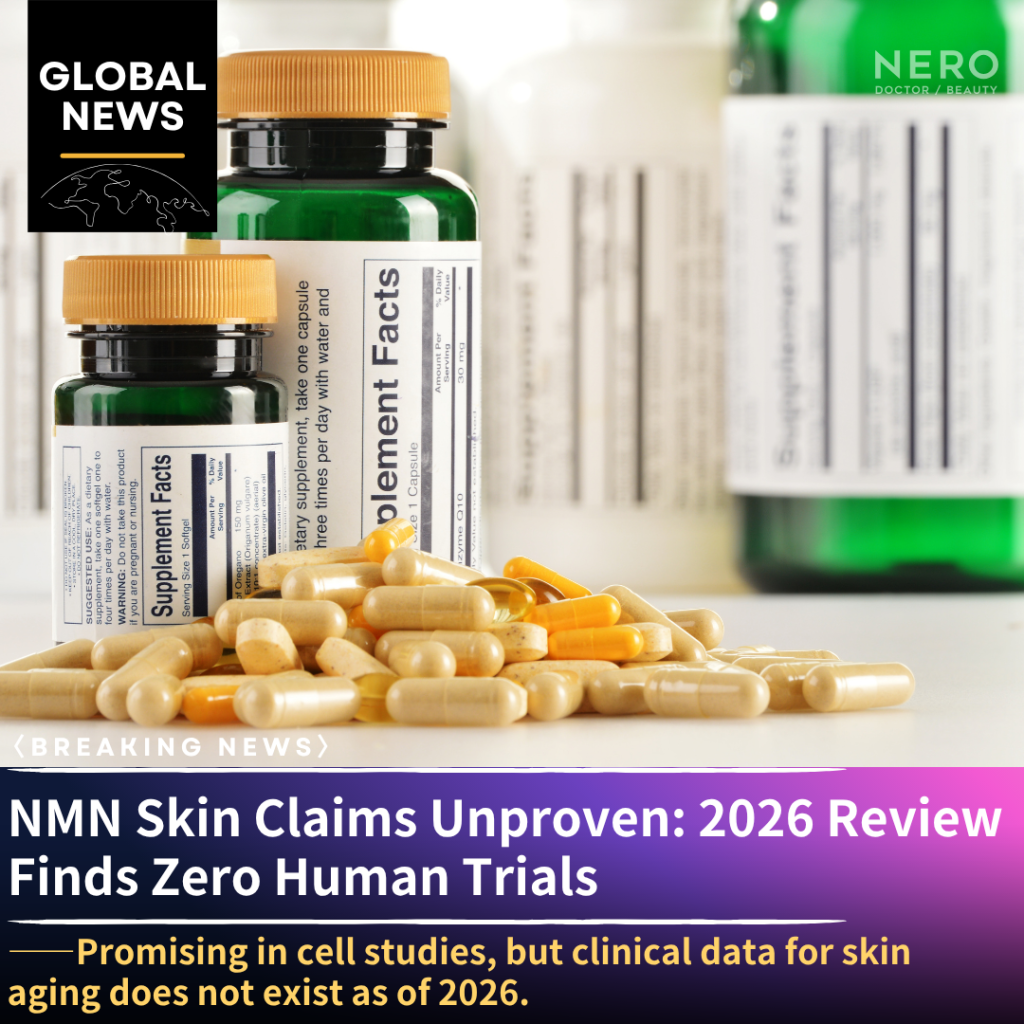
- A February 2026 PRISMA-guided systematic review published on ScienceDirect evaluated NAD+ supplementation (NMN, NR, etc.) for skin aging and aesthetic outcomes.
Conclusion: “No qualifying intervention trials assessing human skin aging were identified.” - A September 2025 study from LG H&H R&D Center in South Korea (Biomedicines) confirmed that NMN activates sirtuin pathways,
suppresses cellular senescence, and supports collagen structure—in cultured human skin fibroblasts.
This is promising at the cellular level, but not yet clinical evidence. - The accurate current position is not “NMN doesn’t work”—
it is “NMN’s effects on human skin have not yet been proven.”
Cell studies and animal studies are fundamentally different from human clinical trials. - NMN supplements and clinic-administered infusions are expanding rapidly in Japan and globally,
but advertising claims of skin rejuvenation remain unsupported by human trial data. - In longevity medicine, NAD+ is central to cellular energy metabolism—
but whether orally ingested NMN actually reaches skin cells in meaningful concentrations remains an open research question.
In February 2026, a PRISMA-guided systematic review was published on ScienceDirect,
comprehensively evaluating NAD+ supplementation—including NMN and NR—
for anti-aging, wellness, and skin aging outcomes.
The conclusion was unambiguous:
“No qualifying intervention trials assessing human skin aging or aesthetic outcomes were identified.”
NMN supplements are proliferating in pharmacies, beauty clinics, and online medical platforms worldwide.
Claims like “cellular rejuvenation,” “collagen synthesis boost,” and “improved skin turnover” are everywhere.
Yet as of 2026, virtually no human clinical trials exist to substantiate these claims for skin.
NERO reports this fact directly.


INDEX
What Are NMN and NAD+? Understanding the “Cellular Wi-Fi” Analogy
NAD+ (Nicotinamide Adenine Dinucleotide):
A coenzyme involved in energy metabolism, DNA repair, and activation of sirtuins
(proteins associated with longevity) in every cell of the body.
Multiple peer-reviewed studies confirm that NAD+ levels decline with age.
NMN (Nicotinamide Mononucleotide):
A precursor molecule that the body converts into NAD+.
The hypothesis: supplementing with NMN raises NAD+ levels.
It is now sold as a supplement worldwide.
Harvard professor David Sinclair’s public disclosure that he takes NMN daily
accelerated its popularity in longevity communities.
However, “the expected benefits of elevated NAD+” and “what NMN supplements do to human skin”
are two entirely separate questions.
What the 2026 Systematic Review Actually Found
The Other Side: Research That Shows Promise
While the systematic review concluded that human clinical trials are absent,
cell-level research has produced encouraging data worth understanding in context.
✅ NMN in Human Skin Fibroblasts — South Korea, September 2025
Kang S et al. “Distinctive Gene Expression Profiles of Skin Fibroblasts to NMN”
Biomedicines 2025;13(10):2395 (DOI: 10.3390/biomedicines13102395)
Research from LG H&H R&D Center in South Korea demonstrated that NMN
activates sirtuin pathways, suppresses cellular senescence,
and supports collagen structural integrity in human skin fibroblasts.
Critically, this was an in vitro experiment using cultured human skin cells—
not a clinical trial in which humans ingested NMN and showed measurable skin improvement.
⚠️ “Effective in Cell Studies” ≠ “Drink It and Your Skin Will Rejuvenate”
Understanding the hierarchy of evidence is essential:
In vitro (cell study): Adding NMN directly to cells in a dish produces measurable changes.
In vivo (animal study): Administering NMN to mice improves aging markers.
Human RCT: Humans orally ingest NMN and show measurable skin aging improvement—this does not yet exist.
“Effective in cell studies” means “worth pursuing further research.”
It does not mean “drinking this supplement will rejuvenate your skin.”
The Global Market Reality: Rapid Expansion and Advertising Gray Zones
NMN supplements and clinic-administered infusions are expanding rapidly—
not only in Japan but across the U.S., South Korea, and Europe.
Claims of “skin rejuvenation,” “collagen increase,” and “anti-aging” saturate the market.
This creates a structural tension:
the commercial narrative is running significantly ahead of the clinical evidence base.
⚠️ Regulatory and Advertising Risk
NMN is classified as a dietary supplement, not a pharmaceutical drug.
Making definitive claims such as “reverses skin aging” or “increases collagen”
without supporting human clinical trial data
carries regulatory risk under consumer protection and advertising standards laws
in Japan, the U.S. (FTC), and the EU.
Japan’s Ministry of Health, Labour and Welfare and the Consumer Affairs Agency
have flagged the practice of advertising unproven effects as a priority enforcement area.
The same scrutiny is increasingly applied in Western markets.

This isn’t about dismissing NMN.
NAD+ is genuinely central to cellular energy metabolism,
and the cell-level research is legitimately interesting.
What NERO is pointing to is a different problem:
selling “what we don’t yet know” as if we already do.
“Possible” and “proven” are not the same thing.
Our role is to help readers understand that difference—
and make decisions from that understanding.
“NMN works at the cellular level” may well be true.
“Drinking NMN will rejuvenate your skin”
remains unproven as of 2026.
Knowing the difference is what leads to smarter choices.
- A February 2026 PRISMA systematic review concluded that
no qualifying human clinical trials exist on NMN/NAD+ supplementation for skin aging or aesthetic outcomes. - A 2025 South Korean study (LG H&H R&D) confirmed NMN’s
sirtuin activation and collagen structural support in human skin fibroblasts at the cellular level.
The verdict: “promising in vitro—human trials still needed.” - The accurate framing is not “NMN doesn’t work”—
it is “NMN’s effects on human skin have not yet been clinically proven.”
Cell studies, animal studies, and human RCTs are fundamentally different evidence tiers. - Advertising claims of skin rejuvenation for NMN products
carry regulatory risk under consumer protection laws in Japan and increasingly in Western markets.
Frequently Asked Questions
Long-term safety data remain limited, so use under medical supervision is advisable.
Regarding skin effects specifically: there is currently no human clinical trial evidence to support them.
Choosing to invest in the “potential” is a personal decision,
but managing expectations carefully is recommended.
for skin aging or aesthetic outcomes.
The logic that “intravenous delivery reaches cells more directly” is intuitive,
but it is not supported by human skin trial data as of 2026.
Before committing to high-cost infusion protocols,
ask your provider specifically which evidence base they are drawing from.
and intermittent fasting have shown potential to elevate NAD+ levels—primarily in animal studies.
NR (Nicotinamide Riboside), another NAD+ precursor similar to NMN,
has shown increases in blood NAD+ levels in some short-term human trials.
However, the evidence for any of these approaches improving human skin aging
remains similarly limited.
Sources: ScienceDirect — “NAD⁺ supplementation for anti-aging and wellness: A PRISMA-guided systematic review of preclinical and clinical evidence,” published February 6, 2026 / Kang S, Park J et al. — “Distinctive Gene Expression Profiles and Biological Responses of Skin Fibroblasts to NMN,” Biomedicines 2025;13(10):2395 (DOI: 10.3390/biomedicines13102395) / Tsubota K — “The first human clinical study for NMN has started in Japan,” NPJ Aging and Mechanisms of Disease, 2016 / Fukumoto T et al. — “Open-label NMN study with hair-related endpoints,” 2025 (cited in ScienceDirect systematic review)