📌 Key Takeaways
- The 26th Annual Congress of the Japanese Anti-Aging Medicine Society (JAAM) was held June 26–28, 2026,
at Pacifico Yokohama North, drawing 5,261 attendees nationwide—
despite an approaching typhoon. - For the first time, “beauty” was explicitly listed alongside diet, exercise, and sleep
as a pillar of the congress theme,
signaling that aesthetic medicine is now framed as aging intervention. - A packed symposium titled “Mechanisms of Aging and Treatment Strategies”
covered hyperpigmentation, laser photoaging therapy,
non-surgical facial rejuvenation, and next-generation facelift techniques. - Japanese aesthetic philosophy—”natural-looking results over dramatic change”—
was presented as a clinical framework,
merging cultural aesthetics with evidence-based anti-aging medicine.
“Is aesthetic medicine a form of aging treatment, or simply the pursuit of beauty?”
Japan’s largest academic gathering on anti-aging medicine has offered a clear answer.
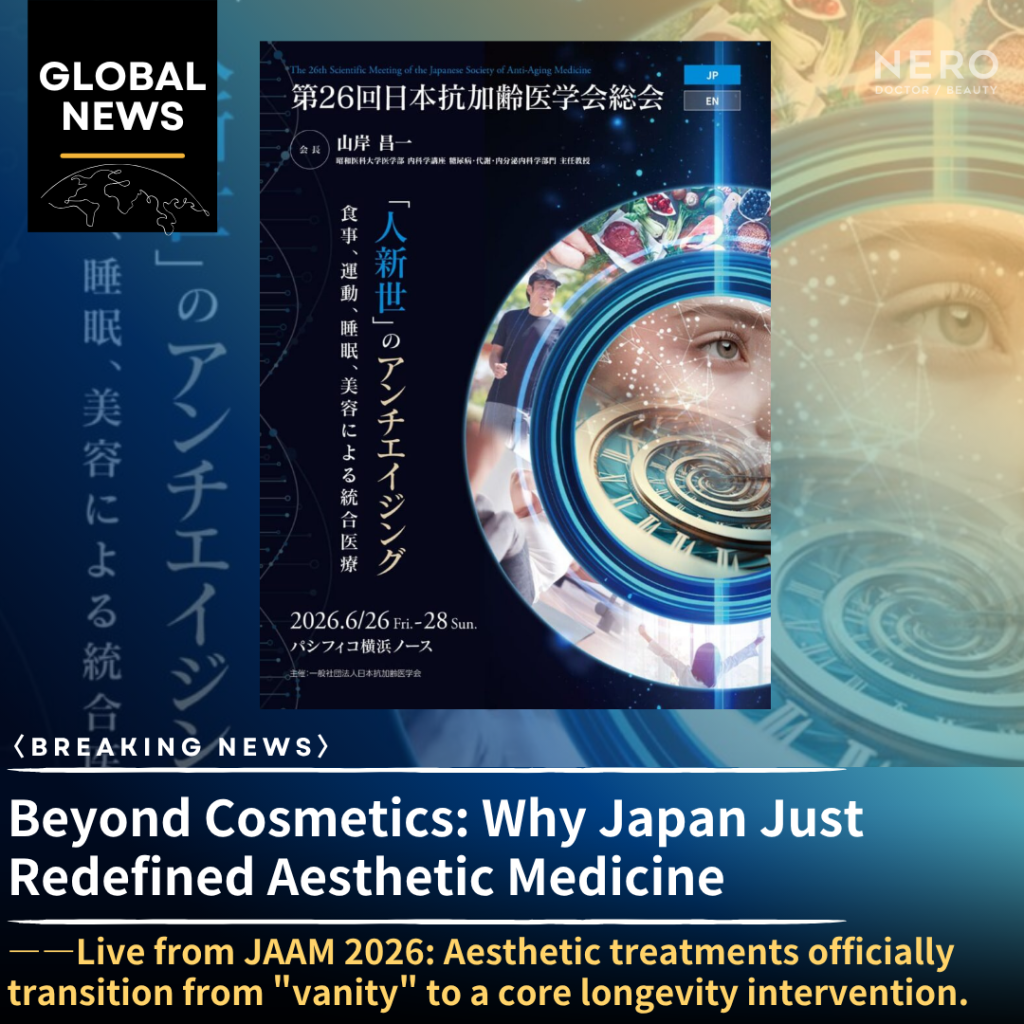
The 26th Annual Congress of the Japanese Anti-Aging Medicine Society (JAAM 2026)
convened June 26–28, 2026, at Pacifico Yokohama North.
Congress President was Dr. Shoichi Yamagishi (Showa University School of Medicine,
Department of Diabetes, Metabolism and Endocrinology).
Despite typhoon warnings, 5,261 physicians and researchers attended from across Japan.
The congress theme: “Integrative Medicine Through Diet, Exercise, Sleep, and Beauty—
Anti-Aging in the Anthropocene.”
The explicit inclusion of “beauty” alongside diet, exercise, and sleep
marks a formal institutional shift in how Japanese medicine categorizes aesthetic care.


INDEX
Why Aesthetic Medicine Now Belongs in Anti-Aging Science
5,261
from across Japan
Attended despite typhoon conditions
3
Days (June 26–28)
Pacifico Yokohama North
4
Core Areas
Diet · Exercise · Sleep · Beauty
Source: JAAM 2026 Official Congress Site (c-linkage.co.jp/jaam2026)
Anti-aging medicine (or longevity medicine) is the scientific study of aging mechanisms
with the goal of extending healthy lifespan.
It integrates diet, exercise, sleep, hormone management, and supplementation
into a unified clinical framework.
The addition of “beauty” carries significant weight.
It represents an institutional declaration that caring for external appearance
constitutes a direct intervention in the aging process itself—
not merely cosmetic maintenance.
The congress subtitle referenced the “Anthropocene”—
a geological concept describing the current era in which human activity
has become the dominant force shaping Earth’s environment.
In this context, it frames anti-aging medicine as a response
to accelerating aging populations, climate change, and technological disruption:
a discipline that must evolve for an era unlike any before it.
Symposium: “Mechanisms of Aging and Treatment Strategies” — 4 Presentations
The most attended session of JAAM 2026 was the symposium
“Mechanisms of Aging and Treatment Strategies,”
which drew a near-capacity audience (per JAAM 2026 official records).
Four presentations addressed aesthetic medicine directly.
📋 Symposium Presentations: “Mechanisms of Aging and Treatment Strategies”
Dr. Yoko Funasaka (Professor Emerita, Nippon Medical School, Department of Dermatology)
Presented a multi-factor treatment framework integrating inflammation,
melanocyte biology, and skin aging—
arguing that hyperpigmentation must be addressed as a systemic aging process,
not an isolated cosmetic concern.
Dr. Taro Kawano (Professor and Chief, Department of Plastic Surgery, Tokai University School of Medicine)
Proposed a precision laser protocol optimizing target chromophore,
wavelength, fluence, and spot size
based on individual skin condition—
moving beyond one-size-fits-all laser approaches.
Dr. Nobutaka Furuyama (Director, Jiyugaoka Clinic)
Introduced a long-term, whole-face treatment design philosophy
grounded in Japanese aesthetic values—
prioritizing natural-looking results over dramatic transformation.
Dr. Ryuichi Utsuki (Director, Clinic Utsuki-ryu)
Proposed a surgical approach targeting chronic facial muscle tension—
the underlying force generating wrinkles and sagging—
rather than simply repositioning skin and soft tissue.
Japanese Aesthetic Philosophy Meets Evidence-Based Anti-Aging Medicine
💡 The Core Insight
The core of Dr. Furuyama’s presentation:
“The goal is not to make dramatic changes that look younger—
but to achieve a state where intervention is invisible, and the result looks natural.”
Rather than adding volume indiscriminately,
the approach refines what is necessary while preserving individual character.
Like a bonsai or a Japanese garden—
meticulously tended, yet harmonious as a whole.
This distinctly Japanese aesthetic concept was formally presented
within the framework of anti-aging medicine.
Dr. Utsuki’s next-generation facelift follows the same logic:
rather than pulling skin tighter,
it addresses the chronic muscular tension that generates wrinkles and sagging in the first place.
The shift from “correcting the surface” to “intervening in the cause of aging”
is precisely why aesthetic medicine now belongs inside anti-aging science.
Aesthetic Medicine as Aging Treatment: A Three-Stage Framework
the primary goal was symptom management.
Scientific framing as aging intervention was largely absent.
photoaging (UVA-induced DNA damage, melanocyte activation),
bone resorption, fat redistribution, and muscle dynamics.
JAAM 2026’s symposium was the academic embodiment of this shift.
exercise, sleep, and hormone management.
The inclusion of “beauty” in the JAAM 2026 congress theme
is the formal declaration of this integration.

The inclusion of “beauty” alongside diet, exercise, and sleep in this congress theme is symbolic.
The shift is not “treating dark spots is cosmetic”—
but rather “hyperpigmentation is a photoaging process,
and intervening in it is aging treatment.”
This conceptual reframing has now been made visible at the academic level.
For anyone considering aesthetic medicine,
the perspective that “beauty care is part of aging management” carries real clinical weight.
The era has arrived when “slowing aging” and “looking your best” point to the same goal.
Summary
- JAAM 2026 (June 26–28, Pacifico Yokohama North) drew 5,261 attendees.
“Beauty” was explicitly listed alongside diet, exercise, and sleep
as a core pillar of the congress theme for the first time. - The symposium “Mechanisms of Aging and Treatment Strategies”
addressed hyperpigmentation, laser photoaging therapy,
non-surgical rejuvenation, and next-generation facelift—
to a near-capacity audience. - “Natural-looking rejuvenation” and “muscle-dynamics-based facelift”
were presented as distinctly Japanese clinical frameworks
within an academic anti-aging context. - The integration of aesthetic medicine into anti-aging science
as a legitimate aging intervention is accelerating in 2026.
Frequently Asked Questions
Sources
1. 26th Annual Congress of the Japanese Anti-Aging Medicine Society (JAAM 2026). Official Congress Site: c-linkage.co.jp/jaam2026. Congress President: Dr. Shoichi Yamagishi (Showa University School of Medicine). June 26–28, 2026, Pacifico Yokohama North. Total attendees: 5,261.
2. JAAM 2026 Symposium: “Mechanisms of Aging and Treatment Strategies.” Presenters: Dr. Yoko Funasaka (Professor Emerita, Nippon Medical School), Dr. Taro Kawano (Tokai University, Plastic Surgery), Dr. Nobutaka Furuyama (Jiyugaoka Clinic), Dr. Ryuichi Utsuki (Clinic Utsuki-ryu). June 2026.