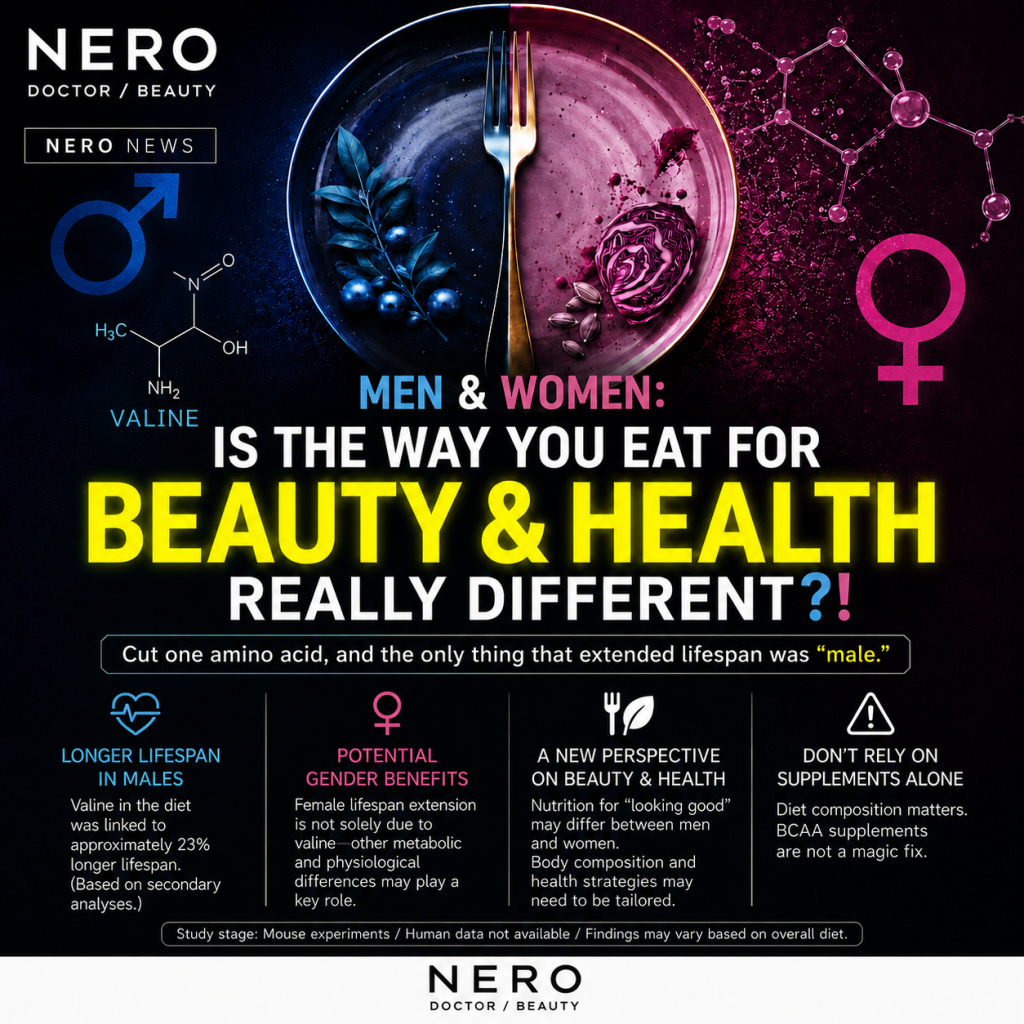
📌 Key Takeaways
- A 2026 Nature Aging study found that lifelong dietary valine restriction
produced sex-specific effects on health and lifespan in mice. - Lifespan extension (~23% per secondary reporting) was observed in male mice only;
females showed distinct metabolic and pathological benefits. - This is a mouse dietary composition study — not evidence that
reducing BCAA supplements extends human lifespan. - The findings open a meaningful question:
should men and women approach nutrition differently for longevity?
We tend to assume that “healthy eating” works the same way for everyone.
A balanced diet, adequate protein, enough sleep — universal advice for universal bodies.
But a peer-reviewed study published in Nature Aging in 2026 complicates that assumption.
When researchers restricted a single essential amino acid — valine — across the entire lifespan of mice,
the effects on health and longevity differed meaningfully between males and females.
Lifespan extension was seen in males.
Females showed their own distinct, sex-specific metabolic benefits.
Same intervention. Different outcomes.
This article is based on a peer-reviewed paper in Nature Aging (2026).
The study was conducted in mice, with lifelong dietary composition adjustments.
Human clinical applicability has not been established.


INDEX
What the Study Actually Did
Valine is an essential amino acid — meaning the body cannot synthesize it
and must obtain it through diet.
It is found in meat, fish, eggs, dairy, and soy.
Together with leucine and isoleucine, valine forms the branched-chain amino acids (BCAAs),
widely used in fitness supplements and protein powders.
Important framing: This study adjusted the valine ratio in the mice’s total diet across their entire lives.
It is not a study about humans stopping BCAA supplements for a few weeks.
Researchers at the Lamming Lab (University of Wisconsin-Madison) fed mice a diet
with reduced valine content from birth through natural death —
a true lifelong dietary intervention, not a short-term experiment.
The result: health and longevity outcomes diverged by sex.
Male mice showed a lifespan extension reported at approximately 23% in secondary coverage.
Female mice did not show the same lifespan extension,
but demonstrated their own sex-specific metabolic and pathological benefits.
(per Lifespan.io secondary reporting)
Sex-Specific Outcomes: What Happened in Males vs. Females
The divergence in outcomes is the study’s most provocative finding.
Both sexes received the same dietary intervention.
Yet the biological response was not the same.
and a lifespan extension of approximately 23% (per secondary reporting).
Researchers attribute this to downstream effects on metabolism and body composition.
However, the study identified sex-specific benefits —
including improvements in metabolic markers and suppression of certain pathological changes.
The absence of lifespan extension does not mean the intervention was ineffective;
it means the benefits manifested differently.
This study does not suggest that reducing BCAA supplements will extend human lifespan.
Drastically cutting a single essential amino acid from a human diet
risks nutritional imbalance and should never be attempted without medical supervision.
The study’s value lies in the conceptual framework it opens —
not in a dietary prescription.
Why This Matters Beyond the Lab
Nutrition science has long operated on a largely gender-neutral model.
Dietary guidelines, supplement recommendations, and wellness content
are typically written as if biology is uniform across sexes.
This study adds to a growing body of evidence suggesting that
the same nutritional intervention can produce different outcomes in males and females.
The mechanisms — likely involving hormonal environments, metabolic rate differences,
and sex-specific gene expression — remain an active area of research.
The following section reflects NERO’s editorial interpretation
in the context of men’s aesthetics and well-aging.
It is not a direct conclusion of the original paper.
Reframing Men’s Aesthetics: From Appearance to Body Composition
Men’s beauty and aesthetic medicine have historically focused on surface-level outcomes:
skin texture, hair density, facial contour.
But longevity research like this invites a broader frame —
one that includes metabolic health, body composition, and dietary strategy
as integral to how men age visibly and biologically.
If nutritional interventions affect males and females differently at the cellular level,
then gender-specific wellness content is not just a marketing angle —
it may reflect a genuine biological reality.
For men interested in well-aging, this suggests:
nutrition advice labeled “healthy for everyone” deserves scrutiny.
Sex-specific research is still early, but the question it raises is legitimate.
This article covers basic science research conducted in mice.
It does not directly establish clinical recommendations for humans.
Any significant dietary changes should be discussed with a qualified healthcare provider.

We often assume that “healthy eating” works the same for men and women.
But the biology may tell a different story.
For anyone thinking seriously about men’s health and aging,
this is a genuinely interesting question to sit with.
That said — this is mouse dietary science, not a supplement protocol.
“Cut valine” or “stop your BCAAs” is not the takeaway.
The value here is the perspective: sex differences in nutrition are real and worth watching.
Extreme dietary self-experimentation remains inadvisable.
✨ Summary
- A 2026 Nature Aging study found that lifelong dietary valine restriction
produced sex-specific effects on health and lifespan in mice. - Lifespan extension (~23% per secondary reporting) was observed in male mice;
females showed distinct metabolic and pathological benefits. - This is not evidence that reducing BCAA supplements extends human lifespan.
The study’s significance lies in the conceptual framework it introduces. - Men’s well-aging may benefit from a broader lens —
one that includes metabolic health and sex-specific nutrition science,
not just aesthetic outcomes.
Frequently Asked Questions
The study restricted valine across the entire lifespan of mice at the dietary composition level.
This is fundamentally different from a human reducing BCAA supplement intake.
Human clinical evidence has not been established,
and extreme restriction of essential amino acids carries nutritional risks.
Researchers believe hormonal differences, sex-specific metabolic rates,
and differential gene expression likely play a role.
This remains an active area of investigation in longevity science.
The practical takeaway is conceptual: nutrition advice presented as universal
may not apply equally to men and women.
A balanced diet, regular exercise, and consultation with a healthcare provider
remain the evidence-based foundation for healthy aging.
Sources:
1. Calubag MF, Ademi I, et al., Lamming DW. “Lifelong restriction of dietary valine has sex-specific benefits for health and lifespan in mice.” Nature Aging. 2026;6:1611–1630. doi:10.1038/s43587-026-01169-0. nature.com
2. “Valine Restriction Increases Male Mouse Lifespan by 23%.” Lifespan.io. (Source of the ~23% figure cited in secondary reporting.)