📌 Key Takeaways
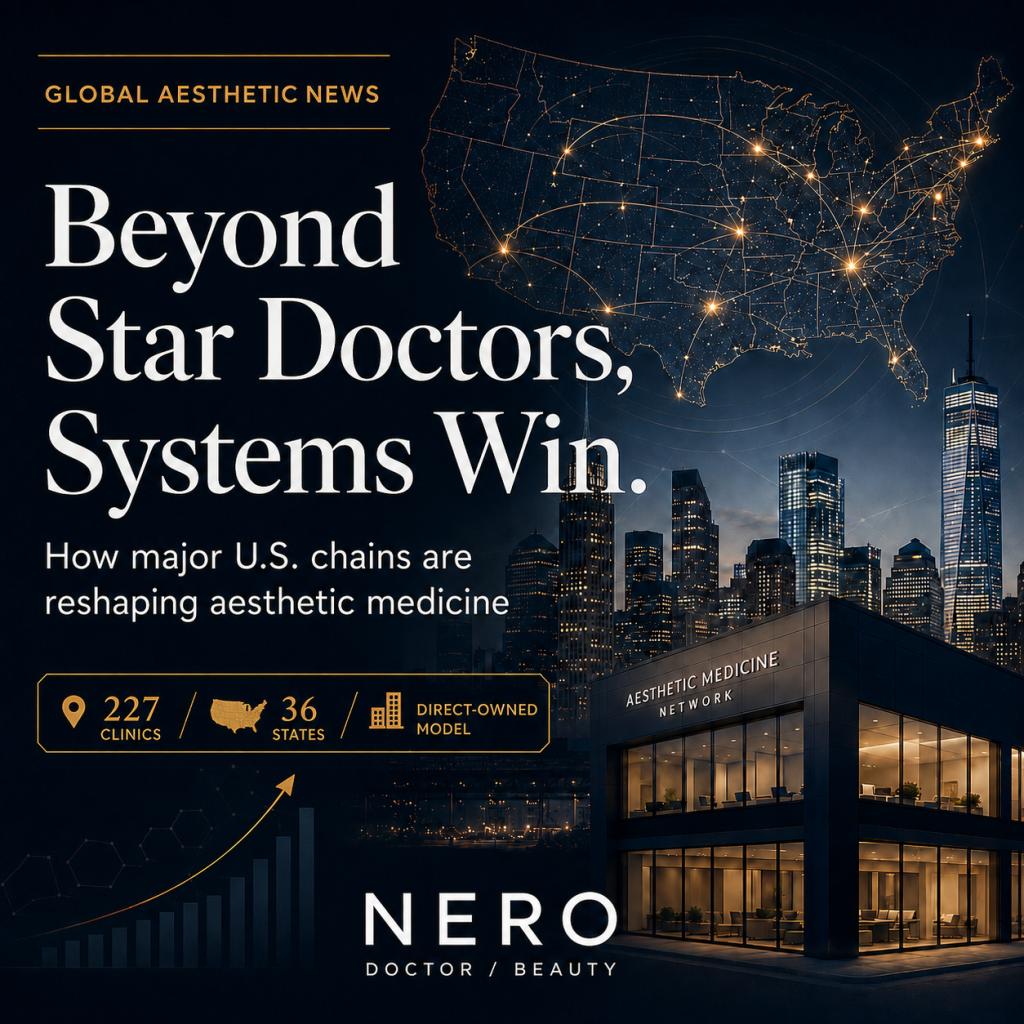
- LaserAway opened its 227th U.S. clinic in Kingwood, Texas on August 19, 2026 —
operating across 36 states with zero closures since its 2006 founding. - Treatments are performed by licensed NPs, PAs, and RNs under state law,
overseen by 25+ dermatologists and CMO Dr. Will Kirby. - The fully company-owned (no-franchise) model prioritizes protocol standardization
over individual physician reputation. - The chain’s growth raises a structural question for the global aesthetics industry:
can system design outperform star-doctor dependency?
Aesthetic medicine has long been sold on the promise of the right doctor.
LaserAway is betting that the right system matters more.
On August 19, 2026, LaserAway — which bills itself as the largest aesthetic dermatology brand in the United States — opened its 227th clinic in Kingwood, Texas (per company announcement).
Founded in West Hollywood, California in 2006, the chain has expanded to 36 states
without a single closure in two decades.
Every location is company-owned. There are no franchises.
And in most locations, the person performing your Botox or laser treatment
is not a physician — it’s a licensed Nurse Practitioner, Physician Assistant, or Registered Nurse.
That last detail tends to raise eyebrows outside the United States.
But understanding why it works reveals something important
about where the aesthetics industry is heading globally.


INDEX
LaserAway by the Numbers
Before analyzing the model, the scale deserves context.
The company’s service menu spans laser hair removal, Botox, dermal fillers,
body contouring, tattoo removal, and medical-grade skincare.
All locations are directly operated — no franchise model, no external ownership.
Why NPs and PAs Can Perform Aesthetic Treatments in the U.S.
For readers outside the United States, the staffing model requires explanation.
In many countries — including Japan — injectable treatments like Botox and fillers
must legally be performed by a licensed physician.
The U.S. system is structured differently.
NP (Nurse Practitioner) — An advanced practice registered nurse
with authority to diagnose, prescribe, and perform procedures.
Scope of practice varies by state; in many states, NPs operate independently
without physician oversight.
PA (Physician Assistant) — A licensed clinician who works
in collaboration with physicians to diagnose, prescribe, and treat.
This credential has no direct equivalent in Japan or most of Asia.
RN (Registered Nurse) — Equivalent to a licensed nurse in other countries,
but in many U.S. states, RNs are legally permitted to perform
specific aesthetic procedures (laser, injectables) under physician direction.
The common thread: all three hold state-issued medical licenses.
LaserAway’s model is not a regulatory workaround —
it is a deliberate use of the U.S. healthcare workforce structure.
LaserAway’s clinical governance layer sits above these practitioners:
25+ dermatologists and a Chief Medical Officer, Dr. Will Kirby,
design the protocols, set the standards, and oversee the entire operation.
The physician’s role shifts from individual performer to institutional architect.
This is the core distinction:
it is not “no physician” — it is “physician as system designer, not sole operator.”
U.S. vs. Japan: A Regulatory Comparison
| United States (LaserAway) | Japan | |
|---|---|---|
| Injectable treatments | NP/PA/RN permitted under state law | Physician only (Medical Practitioners’ Act) |
| Laser treatments | RN performs under physician direction | Nurse permitted under physician instruction (select procedures) |
| Physician’s role | Protocol design, oversight, Medical Board | Direct treatment is the default expectation |
| Chain scalability | High — workforce model supports rapid expansion | Constrained — physician availability is the bottleneck |
Three Structural Advantages Behind 20 Years of Zero Closures
Two decades of uninterrupted operation across 227 locations
is not a matter of luck.
Based on LaserAway’s public disclosures, NERO identifies three design principles
that appear to underpin this continuity.
as ownership changes hands.
LaserAway’s direct ownership structure means every location
operates under the same training, protocols, and management standards.
Slower to scale, but consistent.
carry lower complication risk than surgical procedures.
They also generate repeat visits — patients return regularly
rather than once for a major operation.
This creates a recurring revenue model
while limiting the liability exposure of high-risk surgery.
as making aesthetic treatments available to everyone,
not just a privileged few (per company statement).
The competitive axis is convenience and approachability —
not luxury positioning or premium exclusivity.
The data in this article is drawn from LaserAway’s own press releases and PRNewswire announcements.
Scale of operation does not guarantee clinical quality.
“Zero closures” and “227 locations” are indicators of business continuity,
not independently verified measures of treatment outcomes or patient safety.
Third-party clinical performance data would be required for a fuller assessment.
What This Means for Patients Choosing a Clinic
LaserAway does not operate outside the United States.
But the structural lessons it demonstrates apply to any market.
correction procedures, and treatment records.
For anyone receiving fillers, lasers, or other multi-session treatments,
continuity of care is a safety consideration — not just a convenience.
A clinic’s track record of staying open is a meaningful selection criterion.
than “What happens if something goes wrong?”
Understanding the oversight structure, follow-up protocols,
and practitioner training gives a more complete picture of quality
than a single practitioner’s reputation.
How is the supervising physician involved?”
what is your follow-up protocol?
Is this a clinic I can return to long-term?”
What the LaserAway Model Asks of the Global Aesthetics Industry
Read through an industry lens, LaserAway’s 20-year trajectory
poses a structural challenge to how aesthetic medicine is organized
in most markets outside the United States.
Value is generated by the team and the system —
not by any single practitioner’s reputation.
Physicians architect the standard; licensed professionals execute it.
Patient acquisition is tied to a specific doctor.
When that doctor leaves, clinic value often follows.
The NP/PA model cannot be directly transplanted into markets
where physician-only injection laws apply.
But the underlying principles — protocol standardization, visible oversight structures,
and quality management for nurse-eligible procedures —
are applicable regardless of regulatory context.
In markets where nurses can legally perform certain aesthetic treatments
under physician supervision, building rigorous protocol and QA systems
around those procedures is a direct application of the LaserAway approach.
Clinics that can clearly articulate their supervision structure,
training standards, and follow-up protocols —
rather than relying on a single physician’s name recognition —
are positioned to differentiate as patient sophistication increases.

For readers unfamiliar with the U.S. system,
the idea of a nurse performing Botox can feel counterintuitive.
But the credential gap is smaller than it appears.
What LaserAway’s practitioners are doing is exactly what the name suggests:
licensed medical professionals performing treatments
under physician-designed protocols.
The more uncomfortable question isn’t whether NPs can do this safely.
It’s whether physician-performed treatments in other markets
are consistently held to the same standard of oversight and accountability.
To anyone building or running an aesthetic clinic:
what LaserAway proved over 20 years is that
system design can outperform star-doctor dependency.
The NP/PA model isn’t directly portable to every market.
But protocol standardization, visible physician oversight,
and rigorous quality management for nurse-eligible procedures
are available to any clinic willing to invest in them.
The clinics that start building these systems now
will have a structural advantage in the next competitive cycle.
Summary
- LaserAway opened its 227th U.S. clinic on August 19, 2026,
with zero closures across 36 states since its 2006 founding (company-reported).
All locations are company-owned; no franchise model is used. - Treatments are performed by licensed NPs, PAs, and RNs under U.S. state law,
with clinical oversight from 25+ dermatologists and CMO Dr. Will Kirby.
This is a legally sanctioned workforce model, not a regulatory workaround. - Three structural factors appear to underpin the chain’s longevity:
full company ownership, a non-invasive/minimally invasive menu,
and an accessibility-first positioning strategy. - “Zero closures” and “227 locations” reflect business continuity,
not independently verified clinical quality.
The model’s relevance for other markets lies in its organizational principles —
protocol standardization, visible oversight, and system-led quality assurance —
not in direct regulatory transplantation.
Frequently Asked Questions
making the NP/PA staffing model legally unavailable.
However, the organizational principles — protocol standardization, physician oversight structures,
and quality management for nurse-eligible procedures like laser hair removal —
can be applied within existing regulatory frameworks.
The model’s transferable value is in its system design, not its specific workforce structure.
and no recourse for corrections or complications.
For patients receiving multi-session treatments — fillers, laser series, body contouring —
a clinic’s operational continuity is a legitimate safety consideration.
That said, “zero closures” is a measure of business stability, not clinical outcome quality.
Both dimensions matter when choosing a provider.
“How is the supervising physician involved in my care?”
“What is your protocol if I experience side effects or need a correction?”
A clinic that cannot answer these questions clearly
may not have the oversight infrastructure those answers require.
The willingness to ask — and the quality of the response — is itself a useful filter.
Sources:
1. LaserAway. “LaserAway, Nation’s Largest Aesthetic Dermatology Brand, Opens Its 227th Clinic.” PRNewswire. August 19, 2026. prnewswire.com
2. LaserAway Official Website. laseraway.com