📌 Key Takeaways
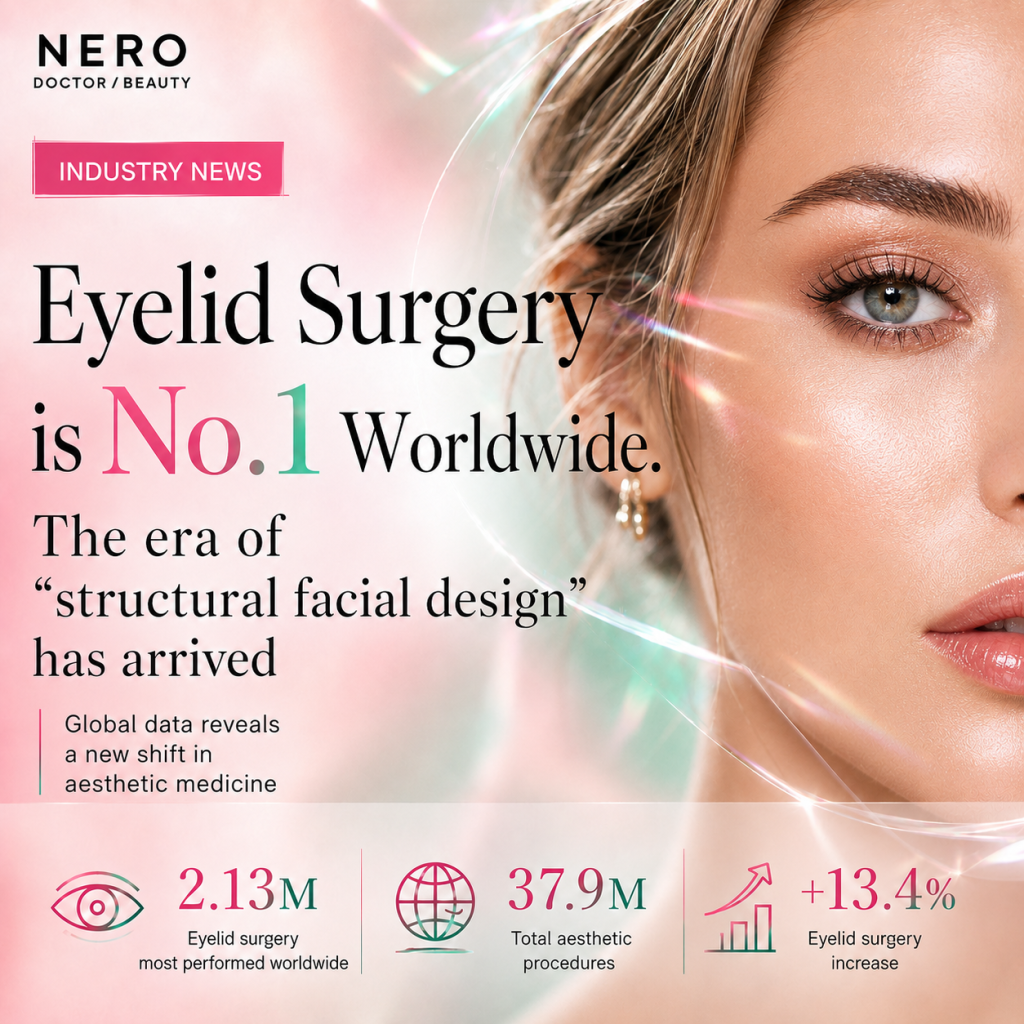
- Blepharoplasty (eyelid surgery) became the world’s most performed surgical cosmetic procedure in 2024,
with 2.13 million cases—a 13.4% year-over-year increase—surpassing liposuction for the first time in ISAPS history. - The ISAPS Global Survey 2024 recorded 37.9 million total aesthetic procedures worldwide,
a 42.5% increase over four years, signaling sustained and accelerating industry growth. - ISAPS now tracks buccal fat removal, hand rejuvenation, combination procedures, and dimpleplasty—
reflecting a structural shift from single-treatment thinking to holistic facial design. - Japan ranks 3rd globally in procedure volume (after the U.S. and Brazil),
with a market profile favoring minimally invasive, low-downtime treatments.
When people consider aesthetic medicine, the eyes are often the first thing they want to change.
That instinct, it turns out, is globally consistent.
According to the International Society of Aesthetic Plastic Surgery (ISAPS),
blepharoplasty—encompassing double eyelid surgery and ptosis correction—
became the single most performed surgical cosmetic procedure in the world in 2024.
At 2.13 million procedures, it surpassed liposuction for the first time in ISAPS’s long-term tracking history.
This is not simply a popularity contest.
It signals a fundamental reorientation in what people want from aesthetic medicine:
a shift from reshaping the body to redesigning the face.


INDEX
Blepharoplasty at No. 1: What the ISAPS Data Actually Tells Us
The ISAPS Global Survey 2024, presented at the ISAPS Olympiad World Congress in Singapore in June 2025,
contained data that marks a turning point in aesthetic medicine history.
up 13.4% year-over-year, surpassing liposuction.
(17.4M surgical / 20.5M non-surgical) — a 42.5% increase over four years.
the top non-surgical procedure. (via AmSpa summary of ISAPS data)
behind the United States and Brazil. (via AmSpa summary of ISAPS data)
The significance of blepharoplasty reaching No. 1 deserves careful interpretation.
Unlike liposuction, which reduces volume, eyelid surgery changes the aperture, shape, and perceived expression of the eye.
In other words, the world’s most popular surgical cosmetic procedure is no longer about making the body smaller—
it is about changing how a face communicates.
This is a meaningful signal that facial intervention has become the dominant axis of surgical aesthetic medicine.
Eyelid surgery carries particularly high demand across East Asia—Japan, China, South Korea, and Thailand among others.
A 2025 study published in Plastic and Reconstructive Surgery (PMC11723682) introduced the term “East Asian blepharoplasty”
to emphasize that eyelid surgery in this population requires distinct anatomical considerations
that differ substantially from Western techniques.
The paper’s primary focus is terminology and anatomical diversity—
not market trends—but it provides a clinically grounded basis for understanding
why a one-size-fits-all approach to eyelid surgery is insufficient.
New Procedures Enter the ISAPS Tracking System
Beyond the headline ranking, the 2024 ISAPS survey introduced another significant change:
several previously untracked procedures were added to the global dataset.
According to Dr. Amin Kalaaji, ISAPS Global Survey Chair,
the new additions include buccal fat removal, hand rejuvenation (fat grafting),
combination procedures, dimpleplasty, and inverted nipple correction.
ISAPS described the expansion as reflecting “emerging trends in the aesthetic field.”
Buccal fat removal: Popularized in part by celebrity culture in the West;
in East Asia, long-term volume loss with aging warrants careful patient selection.
Hand rejuvenation (fat grafting): Reflects growing interest in aging care beyond the face.
Combination procedures: Multiple techniques performed in a single session or sequentially—
a practice growing fast enough that ISAPS now tracks it as a distinct category.
Dimpleplasty / inverted nipple correction: Represent a shift from “changing volume” to “refining form”—
detail-level interventions that signal increasingly granular aesthetic demand.
The decision to formally track combination procedures is particularly telling.
It means the global aesthetic surgery establishment now recognizes
that multi-treatment planning is no longer an edge case—it is a mainstream clinical reality.
Beyond “Fill vs. Sculpt”: The Rise of Facial Structural Design
A widely circulated framing—popularized in part by VOGUE JAPAN—
describes a cultural divide in aesthetic preferences:
East Asia tends to add volume (fill), while the West tends to remove it (sculpt).
It is a useful cultural observation, but the industry has already moved past it.
The more consequential question is no longer “fill or sculpt?”
It is: “How should this face be designed as a whole?”
“I want a slimmer face → book buccal fat removal.”
Each part is addressed in isolation.
then designs a coordinated plan across eyes, cheeks, contour, and skin texture.
HA fillers, botulinum toxin, RF energy, and lasers are combined
across multiple sessions rather than applied in a single visit.
it is asking a physician to evaluate your face as a whole and propose a plan.
This direction is visible at IMCAS China 2026, where combination design and AI-assisted skin analysis
are central themes on the program.
ISAPS’s decision to formally track combination procedures reinforces the same signal:
the era of the single-procedure visit is giving way to coordinated facial planning.
Whether the preference is to add volume or reduce it,
what East Asian and Western markets share is an intensifying focus on
how the face reads as a unified whole—not as a collection of parts.
That shared obsession is what defines the structural design era.
Japan at No. 3: Market Profile and the Path Toward Structural Design
Japan ranks third globally in aesthetic procedure volume, behind the United States and Brazil,
according to the AmSpa summary of ISAPS 2024 data.
Japan’s market is widely understood to favor minimally invasive, low-downtime treatments—
botulinum toxin, HA fillers, laser therapies—though procedure-level breakdowns
for the Japanese market were not directly available in the sources reviewed for this article.
Japan’s current market is dominated by single-procedure demand.
Transitioning to combination-based structural design requires clinics to invest in
longer consultation time, whole-face assessment protocols, and clearer patient communication frameworks.
The gap between clinics that can propose a 10-year facial plan
and those that simply repeat individual treatments will become increasingly visible
in patient outcomes over time.
The “AI skin analysis + combination design” model highlighted at IMCAS China 2026
points toward where the industry is heading—
though the timeline for mainstream adoption in Japan remains to be seen.
How to Choose a Clinic in the Structural Design Era
Many patients still select clinics based on a physician’s reputation for a single technique,
a specific device on the menu, or social media presence.
The ISAPS data suggests that framework is becoming outdated.
The more relevant question is no longer “What is this doctor good at?”
It is: “Can this doctor design my face as a whole?”
A physician who plans for long-term natural aging—not just immediate results—
is thinking structurally.
Look for a physician who can say “for you, these two work together—
and this one you don’t need.”
Data-informed planning is a marker of structural design capability.
A physician willing to say “you don’t need that” is one who sees the whole picture—
not just the next invoice.

Blepharoplasty reaching No. 1 globally means one thing clearly:
the desire to change how a face is perceived has overtaken the desire to change body size.
Double eyelid surgery—deeply familiar across East Asia—
now sits at the front of a global trend.
Japan’s market and the world’s market are not separate conversations.
For industry professionals, the most important signal in this survey
is not the ranking itself—it is that ISAPS now formally tracks combination procedures.
The world’s leading aesthetic surgery organization has begun measuring “the combination” as a unit.
The era of competing on a single signature technique is ending.
The clinics that will lead are those that can start from a patient’s facial blueprint—
not from a procedure menu.
Summary
- Blepharoplasty reached 2.13 million procedures in 2024—a 13.4% year-over-year increase—
becoming the world’s No. 1 surgical cosmetic procedure for the first time in ISAPS history,
surpassing liposuction. (ISAPS, June 2025) - ISAPS now formally tracks buccal fat removal, hand rejuvenation, combination procedures, and dimpleplasty—
reflecting the industry’s shift from single-part interventions to whole-face composite design. - The “East fills, West sculpts” cultural framing is a useful starting point,
but both markets are converging on a shared priority:
how the face reads as a unified whole.
IMCAS China 2026 and ISAPS both point toward AI-assisted combination design as the next standard. - Japan ranks 3rd globally in procedure volume.
The gap between clinics capable of long-term structural planning
and those offering repeated single treatments will increasingly show in patient outcomes.
At consultation, look for physicians who can articulate a long-term plan,
propose combinations, explain their reasoning—and tell you what you don’t need.
First, demand in East Asian markets (Japan, China, South Korea, Thailand) is structurally high,
driven by both cosmetic and functional indications.
Second, awareness of ptosis—drooping eyelids that create a fatigued appearance—
has expanded the patient base to younger demographics.
Third, the mask-wearing culture that followed COVID-19 intensified focus on the eye area.
Finally, blepharoplasty typically involves faster recovery and more immediately visible results
than procedures like liposuction, lowering the perceived barrier to treatment.
When eyelid surgery, filler injections, and laser treatments are performed at separate clinics,
no single physician has a complete picture of the patient’s facial balance.
This creates conditions for contradictory treatments, over-treatment,
and missed contraindications such as allergy history.
At minimum, patients benefit from designating one clinic as a primary reference point—
a physician who sees the face as a whole, even if not performing every procedure.
Camera-based systems can assess skin aging markers, pigmentation, pore condition, and wrinkle depth—
providing useful reference data for treatment planning.
The key distinction: AI informs the physician’s judgment; it does not replace it.
Accuracy and clinical application vary significantly by device and clinic.
Patients should ask not just “what did the AI find?” but
“how is the physician interpreting and applying that output?”
Sources:
1. ISAPS. “New Global Aesthetics Report: A Shift Towards Facial Surgery Globally as Eyelid Ranks Top Procedure.” PRNewswire. June 20, 2025. prnewswire.com
2. ISAPS Global Survey 2024 (full report). isaps.org
3. AmSpa (ISAPS 2024 summary). “ISAPS Annual Statistics Now Available.” 2025. americanmedspa.org
4. PMC11723682. “Embracing Diversity in Asian Facial Morphologies: Rethinking Terminology in Eyelid Surgery.” Plastic and Reconstructive Surgery. 2025. pmc.ncbi.nlm.nih.gov
5. IMCAS China 2026 official site. imcas.com
6. VOGUE JAPAN. “Comparing Plastic Surgery Trends in the East and West.” vogue.co.jp