📌 Key Takeaways
- The EAU 2026 Sexual and Reproductive Health Guidelines (Chapter 3: Male Hypogonadism) specify that LOH syndrome requires both persistent symptoms and biochemically confirmed low testosterone — symptoms or lab values alone are insufficient for diagnosis.
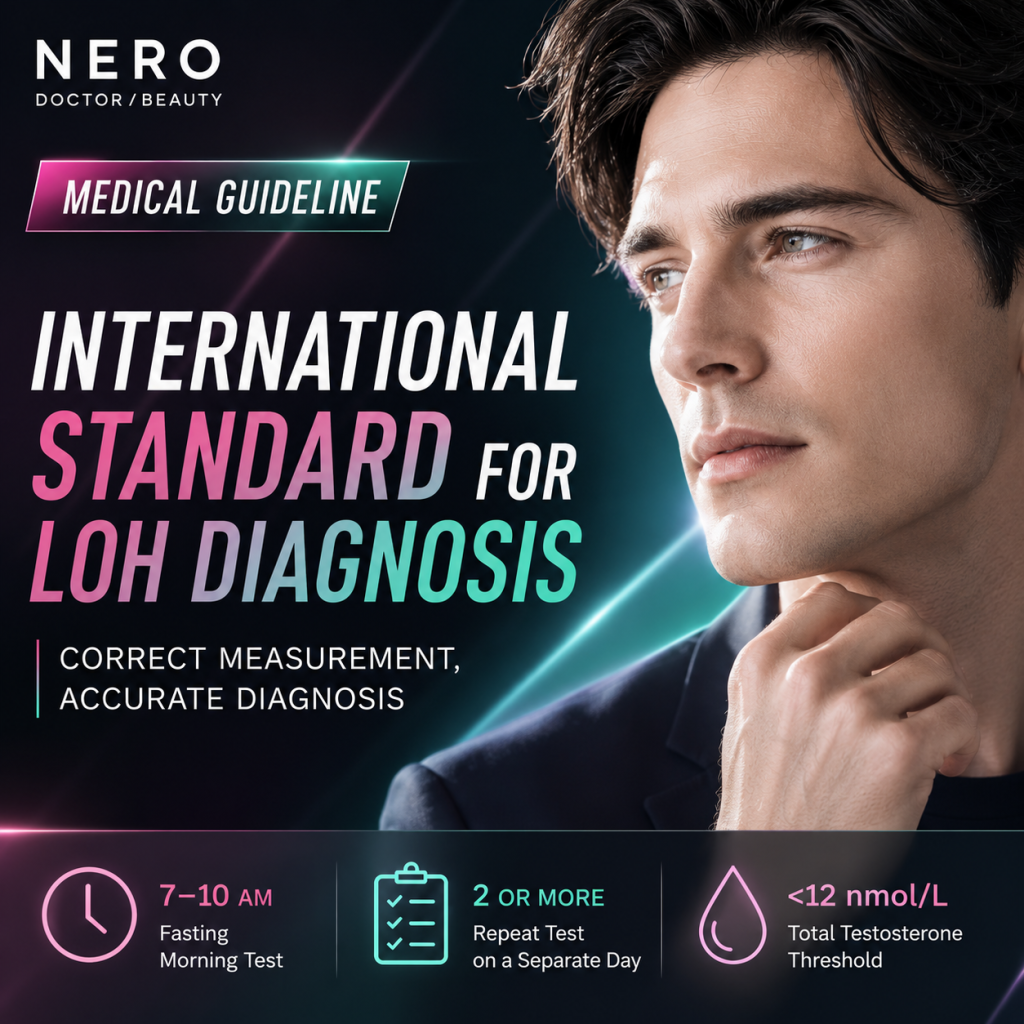
- EAU’s Strong Recommendation: blood must be drawn between 7–10 a.m. in a fasted state, and if total testosterone falls below 12 nmol/L (≈346 ng/dL), the test must be repeated on a separate day before initiating TRT.
- In men with obesity, diabetes, or advanced age, SHBG measurement and free testosterone calculation (reference threshold: 220 pmol/L) are recommended, as total testosterone alone may be misleading.
- TRT is explicitly contraindicated in men with normal testosterone levels, men seeking fertility, and men pursuing it solely for fatigue or vitality — all classified as Strong Recommendations against use.
“I’ve been feeling exhausted lately.” “My morning workouts aren’t producing results anymore.” “I just don’t have the drive I used to.”
These are the kinds of complaints driving a growing number of men toward men’s health clinics and testosterone replacement therapy (TRT) consultations.
But before any treatment begins, a critical question must be answered: was the diagnosis done correctly?
The European Association of Urology (EAU) 2026 edition of its Sexual and Reproductive Health guidelines — a limited update of the 2025 version with significant revisions to the Male Hypogonadism chapter — makes one thing unmistakably clear:
the quality of a testosterone diagnosis depends less on the number itself, and more on how and when it was measured.


INDEX
- What Is LOH Syndrome? The Medical Definition Behind “Male Menopause”
- EAU 2026 Diagnostic Standards: What “12 nmol/L, Twice, Fasted” Actually Means
- Why Total Testosterone Alone Is Not Enough: Understanding SHBG
- TRT Indications and Contraindications: What EAU 2026 Confirms
- Questions to Ask Before Your First TRT Consultation
- Summary
- Frequently Asked Questions
What Is LOH Syndrome? The Medical Definition Behind “Male Menopause”
Late-Onset Hypogonadism (LOH syndrome) is a subtype of male hypogonadism in which testosterone levels decline in adult men, producing a recognizable cluster of symptoms.
It is commonly referred to as “male menopause,” though that term is clinically imprecise.
“Diagnosed when specific symptoms and signs are persistently present and biochemical evidence of low testosterone is simultaneously confirmed.”
In other words: symptoms alone cannot diagnose LOH. Lab values alone cannot diagnose LOH.
Both must be present together.
According to EAU 2026 Table 3.2, LOH-associated symptoms fall into two categories:
Reduced physical activity · Difficulty walking more than 1 km · Decreased forward bending
Depressed mood · Loss of motivation · Persistent fatigue
Reduced concentration and memory · Sleep disturbances
This is precisely why EAU guidelines prohibit symptom-only diagnosis — and why rigorous lab confirmation is non-negotiable.
EAU 2026 Diagnostic Standards: What “12 nmol/L, Twice, Fasted” Actually Means
The EAU 2026 guidelines issue Strong Recommendations on five specific diagnostic conditions.
Notably, the 2026 update does not represent a dramatic shift in thresholds — rather, it is a clarification and reinforcement of diagnostic rigor that was already expected but inconsistently applied in clinical practice.
Testosterone follows a diurnal rhythm, peaking in the morning.
Post-meal or afternoon draws can produce artificially low readings.
Acute illness, stress, or temporary factors can transiently suppress testosterone.
TRT must not begin until two separate measurements confirm the deficit.
Evidence does not support TRT in men with levels above this threshold.
Treatment consideration begins only when confirmed values fall below 12 nmol/L.
Standardized immunoassays show acceptable correlation for total testosterone,
but are not appropriate for direct measurement of free testosterone.
In men with obesity, diabetes, aging, or thyroid disease, SHBG fluctuations
can make total testosterone an unreliable indicator.
Free testosterone reference threshold: 220 pmol/L (6.4 ng/dL).
Why Total Testosterone Alone Is Not Enough: Understanding SHBG
When a clinician says “your testosterone is low,” the first question should be: which testosterone value?
Total Testosterone:
The aggregate amount of testosterone in the bloodstream.
However, the majority is bound to SHBG (a carrier protein) and biologically inactive.
SHBG (Sex Hormone-Binding Globulin):
A protein that binds testosterone, rendering it unavailable to cells.
SHBG levels can shift significantly with obesity, diabetes, aging, and thyroid disorders.
Free Testosterone:
The fraction not bound to SHBG — the testosterone that actually acts on tissues.
Represents only 1–2% of total testosterone.
→ In obese or older men, total testosterone may appear normal
while free testosterone is clinically low.
In these cases, SHBG measurement and free testosterone calculation are essential for accurate diagnosis.
TRT Indications and Contraindications: What EAU 2026 Confirms
The EAU 2026 guidelines consolidate and clarify the indications, contraindications, and cautions for testosterone replacement therapy.
The 2026 update is a limited revision of the 2025 version — the emphasis is on reinforcing diagnostic rigor rather than introducing new thresholds.
(For a line-by-line comparison with the prior version, consult the EAU official update log.)
2026 Update: In low-risk patients following radical prostatectomy with no evidence of recurrence (PSA <0.01 ng/mL, minimum 1 year follow-up), limited TRT use is acknowledged as a Weak Recommendation.
· Male breast cancer
· Men actively seeking fertility (TRT suppresses spermatogenesis)
· Hematocrit ≥54%
· Uncontrolled heart failure
· Severe lower urinary tract symptoms (IPSS ≥19)
· Family history of venous thromboembolism
“Do not use TRT in eugonadal men (normal testosterone).”
“Do not use TRT in men actively seeking to father children.”
“Do not use TRT to improve cognition, vitality, or physical performance in older men.”
“Do not use TRT for weight loss or cardiometabolic improvement.”
Questions to Ask Before Your First TRT Consultation
When evaluated against EAU 2026 standards, some men’s health clinics — particularly those operating outside standard insurance frameworks — may not be following the full diagnostic protocol.
Here are five questions worth raising before any consultation or blood draw.
“Is the blood draw scheduled between 7–10 a.m. in a fasted state?”
Post-meal or afternoon draws may produce artificially low readings.
EAU issues a Strong Recommendation for morning fasted sampling.
“Will you confirm the result with a second draw on a separate day?”
EAU strongly recommends two separate confirmed readings below 12 nmol/L
before initiating TRT.
“Will you also measure SHBG and calculate free testosterone?”
For men with obesity, diabetes, or age-related changes,
total testosterone alone may not reflect actual hormonal activity.
“Will LH and FSH also be tested to determine the type of hypogonadism?”
Primary vs. secondary hypogonadism require different treatment approaches.
The full hormone panel determines diagnostic accuracy.
“Before TRT, is there an option to address lifestyle factors or underlying conditions first?”
This reflects the spirit of EAU’s diagnostic-first approach.
A clinic that engages seriously with this question is worth trusting.

LOH syndrome is a real clinical condition,
and TRT genuinely helps men who are properly diagnosed.
But the pathway from “I’ve been feeling tired” to a single blood draw to a TRT prescription
is one the EAU guidelines explicitly reject.
This article exists to make that standard visible.
To clinicians and clinic operators reading this:
the fact that EAU specifies draw timing, repeat confirmation, and measurement methodology
is not bureaucratic detail — it reflects a real-world problem of diagnostic variability.
“LC-MS/MS is most accurate, but standardized immunoassays show acceptable correlation”
is a pragmatic statement that acknowledges clinical reality.
It is also the standard that any serious men’s health practice should be meeting.
Summary
- ✦The EAU 2026 Sexual and Reproductive Health guidelines (Chapter 3: Male Hypogonadism) consolidate diagnostic standards for LOH syndrome.
The 2026 edition is a limited update of the 2025 version, with significant revisions to Section 3 (source: uroweb.org). - ✦Strong Recommendations for correct diagnosis: morning fasted blood draw (7–10 a.m.);
if total testosterone is below 12 nmol/L (≈346 ng/dL), confirm with a second draw on a separate day before initiating TRT. - ✦In men with obesity, diabetes, or age-related changes, SHBG fluctuations can make total testosterone unreliable.
SHBG measurement and free testosterone calculation (reference threshold: 220 pmol/L) are broadly recommended. - ✦TRT is contraindicated (Strong Recommendation) in men with normal testosterone,
men seeking fertility, and men pursuing it solely for fatigue or general vitality.
Limited TRT post-radical prostatectomy in low-risk patients is acknowledged as a Weak Recommendation.
Frequently Asked Questions
Total testosterone, SHBG, LH, and FSH testing is available through urology departments, internal medicine clinics, and some men’s health practices — either through insurance (where applicable) or as a self-pay service.
Before booking, confirm whether the clinic can accommodate morning fasted draws and repeat testing on separate days, as required by EAU guidelines.
The availability of insurance coverage varies by jurisdiction and diagnosis.
When considering a private or direct-pay clinic that markets “easy testosterone therapy,” use the diagnostic checklist in this article to evaluate whether their protocol meets international standards.
EAU guidelines are explicit: symptoms alone cannot diagnose LOH syndrome.
Blood testing is required, and the results must meet specific criteria before any treatment is considered.
If these symptoms are affecting your quality of life, a comprehensive evaluation by an internist or urologist is the appropriate first step.
Source: European Association of Urology (EAU). “Sexual and Reproductive Health Guidelines 2026 – Chapter 3: Male Hypogonadism.” Updated August 10, 2026. uroweb.org (Primary source; all diagnostic criteria and recommendations in this article are drawn directly from this guideline.)