📌 Key Takeaways
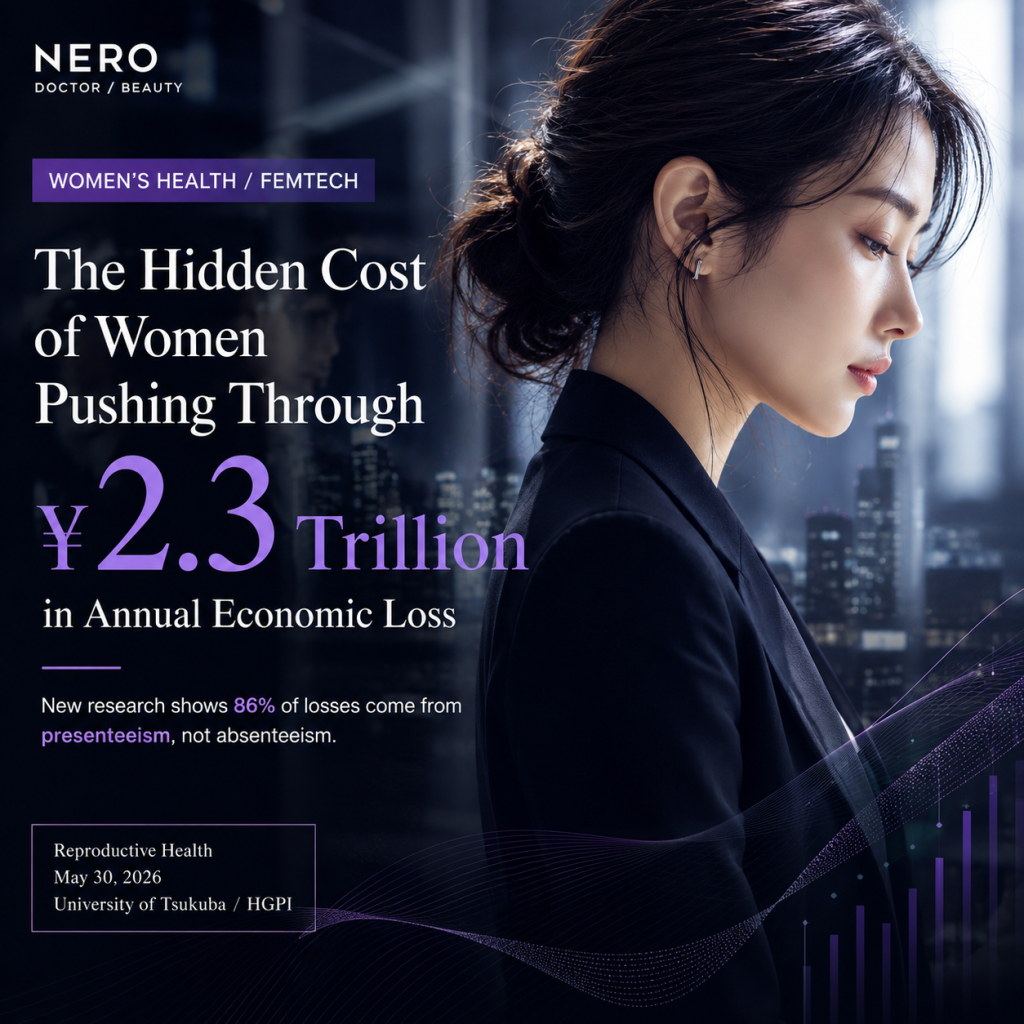
- A peer-reviewed study published in Reproductive Health (May 2026) estimates that menstrual and menopausal symptoms cost Japan’s working women approximately ¥22.9 trillion (USD 14.65 billion) per year in lost productivity.
- 86% of that loss—roughly ¥19.7 trillion—comes not from absenteeism but from presenteeism: women showing up to work while symptomatic and unable to perform at full capacity.
- 79.7% of surveyed working women reported that symptoms had impacted their job performance; yet a separate study found 22.8% of those who felt they needed medical care actively avoided seeking it.
- The findings reframe menstrual and menopausal health as a measurable economic issue—not merely a welfare concern—with direct implications for employers, clinicians, and policymakers.
Have you ever told yourself to push through the pain—
a brutal period, a brain-fog day from perimenopause—
because “work doesn’t stop”?
For millions of Japanese working women, that silent endurance has a price tag.
And a new study has put a number on it.
Published on May 30, 2026 in the international peer-reviewed journal Reproductive Health,
a research team led by Associate Professor Shohei Okamoto of the University of Tsukuba
analyzed data from 3,046 employed women aged 25–59.
Using the validated Work Productivity and Activity Impairment (WPAI) questionnaire,
they extrapolated individual-level data to a national estimate—
arriving at an annual productivity loss of approximately ¥22.9 trillion (USD 14.65 billion).
The most striking finding is not the headline number.
It is what drives it.
Absenteeism—days missed from work—accounts for only 14% of the total loss.
The remaining 86% comes from presenteeism:
women who are physically present but operating well below their potential.
“Just showing up” is not the solution. It may be the problem.


INDEX
Absenteeism vs. Presenteeism: Why the Distinction Matters
To understand the study’s implications, two terms are essential.
This is the visible, measurable loss—the tip of the iceberg.
but unable to perform at full capacity.
In this study, presenteeism accounted for approximately 86% of total productivity loss.
“She came in, so she must be fine” is a dangerous assumption—
and one that has led organizations to systematically underestimate this problem.
Presenteeism is the invisible loss.
It does not appear on attendance records.
It does not show up in absenteeism rates.
Organizations that measure only days missed
have been looking at roughly one-seventh of the actual problem.
How the ¥22.9 Trillion Figure Was Calculated
Transparency about methodology matters here.
The number is significant—and so are its limitations.
Survey: Cross-sectional internet survey conducted in Japan, September 2022
Sample: 3,046 employed women aged 25–59 with complete data
Measurement tool: WPAI (Work Productivity and Activity Impairment Questionnaire)—
a validated, internationally used instrument measuring absenteeism,
work time reduction, and on-the-job performance impairment via self-report
Extrapolation: Individual-level data scaled to Japan’s full population
of employed women aged 25–59 to derive a national annual cost estimate
Limitations: Internet-based cross-sectional design; self-reported data.
This is an estimation study, not a causal study.
The ¥22.9 trillion figure represents a modeled annual estimate
of symptom-related productivity loss among working women—
not a confirmed economic loss verified through direct measurement.
(approx. ¥22.9 trillion)
approx. ¥19.7 trillion
approx. ¥324 billion
due to menstrual or menopausal symptoms in the prior 3 months
(equivalent to 2–3 missed days or 2–5 hours of reduced work time)
Source: Kasahara S, Goto R, Suzuki S, Sakamoto H, Okamoto S. Reproductive Health. 2026;23(1):153. DOI: 10.1186/s12978-026-02331-y
The Care Gap: Why Women Who Need Help Are Not Seeking It
Behind the productivity numbers lies a structural problem in healthcare access.
A companion study using the same baseline dataset
(Uchibori et al., Preventive Medicine Reports, 2023)
surveyed 4,950 women aged 25–59 and found:
- 50.6% had felt the need for medical support
for menstrual or menopausal symptoms in the past 12 months. - Of that group, 22.8% had actively avoided seeking care.
(Note: this is 22.8% of those who felt they needed care—
not 22.8% of all women surveyed.)
· The belief that “period pain is something to endure” was linked to avoidance behavior
· Younger women and higher-income women showed higher avoidance rates—
likely reflecting work-first environments and social pressure
· Prior gynecological history, menstrual health literacy,
and attitudes toward menstruation were all associated with avoidance
The core issue is not that symptoms are absent.
It is that structural and cultural barriers prevent women
from converting recognized need into actual care.
The productivity loss documented in this study
is not only a function of symptom severity.
It is also a function of a healthcare system
where the path from “I feel unwell” to “I received treatment” is blocked
by stigma, workplace culture, and low health literacy.
Whether earlier intervention would meaningfully reduce productivity loss
remains to be tested in controlled trials.
But the structural gap between need and access is documented—
and it is large.
When to Seek Care: A Practical Guide for Working Women
“Is my pain bad enough to see a doctor?”
is the wrong question.
If symptoms are affecting your ability to work,
that is sufficient reason to consult a gynecologist or menopause specialist.
Missing work, losing focus, or underperforming on a recurring basis
is a legitimate clinical reason to seek evaluation.
Options may include low-dose oral contraceptives, hormone replacement therapy (HRT),
herbal medicine, and lifestyle modification.
Ask your clinician which options fit your situation.
“I miss approximately X days per month” or
“I lose about X hours of productive work per cycle”
gives your clinician concrete data to work with.
Menstrual and menopausal symptoms evolve over years.
A single visit is rarely sufficient.
A clinic that offers continuity of care will serve you better long-term.

When I worked as a registered nurse in the United States,
a patient who came in unable to work due to severe menstrual pain
was simply offered treatment options—without hesitation, without judgment.
In Japan, the cultural script still reads: “Period pain is something you endure.”
What this research makes undeniable
is that this endurance carries a national price tag of USD 14.6 billion per year.
To clinic operators and healthcare executives:
women’s health—menstrual care, menopause management—
is not a “nice-to-have” benefit or a DEI talking point.
When 86% of a USD 14.6 billion annual productivity loss
is driven by presenteeism—women working through symptoms—
early intervention and sustained follow-up care
become economically justified, not just compassionate.
NERO covers women’s health because the data demands it.
Summary
- A study by Associate Professor Shohei Okamoto (University of Tsukuba) and colleagues,
published in Reproductive Health on May 30, 2026,
estimated national-level productivity loss from menstrual and menopausal symptoms
among 3,046 employed Japanese women at approximately ¥22.9 trillion (USD 14.65 billion) per year.
The estimate uses the validated WPAI instrument
and is based on an internet cross-sectional survey—not a causal study. - The breakdown: absenteeism (missed work / reduced hours) accounts for ~¥324 billion (14%);
presenteeism (on-the-job performance impairment) accounts for ~¥19.7 trillion (86%).
“She showed up, so she’s fine” is not a valid assumption—
it is the source of the largest share of loss. - 79.7% of working women reported symptoms had affected their productivity.
A companion study (Uchibori et al., 2023) found that 22.8% of women
who felt they needed care had actively avoided seeking it in the past year.
Structural and cultural barriers to care access are part of the problem. - “My symptoms are affecting my work” is sufficient reason to consult a specialist.
This study does not prove that any specific intervention will recover the ¥22.9 trillion—
that requires controlled trials.
But it establishes a rigorous economic baseline
for corporate health programs, clinical service design, and health policy.
with established treatment and management options.
This study documents that symptoms affecting work performance
translate to a national productivity loss of USD 14.6 billion annually.
Seeking timely care is not an overreaction—
it is a rational decision for both personal quality of life and sustained employability.
not an intervention trial.
It does not test whether HRT, low-dose contraceptives, or herbal medicine
improve productivity by a specific percentage.
However, symptom relief is associated with improved daily functioning,
and discussing treatment options with a qualified clinician
is the appropriate next step for individuals experiencing work-related impairment.
for measuring productivity loss.
However, the national figure is an extrapolation from a self-reported internet survey sample—
not a directly measured economic loss.
The accurate interpretation is: “Modeled estimates of symptom-related productivity loss
among Japan’s working women reach approximately ¥22.9 trillion annually.”
Similar economic modeling studies have been conducted in other countries;
this study provides the Japanese-context equivalent.
Sources:
1. Kasahara S, Goto R, Suzuki S, Sakamoto H, Okamoto S. “Financial burden of menstrual and menopausal symptoms: productivity loss from absenteeism and presenteeism among working-age women.” Reproductive Health. 2026;23(1):153. doi.org/10.1186/s12978-026-02331-y
2. Health and Global Policy Institute (HGPI). Research summary. May 30, 2026. hgpi.org
3. Uchibori M, Eguchi A, et al. “Understanding factors related to healthcare avoidance for menstrual disorders and menopausal symptoms: A cross-sectional study among women in Japan.” Preventive Medicine Reports. 2023;36:102467.