📌 Key Takeaways
Complaints about unlicensed cosmetic procedures are rising in the UK
Treatments linked to short-term rental clinics on Harley Street are drawing scrutiny
Calls are growing for a national licensing system and stricter regulation of high-risk procedures
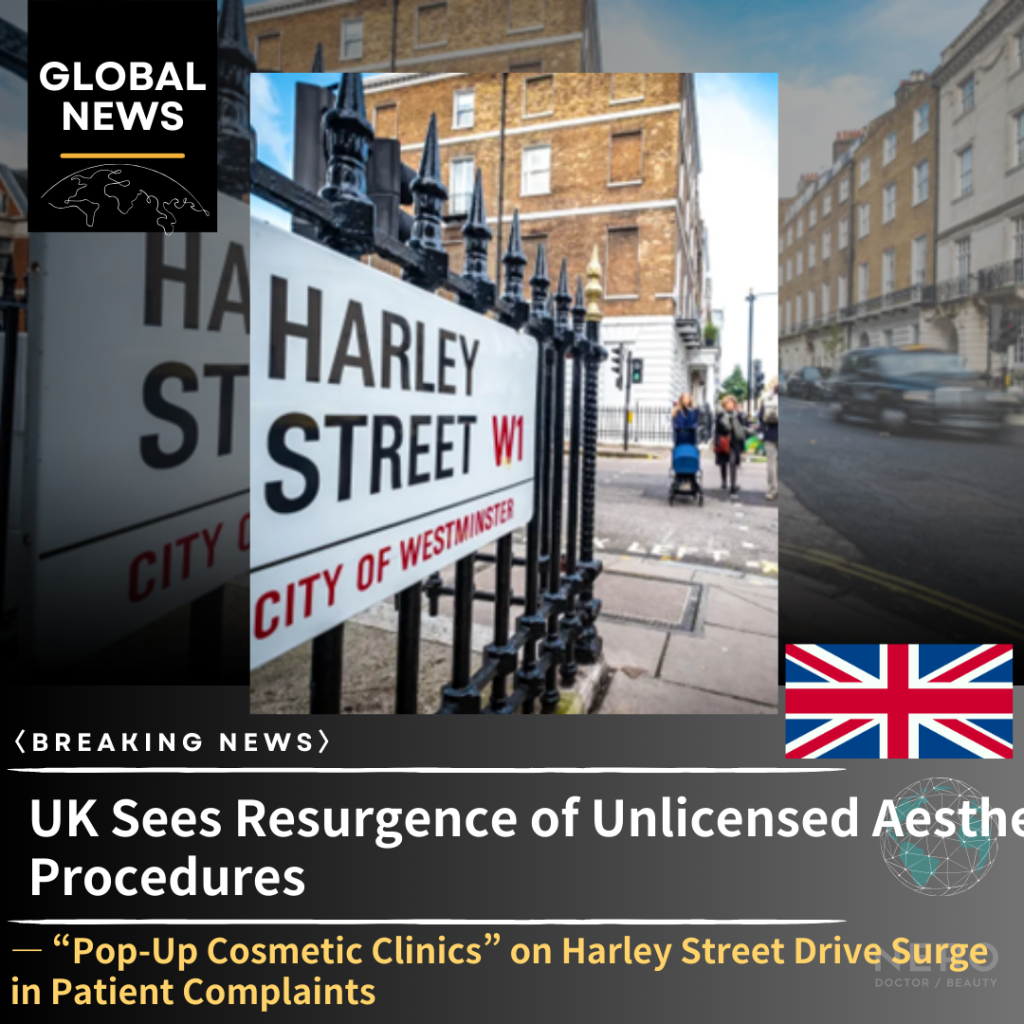
Complaints about cosmetic treatments performed by unlicensed practitioners are rising in London’s prestigious Harley Street medical district, raising renewed concerns about regulatory gaps in the UK aesthetic industry.
The surge in cases linked to short-term “pop-up” cosmetic clinics is fueling calls for a national licensing system and tighter oversight of high-risk aesthetic procedures.


INDEX
What is happening in London?
In London’s prestigious medical district Harley Street,
complaints involving unlicensed aesthetic practitioners are rapidly increasing.
According to UK aesthetic industry watchdog Save Face,
complaints linked to “pop-up cosmetic clinics” operating from short-term rented rooms on Harley Street have surged dramatically.
Reports rose from:
18 complaints → 118 complaints over the past five years
The trend highlights a growing business model built around:
-
Unlicensed practitioners
-
Short-term rental clinic spaces
-
Social media-driven patient acquisition
The surge has reignited debate in the UK over introducing:
A national licensing system
and restricting high-risk aesthetic procedures to medical professionals.
Why Harley Street has become the center of the issue
Harley Street is internationally recognized as one of the UK’s most prestigious medical districts, home to numerous clinics specializing in:
Plastic surgery
Dermatology
Aesthetic medicine
However, the address itself has also become a marketing tool.
Some practitioners reportedly rent clinic rooms for short periods, using the Harley Street address to promote treatments as if they were delivered by established medical clinics.
Patients may therefore assume the provider is a licensed medical professional.
In some cases, once complications arise,
the practitioner is no longer present at the location, leaving patients without proper follow-up care.
Social media and the rise of “pop-up aesthetics”
Many of these treatments are marketed through platforms such as:
-
Instagram
-
TikTok
Common marketing characteristics include:
Low-cost cosmetic treatments
Influencer-driven promotion
Temporary or “pop-up” clinic locations
Procedures being promoted include:
Botox injections
Hyaluronic acid fillers
Non-surgical BBL (liquid buttock enhancement)
Medical experts warn that such procedures can carry risks including:
Infection
Vascular complications
Severe adverse reactions
Why regulatory debate is intensifying in the UK
Unlike many medical procedures,
a large portion of aesthetic treatments in the UK currently fall outside a comprehensive national licensing framework.
As a result, questions have emerged regarding:
Practitioner qualifications
Medical supervision
Patient safety oversight
The recent surge in complaints has revived discussions about introducing:
A national licensing system for aesthetic practitioners
Medical-only restrictions for high-risk cosmetic procedures
Procedures such as non-surgical BBL injections are increasingly being discussed as candidates for stricter medical oversight.
The aesthetic medicine market is increasingly intertwined with social media marketing.
At the same time, this environment has exposed structural risks such as:
Unlicensed practitioners
Regulatory gaps
Unclear medical accountability
The Harley Street controversy is not simply about illegal procedures.
It reflects a broader structural tension between medical trust and platform-driven cosmetic services.
In fact, UK lawmakers have already described parts of the aesthetic sector as a “Wild West.”
The growing regulatory debate ultimately raises a fundamental question:
Who should be allowed to perform aesthetic medicine?
Summary
-
Complaints about unlicensed aesthetic procedures are rising in the UK
-
Short-term clinic rentals on Harley Street are contributing to the issue
-
Social media-driven “pop-up aesthetics” are expanding rapidly
-
Regulatory debate over national licensing systems is intensifying
-
Oversight of who performs aesthetic procedures is becoming the central issue
Source:The Times (UK)
“Harley Street pop-up cosmetic clinics accused of faking credibility”
(Original title: Rogue cosmetic clinics fake credibility with Harley Street pop-ups)
NERO’s Mission
NERO reports on global developments in aesthetic medicine
through the lens of structure, ethics, and long-term consequence.
Rather than amplifying surface-level trends,
we examine how medical practices are regulated, commercialised, and normalised —
and what is reshaped when innovation moves faster than existing frameworks.
As aesthetic medicine expands beyond traditional clinical boundaries,
NERO focuses on the grey zones where definitions blur, responsibilities shift,
and medical decision-making becomes increasingly complex.
In an era of accelerating innovation,
NERO remains committed to transparency, critical scrutiny,
and responsible reporting —
so readers can understand not only what is new,
but what deserves closer examination before it becomes standard practice.