📌 Key Takeaways
- A PRISMA-compliant narrative review of 45 studies found that increasing treatment intensity does not consistently improve patient satisfaction with Botox or dermal fillers.
- Overcorrection and unnatural results are among the leading drivers of post-treatment regret, not underdosing.
- An estimated 7–15% of aesthetic medicine seekers may show signs of Body Dysmorphic Disorder (BDD), for whom additional procedures worsen outcomes.
- “Ozempic Face” — facial volume loss after GLP-1 weight loss — is emerging as a new clinical context, though evidence remains preliminary.
“More Botox will erase more wrinkles.”
“A little extra filler will make it look even better.”
These assumptions are common in aesthetic consultations — and they are increasingly being challenged by clinical evidence.
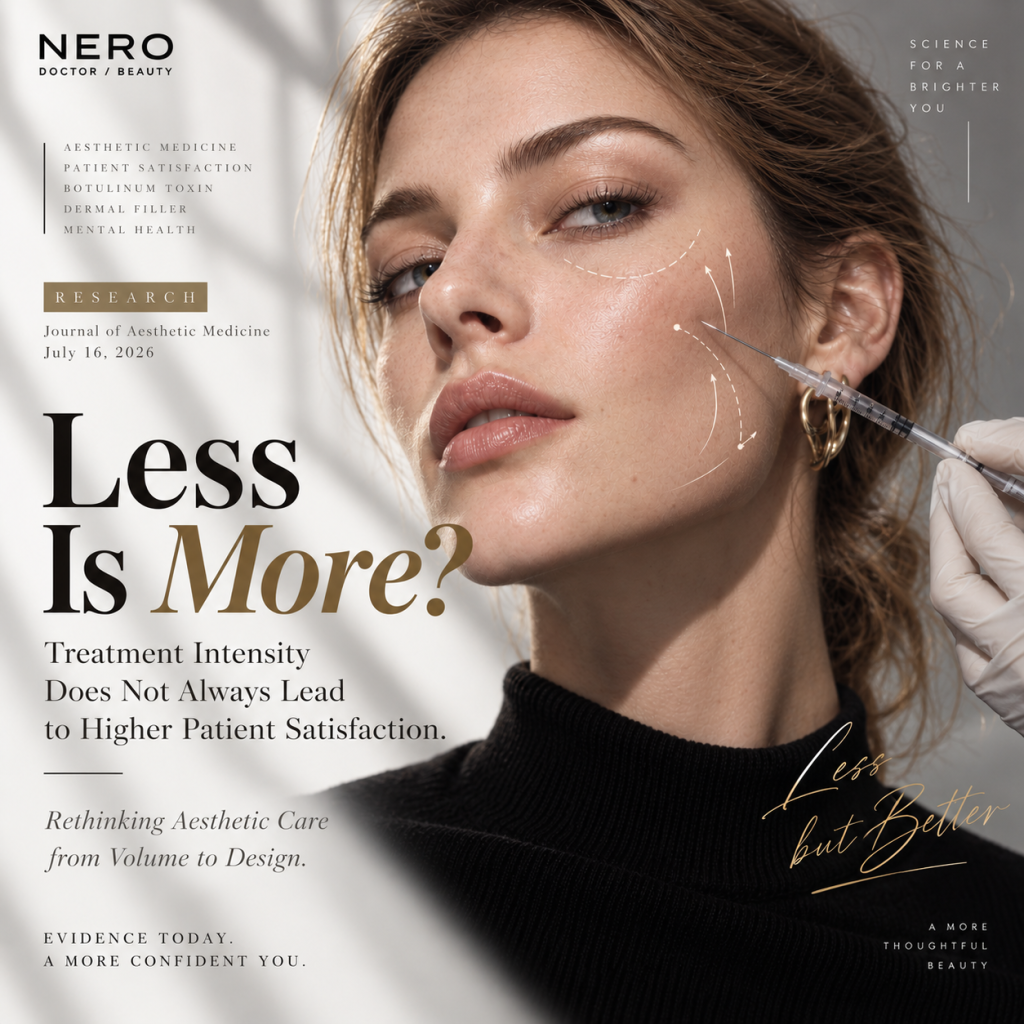
A structured narrative review published on July 16, 2026, in the Journal of Aesthetic Medicine (MDPI, PRISMA-compliant) analyzed 45 studies and reached a clear conclusion:
Higher treatment intensity does not reliably translate into higher patient satisfaction.
The research team, based in Italy and Spain, found that the real determinants of satisfaction are not volume or dosage —
but treatment design, expectation alignment, and psychological screening.


INDEX
What the 45-Study Review Actually Found
The review followed PRISMA (Preferred Reporting Items for Systematic Reviews and Meta-Analyses) guidelines.
Researchers searched PubMed, Scopus, and the Cochrane Library for studies published between January 2015 and May 2026,
ultimately selecting 45 studies for inclusion.
Treatment categories covered: botulinum toxin, hyaluronic acid fillers, and biostimulators,
alongside psychosocial factors affecting outcomes.
The review relied on validated Patient-Reported Outcome Measures (PROMs), including:
FACE-Q (facial surgery satisfaction scale),
GAIS (Global Aesthetic Improvement Scale),
Decision Regret Scale, and
BDDQ (Body Dysmorphic Disorder Questionnaire).
These are not subjective preference surveys — they are clinically validated instruments used in international research and academic settings.
The core conclusion: “Increasing treatment intensity was not consistently associated with improved patient-reported outcomes.
High-volume or high-dose approaches were frequently linked to dissatisfaction and regret.”
Note: This review does not quantify an optimal dosage threshold (e.g., exact units or ml).
It identifies a directional trend — that the relationship between quantity and satisfaction is not linear.
Why Overcorrection Leads to Regret
“I went too far.” “It looks unnatural.” “Something feels off.”
These are the most commonly reported sources of post-treatment dissatisfaction in the literature reviewed.
· Unnatural appearance: The discomfort of others noticing “something is different”
· Expectation-outcome mismatch: The gap between what patients imagined and what they received
· Insufficient pre-treatment counseling: No concrete discussion of realistic outcomes before the procedure
· Pre-treatment expectation alignment: Clear, specific discussion of what is and is not achievable
· PROM-guided treatment design: Using validated tools to understand what the patient actually values
BDD in Aesthetic Medicine: 7–15% of Patients May Be Affected
One of the most clinically significant findings in this review concerns Body Dysmorphic Disorder (BDD).
BDD is a psychiatric condition listed in DSM-5,
characterized by obsessive preoccupation with a perceived flaw in one’s appearance —
a flaw that is either minimal or invisible to others.
Individuals with BDD may repeatedly seek aesthetic procedures without achieving satisfaction,
and additional treatments typically worsen rather than relieve the underlying distress.
(The following is general educational information from NERO editorial, not a direct citation from the reviewed paper.)
Consider consulting a mental health professional before proceeding with further treatment if several of the following apply:
· You spend hours each day examining a specific feature in the mirror
· You repeatedly seek reassurance from others about how that feature looks
· You have had multiple aesthetic procedures but remain unsatisfied and want more
· Concern about that feature is interfering with work, relationships, or daily life
Ozempic Face: A New Clinical Context, Still Emerging
The review also flags a growing clinical phenomenon:
“Ozempic Face” — the facial hollowing and aged appearance that can follow rapid weight loss
induced by GLP-1 receptor agonists such as semaglutide (Ozempic, Wegovy).
As GLP-1 prescriptions surge globally, aesthetic practitioners are increasingly encountering patients
seeking Botox or filler interventions to address this specific type of volume loss.
However, the review classifies evidence in this area as “preliminary.”
No strong conclusions can yet be drawn about optimal treatment design for Ozempic Face.
It is identified as a priority area for future research.
From Dosage to Design: What to Look for in a Clinic
Tell your provider: “I want to look less tired and more natural” rather than “I want more Botox.” Specific goals lead to better-designed treatments.
A clinic that can show you “hard to notice” improvements understands natural-looking outcomes.
A provider who says “you don’t need that right now” is more trustworthy than one who recommends treating everything.
For patients with BDD, additional procedures do not resolve the distress. A specialist referral is the appropriate first step.

The assumption that “more treatment means better results”
is one I encounter regularly in aesthetic medicine discussions.
What this research makes clear is that
treatment design — understanding the patient’s goals,
psychology, and expectations — must come before dosage decisions.
From a clinic management perspective,
this paper reinforces the value of FACE-Q and PROM-based treatment planning.
These tools are standard in international academic settings,
though adoption varies widely in clinical practice globally.
The clinics that will earn patient trust going forward
are those that ask not “how many units?”
but “what does this patient actually want to achieve?”
Summary
- A PRISMA-compliant narrative review of 45 studies, published July 16, 2026 in the Journal of Aesthetic Medicine (MDPI), found that increasing treatment intensity was not consistently linked to improved patient satisfaction. Evidence was strongest for botulinum toxin and HA fillers; weaker for biostimulators.
- Overcorrection, unnatural appearance, and expectation-outcome gaps are the primary drivers of regret. Natural results, pre-treatment expectation alignment, and PROM-guided design are associated with higher satisfaction. This review does not quantify optimal dosage — it identifies a directional trend.
- An estimated 7–15% of aesthetic medicine seekers may show signs of BDD. For these patients, additional procedures worsen outcomes. Pre-treatment psychological screening is recommended.
- “Ozempic Face” — facial volume loss following GLP-1 weight loss — is emerging as a new treatment context, but evidence for intervention design remains preliminary.
for example, “My cheeks look heavy and I want to look less tired.”
Goal-based communication helps providers design more appropriate treatments.
If the desire for “more” persists despite multiple procedures without satisfaction,
it may be worth pausing to explore the psychological dimension with a specialist.
developed to assess satisfaction, psychological well-being, and quality of life
in facial aesthetic and surgical patients.
It evaluates appearance satisfaction by facial area, social reactions, and treatment regret
using standardized questions.
While not yet routine in all clinical settings,
asking whether your provider uses any outcome measurement tool
is a reasonable way to assess the quality of their treatment planning process.
that can result from rapid weight loss caused by GLP-1 drugs like semaglutide.
Botox and dermal fillers are being explored as potential interventions,
but the 2026 review classifies current evidence as preliminary.
No strong clinical guidelines exist yet for this specific indication.
Consult a board-certified aesthetic physician for individualized assessment.
Source: “Less Is More? Treatment Intensity and Patient-Reported Outcomes in Minimally Invasive Aesthetic Medicine: A Narrative Review.” Journal of Aesthetic Medicine. MDPI. July 16, 2026. mdpi.com/3042-6774/2/3/15
★ Structured narrative review (45 studies). This paper identifies directional trends, not quantified dosage thresholds.