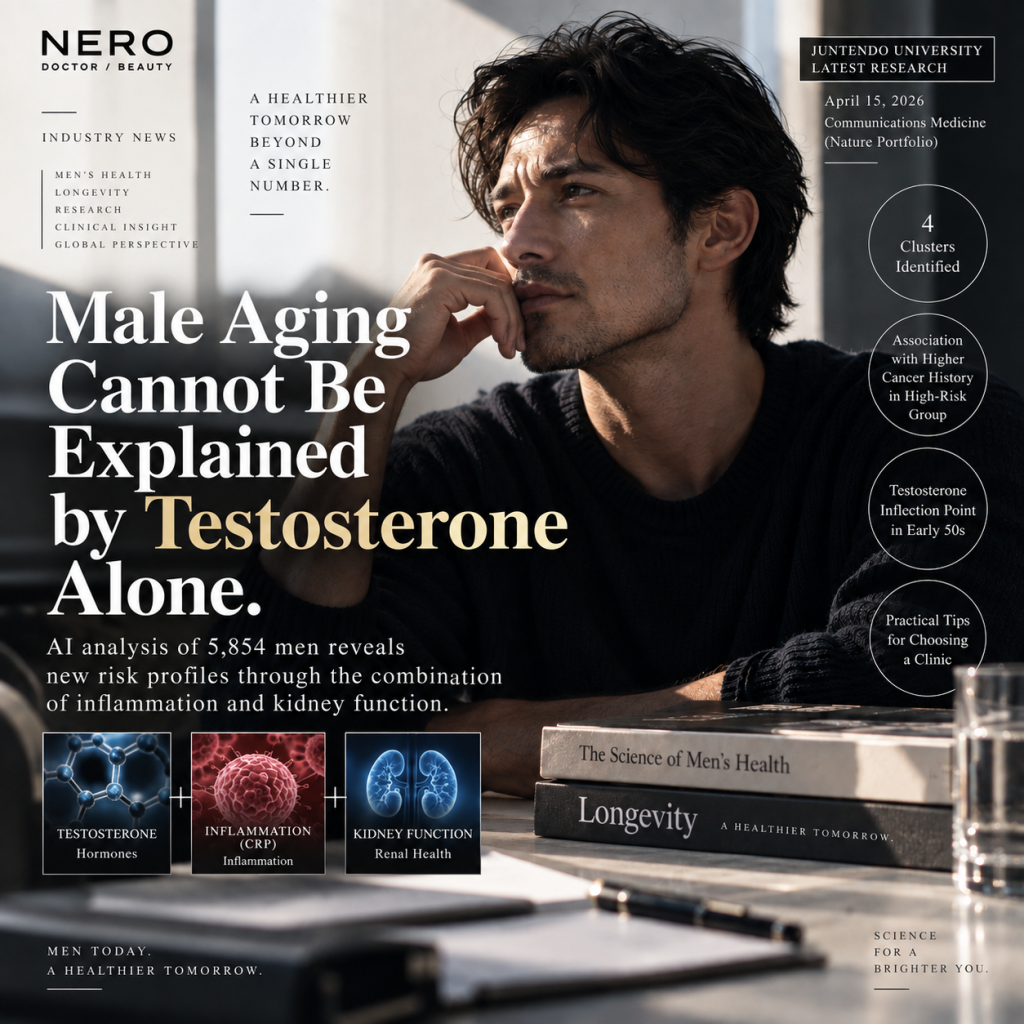
📌 Key Takeaways
- Juntendo University researchers applied AI clustering to data from 5,854 men,
published in Communications Medicine (Nature Portfolio), 2026. - A specific high-risk cluster — low total testosterone (TT) + high CRP + reduced eGFR —
showed a significantly elevated rate of cancer history compared to other groups. - Testosterone alone does not capture the full picture of male aging;
inflammation and kidney function must be assessed together. - The findings challenge the “testosterone-first” framing in men’s health,
pointing toward a multi-biomarker approach for clinical risk stratification.
“Just check testosterone” — it’s the default assumption in many men’s health consultations.
But a large-scale AI analysis published in 2026 suggests that framing may be dangerously incomplete.
Researchers at Juntendo University used unsupervised machine learning
to analyze biomarker data from 5,854 men.
What they found wasn’t a simple hormonal decline story —
it was a cluster of converging risks that, when combined,
produced outcomes no single marker could predict alone.


INDEX
The Study: AI Clustering Across 5,854 Men
The research team applied unsupervised clustering algorithms
to a dataset of 5,854 adult men,
examining a broad panel of biomarkers including:
total testosterone (TT), C-reactive protein (CRP),
estimated glomerular filtration rate (eGFR, a kidney function marker),
and additional metabolic and hormonal variables.
The study was published in Communications Medicine,
a peer-reviewed journal in the Nature Portfolio,
lending it significant methodological credibility.
Estimated Glomerular Filtration Rate (eGFR) is the standard clinical measure of kidney function.
A declining eGFR indicates reduced kidney filtration capacity —
a marker increasingly linked to systemic aging and cardiovascular risk.
The “Dangerous Cluster”: What Happens When Three Risks Converge
The AI did not simply rank men by testosterone level.
Instead, it identified distinct biological profiles —
groups of men whose biomarkers clustered together in meaningful patterns.
One cluster stood out:
men with low total testosterone + elevated CRP + reduced eGFR.
This group showed a notably higher rate of cancer history
compared to other clusters in the dataset.
C-reactive protein (CRP) is a blood marker of systemic inflammation.
Chronically elevated CRP is associated with cardiovascular disease,
metabolic syndrome, and — as this study suggests —
may interact with hormonal and renal decline in ways
that amplify overall health risk in aging men.
The significance is not that any one of these markers is dangerous in isolation —
it’s that their co-occurrence defines a risk profile
that conventional single-marker screening would miss.
Why “Testosterone Alone” Is an Insufficient Framework
The dominant narrative in men’s health — particularly in the growing
testosterone replacement therapy (TRT) and longevity medicine space —
has centered on testosterone as the primary aging biomarker for men.
This study complicates that narrative directly.
A man with low testosterone but normal CRP and eGFR
may occupy a very different risk category
than a man with the same testosterone level
but elevated inflammation and declining kidney function.
The implication for clinical practice is significant:
men’s health risk stratification should incorporate inflammation
and kidney function markers alongside testosterone.
Implications for Aesthetic Medicine and Longevity Clinics
This research has direct relevance beyond internal medicine.
The growing intersection of aesthetic medicine and longevity science —
including hormone optimization, anti-aging infusions,
and GLP-1-adjacent metabolic treatments —
means that aesthetic practitioners increasingly encounter
patients whose underlying biological profiles matter.
A patient seeking testosterone optimization or body composition improvement
may present with an undetected inflammatory or renal risk cluster.
The study’s findings argue for a more comprehensive biomarker workup
before initiating hormonal or metabolic interventions.
In Japan, this research was conducted within the framework of
university hospital-based men’s health research —
a field that intersects urology, endocrinology, and preventive medicine.
Globally, similar multi-biomarker approaches are gaining traction
in precision medicine and longevity-focused clinical settings.

The “just check testosterone” reflex is understandable —
it’s simple, marketable, and fits neatly into a clinic visit.
But this study is a reminder that male aging is a systems problem,
not a single-hormone problem.
When inflammation and kidney function decline together with testosterone,
the risk profile changes in ways that a hormone panel alone won’t reveal.
For clinicians and longevity practitioners,
the takeaway is structural:
AI-assisted clustering is beginning to show us
that the patients we think we understand
may belong to risk categories we haven’t been measuring.
Adding CRP and eGFR to a testosterone workup costs very little —
but the information it yields may be clinically decisive.
Summary
- Juntendo University published an AI-based clustering analysis of 5,854 men
in Communications Medicine (Nature Portfolio), 2026.
The study identified a high-risk biological cluster:
low total testosterone + elevated CRP + reduced eGFR. - This cluster showed a significantly elevated rate of cancer history
compared to other biomarker groups —
a finding that no single marker could have predicted alone. - The research challenges the testosterone-centric model of male aging,
arguing for multi-biomarker risk stratification
that includes inflammation (CRP) and kidney function (eGFR). - For aesthetic medicine and longevity clinics,
the implication is clear: comprehensive biomarker assessment
should precede hormonal or metabolic interventions
in aging male patients.
low total testosterone (TT), elevated C-reactive protein (CRP, a marker of systemic inflammation),
and reduced estimated glomerular filtration rate (eGFR, indicating declining kidney function).
Men in this cluster showed a notably higher rate of cancer history
compared to other groups in the 5,854-person dataset.
This study demonstrates that two men with identical testosterone levels
can occupy very different risk categories
depending on their inflammatory status (CRP) and kidney function (eGFR).
A multi-biomarker approach provides a more accurate risk profile
than hormone testing alone.
particularly those considering testosterone optimization or longevity protocols —
should ask their physician about comprehensive biomarker testing
that includes CRP (inflammation) and eGFR (kidney function)
alongside standard hormone panels.
This is especially relevant before initiating any hormonal or metabolic intervention.
Source: “AI-Based Clustering Identifies a High-Risk Male Aging Profile Linking Low Testosterone, Elevated CRP, and Reduced Kidney Function.” Communications Medicine, Nature Portfolio, 2026. Juntendo University research team. Study population: 5,854 adult men.